
How Many LED Lights Can I Put On One Circuit?
A standard 15-amp circuit can safely power 144 ten-watt LED bulbs — because home wiring was sized for the power-hungry incandescents LEDs replaced, and the headroom is enormous.
 Eugen
EugenEugen Nikolajev
Creator of LED Lighting Info
Hi, I am Eugen. I was always one of those kids who had all sorts of weird lighting gadgets for every occasion.
Now, I want to share my knowledge and experience about lighting with you on LED Lighting Info.
Read my editorial standards
Key Takeaways
The limit of LED lights on one circuit depends on the wattage of the lights in question. Divide the sum wattage of the lights by the voltage to give you the amperage, and as long as that amperage of lights is no more than 80% of the circuit's rated amperage, it is safe.
The answer comes down to three numbers: your circuit's amperage, your local voltage, and each bulb's wattage. Multiply the first two, take 80% of that figure, then divide by your bulb wattage — that's your maximum number of LEDs.
Exceed the circuit's limit and the breaker trips, cutting power to everything on that circuit. The breaker tripping isn't the danger — that's the breaker doing its job. The real risk is leaving an overload unaddressed: repeated stress on the wiring can degrade insulation over time and create a fire hazard.
In this guide, I'll cover:
- How to calculate the maximum number of lights on any circuit
- The maximum number of LEDs on a 15-amp circuit
- How dimmer switches add a separate wattage ceiling you also need to respect
How To Calculate The Maximum Number Of Lights Per Circuit

You need three pieces of information: the wattage of each bulb, the voltage of the circuit, and the amperage of the circuit.
Voltage depends on where you live. In the US, residential circuits are nominally 120 volts; in the UK and most of Europe, the harmonized standard is 230 volts.
Amperage is set by the circuit breaker. Find your circuit's amp rating by looking at the number printed on the breaker switch in your electrical panel — most US residential lighting circuits are 15A on 14-gauge wire, but 20A circuits on 12-gauge wire are also permitted by the NEC and are increasingly common in modern construction, especially in larger rooms or where there's extensive recessed lighting.
For the bulbs, check the individual wattage of each light and add them together to get the total wattage you want to add to the circuit.
Once you have all three numbers, follow these steps:
- Multiply the amperage of the circuit by the voltage to get the maximum capacity in watts.
- Multiply that figure by 0.8 to get 80% of the maximum — your safe working capacity.
- Divide the safe capacity by the wattage of your bulbs to find out how many you can run on the circuit.
If you're mixing bulbs of different wattages, work it out in reverse: add up the total wattage of every bulb you want on the circuit and check that the sum doesn't exceed 80% of the circuit's maximum capacity.
Don't forget about shared loads
Lighting circuits often share capacity with wall outlets. If your overhead LEDs share a breaker with a TV, a window AC unit, a space heater, or a vacuum, the lights aren't the only load on the wire. A circuit that's fine with bulbs alone can still trip when a high-draw appliance kicks on. Before you calculate maximum bulbs, check what else lives on that breaker.
Why 80%?
Breakers and conductors are rated for continuous duty at 80% of their nameplate — running them closer to 100% for hours generates heat that can degrade insulation and the breaker's internal components, which is why the NEC requires this derating for loads that run three hours or more. The 20% buffer also absorbs brief inrush spikes when fixtures switch on (LED drivers in particular can pull many times their steady-state current for a few milliseconds), keeping the breaker from tripping under normal operation.
How Many LED Lights Can Be On A 15 Amp Circuit?
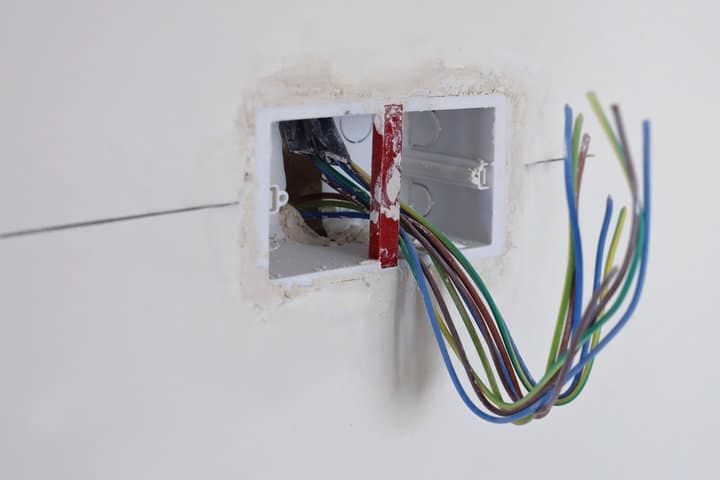
Let's run the numbers on the most common residential lighting setup — a 15-amp breaker on a 120-volt US circuit. Plug those into the formula and the safe working capacity is 1,440 watts.
| Parameter | Value |
|---|---|
| Circuit amperage | 15A |
| US voltage | 120V |
| Max wattage (100%) | 1,800W |
| Safe max (80%) | 1,440W |
| Bulbs at 10W each | 144 |
Before translating that into bulb count, one important point about LED wattage. LEDs draw far less power than the halogen and now-phased-out incandescent bulbs they replaced — in the US, the Department of Energy's 45 lumens-per-watt efficiency standard effectively banned the sale of most traditional incandescents in August 2023, and the EU completed its phase-out more than a decade earlier.
For decades, bulb brightness has been marketed by wattage, even though wattage measures power draw, not light output (which is measured in lumens). That's why LEDs are often sold as "60-watt equivalent" or "40-watt equivalent" — meaning they produce a similar brightness to those older bulbs.
Ignore the "equivalent" figure when sizing a circuit. You need the actual wattage on the box, which is typically 4 to 12 watts for a standard LED household bulb.
Using a 10-watt LED bulb (60-watt equivalent), the math is simple: 1,440 watts ÷ 10 = 144 bulbs on the circuit. That's because home electrical circuits were sized for the higher-wattage bulbs of the past, so an LED retrofit leaves enormous headroom.
If your breaker is labeled 20A instead, the safe capacity rises to 1,920 watts — enough for 192 bulbs at 10 watts each. Worth checking before you assume the 15A figure applies.
How Many LED Lights Can One Switch Handle?
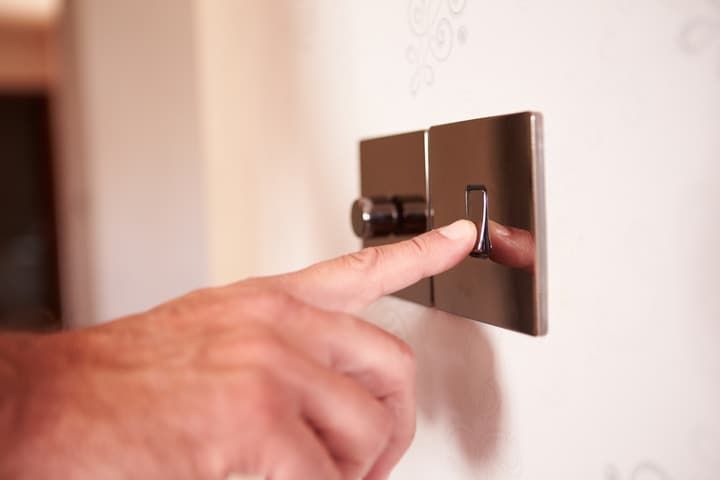
The circuit's amperage isn't the only ceiling. If any of your switches are dimmers, each one imposes its own wattage limit on the bulbs it controls — so factor this in before you finalize your circuit math, not after.
Standard on/off light switches aren't affected by the number of bulbs they control. Dimmer switches are a different story.
Why traditional dimmers don't work with LEDs
Traditional (TRIAC) dimmers work by rapidly chopping the AC waveform — a technique called phase-cutting — which works fine for resistive incandescent bulbs but confuses the capacitive drivers inside LEDs, causing flicker, buzzing, a limited dimming range, or even damage to the bulb. To dim LEDs reliably you need both a dimmable LED bulb and an LED-compatible dimmer switch.
Maximum and minimum wattage
Picture your home lighting circuit as one large loop with off-shoot loops for each room. When you add a dimmer to a room, its rating applies only to the bulbs that switch controls — not the entire home.
LED dimmer wattage ratings vary widely. Common LED dimmer switches range from around 150W of LED capacity at the entry level (for example, Lutron's Caseta PD-6WCL is rated 150W LED / 600W incandescent) up to 450W LED on heavier-duty models like Leviton's Decora Universal DSM10 (450W LED / 1,000W incandescent). Always check the label for the specific rating — and note that ratings often differ between LED/CFL and incandescent loads.
There's also a minimum load to watch for. Many LED-compatible dimmers require a minimum total wattage on the circuit — commonly 25W to 40W — to operate reliably. If you put just one or two low-wattage bulbs on the dimmer, you may see flickering, ghosting, or the dimmer failing to start at low brightness. Check the dimmer's minimum-load spec before pairing it with a single 5W bulb.
A typical LED at 4 to 12 watts means a 150W dimmer can easily handle a room of standard fixtures, but chandeliers and other multi-bulb fixtures can push you closer to the ceiling than you'd expect — count bulbs, not fixtures.
Final Words
For most homes, LEDs leave plenty of headroom — 1,440 watts on a standard US 15-amp circuit is far more than you're likely to use. But if you've got a large home, lots of multi-bulb fixtures, several rooms on a single breaker, or dimmer switches in the mix, the math matters.
When in doubt, calculate before you install. If you're near the limit, or you're not sure what else shares the circuit, consult a licensed electrician before adding fixtures.