
How To Ensure Chandelier Is Safe?
A fan-rated ceiling box looks like the obvious upgrade for a heavy chandelier, but NEC 314.27 caps standard box support at 50 lb — and fan ratings don't transfer.
 Eugen
EugenEugen Nikolajev
Creator of LED Lighting Info
Hi, I am Eugen. I was always one of those kids who had all sorts of weird lighting gadgets for every occasion.
Now, I want to share my knowledge and experience about lighting with you on LED Lighting Info.
Read my editorial standards
Key Takeaways
Match your mounting to your chandelier's weight: a standard fixture-rated outlet box holds up to 50 lb (NEC 314.27(A)), and anything heavier needs a UL-listed brace anchored to the ceiling joists.
Always kill the breaker before wiring, and use a rigid metal rod, never adhesive, to stop a chain-hung fixture from spinning.
A chandelier can anchor a room, but heavy fixtures and chain-hung designs introduce two real safety problems: they can pull free from an under-spec mounting, and they can spin or sway in ways that damage the fixture or its wiring.
In this guide I'll cover:
- Electrical safety basics before you touch any wiring
- Chandelier weight tiers and the mounting required for each
- How to mount the fixture to the ceiling, step by step
- How to stop a chain-hung chandelier from spinning
- When the job should go to a licensed electrician
Electrical Safety First
Before touching any wiring, switch off the circuit at the breaker panel — not just the wall switch — and confirm the wires are dead with a non-contact voltage tester. The wall switch only breaks one leg of the circuit, and live wires at the box are a common cause of shocks during fixture swaps.
- Kill the breaker, then test the wires at the box with a non-contact voltage tester before unboxing the fixture.
- Match wires correctly: black to black (hot), white to white (neutral), and the green or bare copper conductor to the chandelier's grounding screw or pigtail. NEC 410.42 requires luminaires with exposed metal parts to be properly grounded.
- Verify the fixture is UL-listed (or ETL/CSA-listed) for ceiling installation, and confirm the existing outlet box is marked "For Fixture Support" and properly grounded.
- If your home has knob-and-tube wiring, aluminum branch wiring, or no ground conductor at the box, stop and call a licensed electrician.
How Heavy Is Your Chandelier?

Weight determines everything else about how the chandelier is mounted. Get this wrong and the fixture can tear free from the ceiling — at best damaging the drywall, at worst injuring someone below.
Residential chandeliers cover a huge range. Small decorative fixtures often weigh 5–15 lb. Mid-size pieces typically run 15–50 lb. Large foyer and great-room chandeliers regularly exceed 100 lb and can reach 300 lb or more. Different sizes of the same design often weigh very different amounts, so always check the manufacturer's spec sheet before buying a mounting kit.
The thresholds below come from NEC 314.27, which governs how outlet boxes support luminaires.
| Chandelier Weight | Typical Fixture | Mounting Requirement |
|---|---|---|
| Up to 50 lb | Small to mid-size residential | Standard outlet box marked "For Fixture Support" (NEC 314.27(A)) |
| 50–70 lb | Larger residential | UL-listed brace anchored to ceiling joists; a fan-rated box (NEC 314.27(C)) is rated to 70 lb but is intended for ceiling fans, not chandeliers |
| 70–150 lb | Large foyer or great-room | UL-listed expandable brace or flat bracket anchored to joists, rated for the full fixture weight |
| 150 lb and above | Heavy residential, hotel, or commercial | Dedicated structural support engineered for the load; professional installation |
Two key thresholds to remember: 50 lb is the limit for a standard fixture-rated box, and anything heavier must be supported independently of the box. Don't be tempted to substitute a fan-rated box for a heavy chandelier — those are tested for fan loads, not luminaires.
How To Mount A Chandelier To The Ceiling
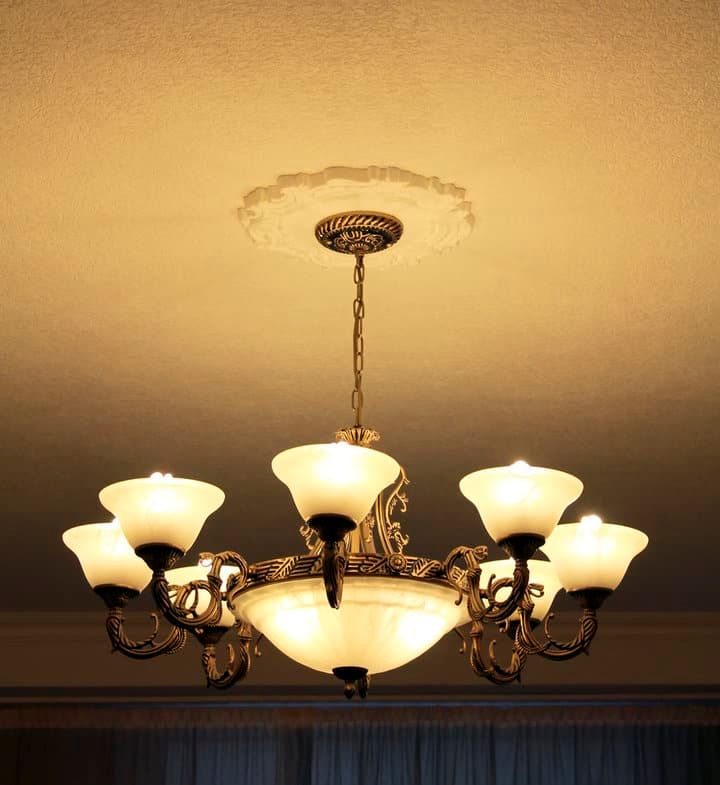
This procedure assumes you've already turned off power at the breaker, confirmed the wires are dead, and verified the existing outlet box is fixture-rated for the chandelier's weight. For any fixture over 50 lb, install a UL-listed brace anchored to the joists before continuing.
For expandable retrofit braces (used between two joists), insert the bar through the ceiling opening and rotate it. The bar extends horizontally until the serrated end caps grip the sides of the adjacent joists — they bite into the joist faces, not into the bottom surface. Stop tightening once the bar is firmly seated; over-torquing can split a joist.
With the box and brace in place, follow these steps:
- Screw the mounting strap (sometimes called a crossbar) onto the electrical box, feeding the supply wires through the center opening.
- Thread the chandelier's chain, cord, or downrod through the canopy, then screw the threaded nipple into the strap, leaving enough thread exposed to attach the fixture.
- Connect the wires with twist-on connectors: black to black (hot), white to white (neutral), and the green or bare copper ground to the grounding screw on the strap or fixture.
- Slide the canopy up against the ceiling and secure it with the decorative cap nut or set screws on the threaded stud, hiding the box.
- Install the bulbs, restore power at the breaker, and test the fixture.
How To Stop A Chandelier From Spinning
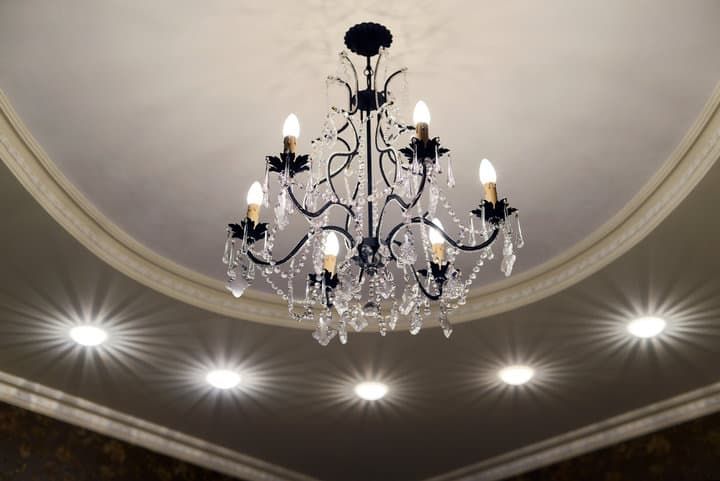
A chain-hung chandelier can rotate freely on its hook, which is more than a cosmetic problem. Constant motion wears paint off the links, can tangle crystals, and over time stresses the wiring threaded through the chain casing.
Lateral sway is a separate issue, usually driven by airflow from a nearby HVAC vent or by an asymmetric fixture design. If the chandelier is directly under a supply register, redirecting the vent louvers or moving the fixture off-axis is more effective than any anti-spin hardware. A loose canopy or under-tightened cap nut can also let the whole fixture wobble — check those first.
For rotational spin, two fixes work reliably:
- Replace the chain with a rigid metal downrod. This is the manufacturer-recommended approach. The downrod hooks onto both the mounting strap and the chandelier loop, eliminating rotation entirely.
- Add a thin metal stabilizer rod alongside the existing chain. The rod doesn't carry the fixture's weight — the chain still does — but it locks out rotation. Choose metal, not plastic: plastic isn't recommended by any major lighting manufacturer for this purpose.
Secure the rod with a mechanical fastener: a small set screw, a locking collar, a threaded coupling, or by hooking it through the mounting bar and the fixture loop. Don't use adhesives. Cyanoacrylate (super glue) loses strength above roughly 180°F — well within reach of an incandescent fixture — and is brittle under the vibration a hanging chandelier sees. No electrical or building standard lists adhesive as an acceptable method for overhead luminaire hardware.
When To Call A Licensed Electrician
Chandelier installation crosses from DIY-friendly to electrician territory at a few specific points:
- The fixture weighs more than 50 lb and the ceiling box isn't already anchored to a UL-listed brace.
- The home has knob-and-tube wiring, aluminum branch circuits, or no ground conductor at the box.
- The existing box is not marked for fixture support, or its rating is unclear.
- The ceiling height makes safe single-person installation impractical.
- The fixture exceeds 100 lb, or the installation is in a vaulted, coffered, or otherwise non-standard ceiling.
Final Words
A safely installed chandelier comes down to three checks: power off at the breaker before any wiring, a box and mounting rated for the fixture's full weight, and a rigid mechanical solution — never adhesive — for any stabilization. If any of those is uncertain, the right call is a licensed electrician.