
How To Remove Chandelier?
Capping abandoned wires with electrical tape and tucking them into the ceiling violates NEC Articles 300.15 and 314 — and it's a genuine fire hazard, not just a code technicality.
 Eugen
EugenEugen Nikolajev
Creator of LED Lighting Info
Hi, I am Eugen. I was always one of those kids who had all sorts of weird lighting gadgets for every occasion.
Now, I want to share my knowledge and experience about lighting with you on LED Lighting Info.
Read my editorial standards
Removing a chandelier is mostly a careful, two-person job: one person supports the fixture while the other unscrews the canopy, takes out the mounting screws, and disconnects the wires. This guide walks through the full process — including the safety steps most articles skip, like verifying the circuit is dead with a voltage tester and capping abandoned wires inside a code-compliant junction box.
What You'll Need
- Phillips and flathead screwdrivers
- Non-contact voltage tester (or a multimeter)
- Wire nuts (assorted sizes)
- Blank junction box cover plate (if you're not installing a replacement right away)
- Type IA step ladder, platform ladder, or extension ladder sized for your ceiling
- Heavy moving blanket or padded drop cloth
- At least one helper (more for tall ceilings or heavy fixtures)
How To Take Down A Chandelier: Step-By-Step

- Switch off the breaker. Find the breaker that controls the chandelier's circuit and flip it off. If your panel isn't labeled, have a helper toggle the wall switch while you identify the right breaker.
- Verify the circuit is dead. Hold a non-contact voltage tester against the chandelier wires before touching them. Breaker labels are often wrong or share circuits in unexpected ways — never trust the label alone.
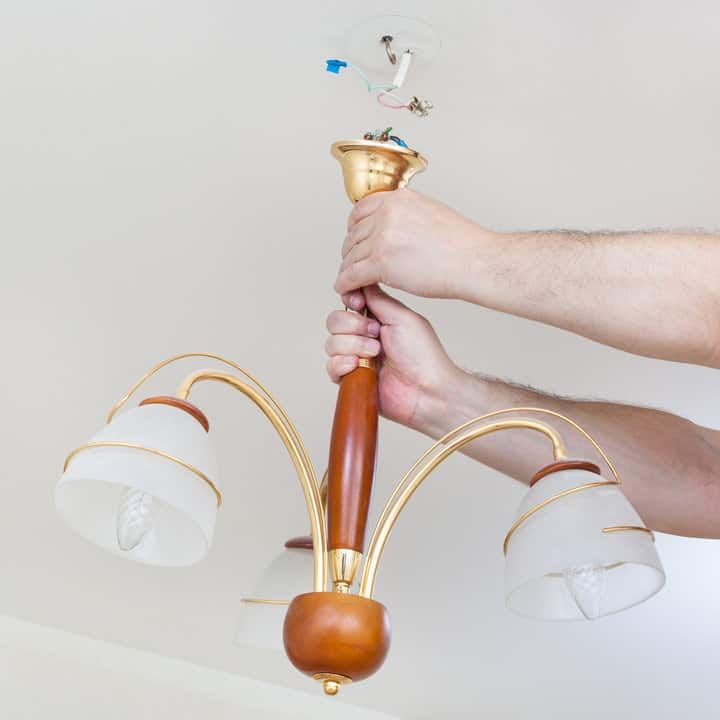
- Unscrew the canopy (escutcheon). The canopy is the decorative cover where the chandelier meets the ceiling. Loosen the visible mounting screw — or unscrew the small dome or ball that hides it — and gently slide the canopy down the chain or stem.
- Support the chandelier and remove the mounting screws. Underneath the canopy is a mounting plate that holds the chandelier to the junction box. Have your helper take the full weight of the fixture before you back out the screws — the wires alone won't support it.
- Disconnect the wires. Pull down enough wire to expose the wire nuts. Twist each nut counter-clockwise to remove it (wire nuts are threaded like a screw), then separate the conductors. If the bare or green ground wire is screwed to the junction box, unscrew it to release it.
- Lower the chandelier to a safe surface. Set it down on a padded blanket or drop cloth where it won't tip over.
- Cap the wires properly before restoring power. If a replacement fixture is going up immediately, you can leave the wires exposed with the breaker still off. If you need to turn the breaker back on first, do not just wrap the wire ends in electrical tape and push them into the ceiling — that violates NEC Article 300.15 and 314 and is a real fire and shock hazard. Cap each conductor with a properly sized wire nut, tuck the capped wires into the junction box, and screw on a blank cover plate (sometimes called a "blank-up" plate). Only then is it safe to re-energize the circuit.
How To Reach High Ceilings Safely

Stacking chairs or propping a ladder against another object is one of the most dangerous things you can do during this job. Match your equipment to the ceiling height, and always have someone footing the ladder.
A few rules apply at every height. Per OSHA's extension ladder guidance, set non-self-supporting ladders at a 4:1 angle (one foot out for every four feet up), never stand on the top three rungs, and have a spotter hold the base. Because chandelier removal forces both hands overhead — breaking the three-points-of-contact rule — a platform ladder or scaffold is safer than an extension ladder when the option exists. For ceilings over 20 feet, whether residential vaulted spaces or commercial atriums, switch to scaffolding or a scissor lift; an extension ladder simply isn't the right tool at that height.
How To Handle A Heavy Chandelier

Before lifting anything, strip the fixture down. Remove hanging chains, crystals, glass shades, and bulbs first — they add weight, snag on ladders, and shatter easily. Then choose a handling method based on size and shape:
- Multi-person carry: Two or more people support the fixture by its frame as it comes down. Best for compact, rigid chandeliers.
- Lower into a blanket: Two helpers hold a heavy moving blanket pulled taut beneath the fixture. As the wires come free, the chandelier settles into the blanket. Best for sprawling, fragile, or awkwardly shaped fixtures — but everyone holding the blanket needs a firm grip.
One thing to check before installing a replacement: chandeliers heavier than 50 lb require a fixture-rated, properly braced ceiling box per NEC Article 314.27. If you remove an old chandelier and find a standard plastic box behind it, do not hang a heavy new fixture from it — the box needs to be upgraded first. Reconnect the ground wire to both the metal box (via the green grounding screw) and the new fixture's ground lead whenever you install the replacement.
Do You Need An Electrician Or A Permit?
In most U.S. jurisdictions, replacing a hardwired fixture in the same location with the existing wiring is considered DIY-friendly and doesn't require a permit. The rules vary more than people assume, though:
- Florida and several other jurisdictions require a licensed electrician and a permit for essentially all hardwired electrical work, including like-for-like fixture changes.
- States like Texas, North Carolina, New York, and Washington grant a homeowner exemption only for an owner-occupied primary residence — not rentals or homes about to be sold.
- International rules are stricter: the UK, Australia, and parts of Canada generally require a licensed electrician for hardwired fixture work.
- If you're relocating the fixture, running new wiring, or installing a new junction box, a permit is generally required everywhere.
Check your local building department's rules before starting. When in doubt, hire a licensed electrician — the cost of a service call is small compared to the cost of an insurance claim being denied because of unpermitted work.
The other side of "can I do this myself?" is whether you should do it alone. Even on a standard 8-foot ceiling, a sprawling chandelier really wants a second person to support its weight while you free the wires. On taller ceilings, you need a spotter on the ladder for safety regardless of fixture size. For anything large, heavy, or above 12 feet, plan for at least one helper.
What To Do With The Old Chandelier
Once it's down, you have a few options:
- Resell on Facebook Marketplace, eBay, or a local consignment shop — vintage and crystal chandeliers often hold real value.
- Donate to a Habitat for Humanity ReStore or similar architectural salvage outlet.
- Store it boxed and padded if you might use it again — wrap crystals individually so they don't rub against each other.
- Recycle the metal frame and bag the glass for disposal if it's beyond saving.
Final Thoughts
Removing a chandelier looks intimidating but breaks down to two real challenges: working safely overhead and handling the wiring to code. Get the breaker confirmed dead with a tester, support the fixture before removing the last screws, and either install the replacement immediately or cap the abandoned conductors inside a covered junction box. With a helper and the right ladder for your ceiling, the rest is mechanical.
| Ceiling Height | Recommended Equipment | Minimum Team Size |
|---|---|---|
| Up to ~12 ft | Type IA step ladder or platform ladder | 2 |
| 12–16 ft | Platform ladder or 20-ft extension ladder | 2–3 |
| 16–20 ft | 24–28 ft extension ladder, platform ladder, or scaffolding | 3–4 |
| Over 20 ft | Scaffolding or scissor lift | 3+ |
FAQ
Do I need to turn off the main power, or just the breaker?
Just the breaker that controls the chandelier's circuit is enough — you don't need to kill power to the whole house. The critical step is verifying the circuit is actually dead with a non-contact voltage tester before touching the wires, because breaker labels are frequently wrong or share circuits in unexpected ways.
Can I leave the wires hanging in the ceiling if I'm not replacing the chandelier right away?
Not safely, and not legally. NEC Articles 300.15 and 314 require that any abandoned wire ends be capped with wire nuts inside an approved junction box, and the box must be closed with a blank cover plate before the breaker is turned back on. Wrapping wires in electrical tape and pushing them into the ceiling is a code violation and a real fire hazard.
What size ladder do I need for a 20-foot ceiling?
A 24–28 ft extension ladder, set at a 4:1 angle with a spotter holding the base. The highest safe standing rung is four down from the top, and extension ladders should extend several feet above the highest contact point. For overhead work like chandelier removal, a platform ladder or scaffold is safer than an extension ladder because you can keep both hands free.
Do I need a permit to replace a chandelier?
Usually no for like-for-like replacement in the same location, but it depends on your jurisdiction. Florida and many international jurisdictions require a licensed electrician for any hardwired work. Several U.S. states only allow the homeowner DIY exemption for an owner-occupied primary residence. If you're relocating the fixture or running new wiring, a permit is generally required. Check your local building department before starting.
How heavy a chandelier can a standard ceiling box support?
Standard ceiling boxes are typically rated for fixtures up to 50 lb. Anything heavier requires a fixture-rated, properly braced ceiling box per NEC 314.27. If you remove an old chandelier and discover a standard plastic box behind it, the box needs to be upgraded before you hang a heavier replacement.