
Is A Bad Light Switch A Fire Hazard?
A switch plate that's warm to the touch isn't just annoying — it's a high-resistance connection converting your wiring into a localized heater. That heat is the first step toward a real fire risk.
 Eugen
EugenEugen Nikolajev
Creator of LED Lighting Info
Hi, I am Eugen. I was always one of those kids who had all sorts of weird lighting gadgets for every occasion.
Now, I want to share my knowledge and experience about lighting with you on LED Lighting Info.
Read my editorial standards
Key Takeaways
A bad light switch usually isn’t a fire hazard on its own, but it can overheat at a worn contact or a loose terminal — and that localized heat is enough to scorch nearby plastic and, in rare cases, ignite surrounding material. A faulty switch can also force a bulb on and off intermittently, which stresses the bulb and creates a second potential failure point on the circuit.
Light switches are one of the most reliable parts of any home circuit. They’re mechanically simple, so there isn’t much that can go wrong with them.
Under normal residential use, they typically last 10 to 20+ years — and often decades — before anything starts to fail. Switches in low-use rooms can outlast the wiring around them, while frequent-use switches in kitchens and bathrooms tend to wear out earlier.
That reliability is exactly why a misbehaving switch is easy to ignore. Don’t. Any neglected electrical component can become a serious hazard once a fault starts to develop.
In this guide I’ll walk through:
- Which parts of a switch can actually cause a fire
- When arcing is normal versus when it’s dangerous
- What to do about crackling switches and flickering bulbs
- How AFCI breakers fit into the picture
- Where the line is between a DIY swap and a job for a licensed electrician
What Parts Of The Switch Are Likely To Cause A Fire?
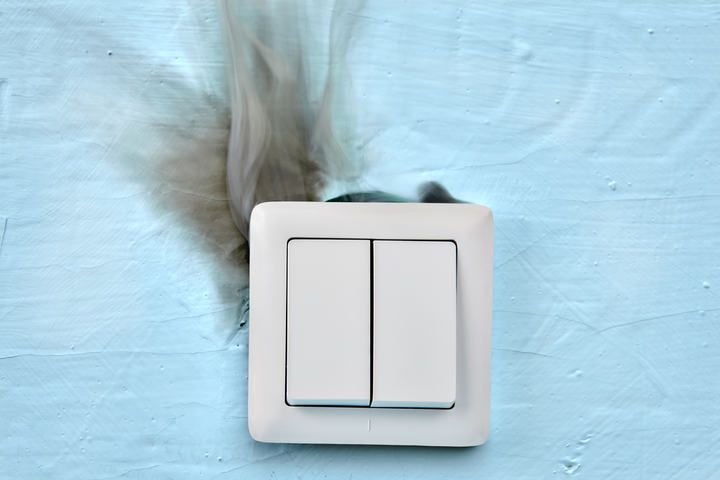
A standard residential toggle switch has only a handful of parts, and only a couple of them ever carry current:
- Toggle / actuator — The lever you touch. Typically plastic or another non-conductive material, and never makes direct contact with live current.
- Faceplate — The decorative cover around the switch. Plastic or metal, but doesn’t touch live conductors.
- Internal contacts — A moving contact and a stationary contact that open and close the circuit each time you flip the toggle. The primary wear point.
- Terminal connections — Where the circuit wires attach to the switch via screw terminals or back-wire push-in holes. Can loosen over time, especially in switches that get flipped many times a day.
Failures generally start at the internal contacts or the terminal connections. Contacts pit and oxidize after many thousands of cycles. Terminal screws can back off slightly over years of thermal expansion and contraction, and push-in (back-wire) connections can lose grip on the wire.
When that happens, contact resistance at the joint goes up. By Ohm’s law, higher resistance doesn’t mean more current — it means a localized voltage drop and resistive heating (I²R loss) right at the bad joint, even at the same load. The heat is concentrated at that one point. Over time it can scorch the surrounding plastic and, in rare cases, ignite nearby material.
Modern residential wiring uses code-compliant electrical boxes — most often plastic with NM cable (Romex), or metal where armored cable or metal raceway is used. Both materials are non-combustible by code, but neither is designed to contain a sustained arc fault, so a deteriorating switch shouldn’t be left in place once you notice symptoms.
Is An Arcing Light Switch A Fire Hazard?
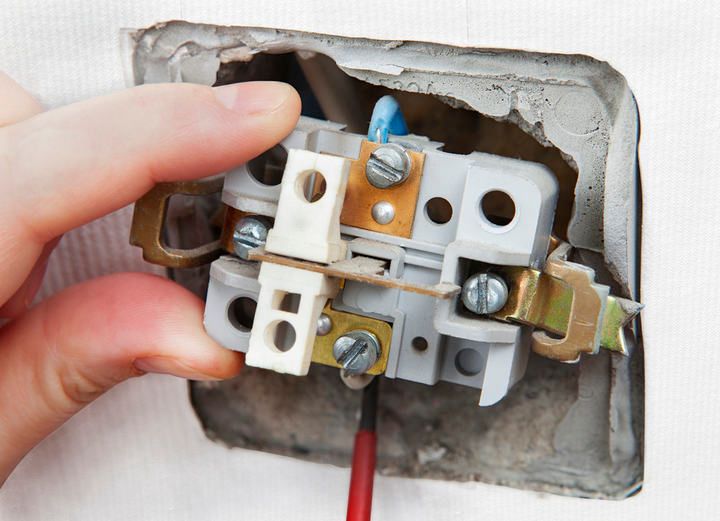
Visible arcing — a flash or a sustained spark when the switch operates — is one of the clearer warning signs. Arcs happen when the contacts aren’t fully touching but are close enough for current to jump the gap, and the arc itself generates intense, localized heat.
A tiny spark at the moment a switch breaks the circuit is normal. The current makes one last jump as the contacts separate, and as long as it’s brief and there are no other symptoms, it isn’t something to worry about. Sustained, repeated, or audible arcing is a different story — there are three common causes.
Cause 1: Worn internal contacts
After many years of use, the contact surfaces oxidize and pit. Instead of meeting cleanly, they make uneven contact and current arcs across small gaps as the switch operates. You may notice this most when you flick the switch slowly — the contacts don’t snap apart, so they hover close enough for the current to jump. Worn contacts aren’t economically repairable; replace the switch.
Cause 2: A worn switch mechanism
The internal spring that snaps the toggle from one position to the other can weaken over time. When it does, the contacts move slowly instead of breaking cleanly, which lets a sustained arc form during each operation. As with worn contacts, replacement is the right call.
Cause 3: Loose terminal connections
If the wires at the terminal screws (or push-in connectors) have worked loose, you can get an intermittent arc that occurs even when no one is touching the switch. This kind of arcing is often audible (a faint crackle from inside the box) rather than visible. Unlike worn contacts, it’s repairable:
- Switch off the breaker for that circuit at the panel.
- Use a non-contact voltage tester to confirm no voltage is present at the switch wires before touching them. Best practice is a “live-dead-live” check: verify the tester works on a known-live source, confirm the target wires are dead, then re-verify the tester on the live source again — non-contact testers can give false negatives.
- With power confirmed off, remove the switch and re-tighten the terminal screws. If the wires were on push-in connectors, move them to the screw terminals — screw terminals hold more reliably long-term.
If you’re not comfortable with any of those steps, call a licensed electrician. The cost of a service call is trivial compared to the cost of doing it wrong.
AFCI breakers add an important layer of protection
Modern US homes built or rewired under NEC 2020 (or later editions) are required to have Arc Fault Circuit Interrupter (AFCI) breakers protecting most habitable-room circuits — bedrooms, living rooms, kitchens, dining rooms, hallways, laundry areas, and similar spaces. AFCIs are designed to detect both parallel and series arc faults and de-energize the circuit before a fault can ignite anything, which is precisely the failure mode a deteriorating switch creates.
If your home is older and your panel doesn’t include AFCI breakers, retrofitting them — especially on circuits feeding bedrooms and living areas — is worth discussing with a licensed electrician. They’re one of the few safety upgrades where the cost-to-benefit ratio is hard to argue with.
Can A Sparking Switch Be Repaired?
For the small, end-of-stroke spark some switches make on the off-flick: nothing needs fixing. If you want a cleaner break, swap in a higher-quality switch with a stronger snap action — but it isn’t a safety requirement.
For sustained or recurring arcing caused by worn contacts or a worn mechanism, replacement is the right call. These aren’t economically repairable parts.
For arcing caused by loose terminals only, re-tightening the connections (with the breaker off and confirmed dead) usually resolves it.
Should I Replace A Switch That Crackles And Makes The Light Flicker?

A bulb is designed to draw a steady current. When a switch develops a fault — contacts that don’t fully open or close, or a loose terminal — the current becomes intermittent as it arcs across the imperfect connection. That’s what produces the crackling sound, and it’s also why the connected bulb starts to flicker. The bulb is being switched on and off rapidly with every micro-arc.
That creates two problems instead of one. The arcing at the switch is itself a heat and ignition risk, and the bulb is being subjected to thermal cycling and current spikes it wasn’t designed for, which can shorten its life or, in extreme cases, cause it to fail dangerously.
If you hear crackling and see flicker together, switch the circuit off at the breaker and replace the switch.
If the bulb flickers but the switch is silent, the switch isn’t necessarily the culprit. Try a different bulb — ideally a known-compatible LED of a different brand — to rule out a defective bulb. If the flicker continues, the issue is most likely the switch (especially a dimmer feeding LEDs) or something more serious on the circuit. The full diagnostic flow is in the guide on why LED bulbs flicker.
Dimmer Switches Need Special Attention
Dimmers fail differently from standard toggles. They contain electronic components that degrade with heat, and they’re easy to overload — a dimmer rated for 600W of incandescent load may only handle 150W of LED load, depending on the model. Symptoms to watch for:
- The dimmer feels hot to the touch (slightly warm is normal; hot is not)
- LED bulbs flicker, hum, or behave erratically only when dimmed
- Buzzing or crackling coming from inside the dimmer
- The usable dimming range has shrunk over time, with bulbs cutting out earlier or refusing to dim smoothly
Pay particular attention if you’ve swapped incandescents for LEDs without changing the dimmer. Many older dimmers aren’t LED-compatible and can overheat or cause the bulbs to flicker. Match the dimmer to the load type, and confirm the LED bulbs are listed as compatible with that dimmer model.
When To Act: A Quick Reference
Use this table to gauge how urgent the situation is. The severity ladder runs from monitor → replace soon → replace immediately → cut power and call a professional.
| Symptom | Likely Cause | Recommended Action |
|---|---|---|
| Tiny spark only at the moment of switching off | Normal contact break | Monitor — no action needed |
| Constant crackling sound and flickering bulb | Intermittent arcing inside the switch | Replace the switch soon |
| Switch plate or toggle warm to the touch | High-resistance connection generating heat | Replace the switch immediately |
| Visible scorch marks, smoke, or burn smell | Active fault — past the ignition stage | Cut power at the breaker and call a licensed electrician |
| Breaker trips repeatedly on that circuit | Possible arc fault (AFCI doing its job) or short | Stop using the circuit; call a licensed electrician |
When To Call A Licensed Electrician Instead
Replacing a standard toggle switch is within reach for a confident DIYer who knows how to safely de-energize a circuit and verify it’s dead. Stop and call a licensed electrician if any of the following apply:
- The switch or surrounding area shows scorch marks, smoke staining, or melted plastic
- The breaker for that circuit trips repeatedly
- You find aluminum wiring, multi-wire branch circuits, or any wiring configuration you can’t identify
- You aren’t completely sure which breaker controls the circuit
- You’re not comfortable using a non-contact voltage tester or working inside an electrical box
Final Words
My rule of thumb is to think of switch problems as an urgency ladder. A tiny end-of-stroke spark with no other symptoms? Monitor it. Crackling, flicker, or a switch that’s slow to snap? Replace it soon. A switch plate that’s warm to the touch? Replace it now — that’s a high-resistance connection generating real heat. Smoke, scorch marks, or repeated breaker trips? Cut power at the panel and call an electrician.
Light switches are simple, cheap, and easy to replace. Once one starts misbehaving, there’s no good reason to keep living with it.