How To Keep Bugs Away From Outdoor Lights?
Swapping to 2200K–2700K LEDs outdoors does more to reduce bug swarms than any gadget — because bugs can't navigate toward light they barely perceive.
 Eugen
EugenEugen Nikolajev
Creator of LED Lighting Info
Hi, I am Eugen. I was always one of those kids who had all sorts of weird lighting gadgets for every occasion.
Now, I want to share my knowledge and experience about lighting with you on LED Lighting Info.
Read my editorial standards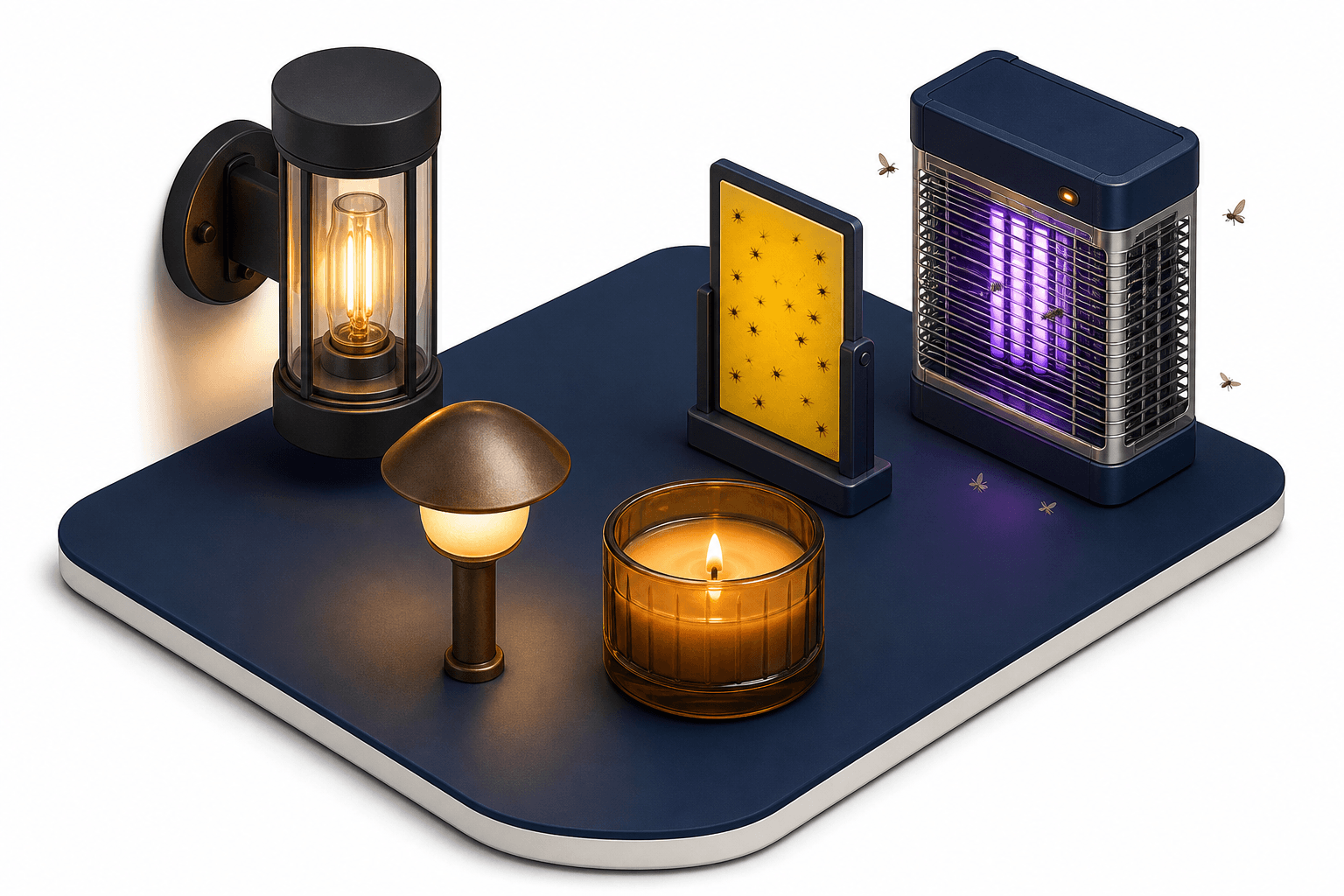
Key Takeaways
If you're having problems with bugs swarming your outdoor lights, the single most effective change is switching to warm-white LEDs in the 2200K–2700K range. A bug zapper helps for general flying insects, but it's a poor mosquito solution. Citronella candles are largely ineffective outdoors.
Outdoor landscape lights set the perfect mood for a garden — until the bugs show up. Here's what actually works to keep them away, and what's been oversold.
Below is a quick comparison, followed by a detailed look at each option.
| Solution | Effectiveness | Humane? | Cost | Works for all light types? |
|---|---|---|---|---|
| Warm-white LEDs (2200K–2700K) | High — biggest single improvement | Yes | $ | Yes |
| Bug zapper | Good for general flying insects; poor against mosquitoes | No | $$ | Standalone unit |
| Patio lights with built-in zapper | Moderate; more discreet | No | $$ | Patio strings only |
| Citronella candles | Very low outdoors | Yes | $ | N/A |
| Invite predators (bats, birds) | Slow but ongoing | Yes | $ | Yes |
| Outdoor ceiling fan | High in airflow zone | Yes | $$$ | Covered patios only |
Why Bugs Swarm Your Outdoor Lights
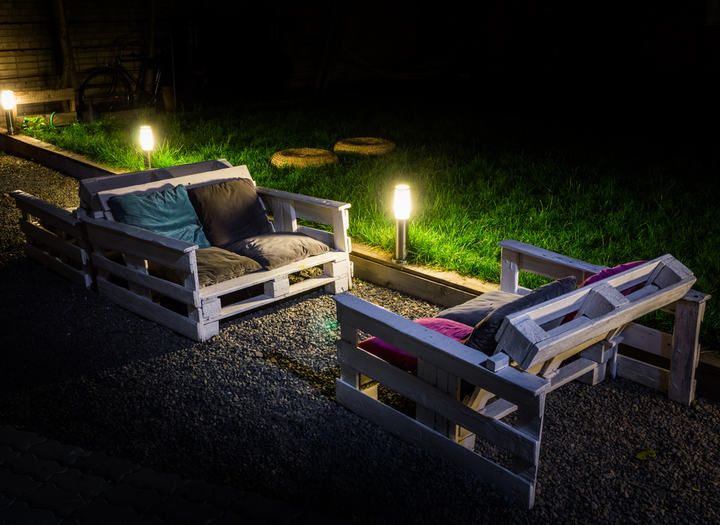
Bugs aren't "attracted" to lights in the way they are to food. Lights confuse them.
One long-standing explanation is that nocturnal insects use moonlight to navigate, and a bright artificial bulb throws off that system. More recent research — including a 2024 motion-capture study — suggests insects instead tilt their backs toward the brightest light source to keep "up" oriented, which causes them to circle artificial lights endlessly. Either way, the practical takeaway is the same: a bright bulb at night is a beacon.
The other half of the puzzle is the color of the light. Insects perceive a different range of wavelengths than humans do, roughly 300–650 nm. Many are most sensitive to UV and blue light (around 300–500 nm), with peak yellow-green sensitivity near 550 nm. Their sensitivity then drops off sharply above ~600 nm — which is why warm orange and red light is largely invisible to them. The NCSU Department of Entomology has a good breakdown of insect color vision.
That biology is why the single most effective fix isn't a gadget — it's choosing the right bulb.
Switch to Warm-White LEDs (The Easy Win)
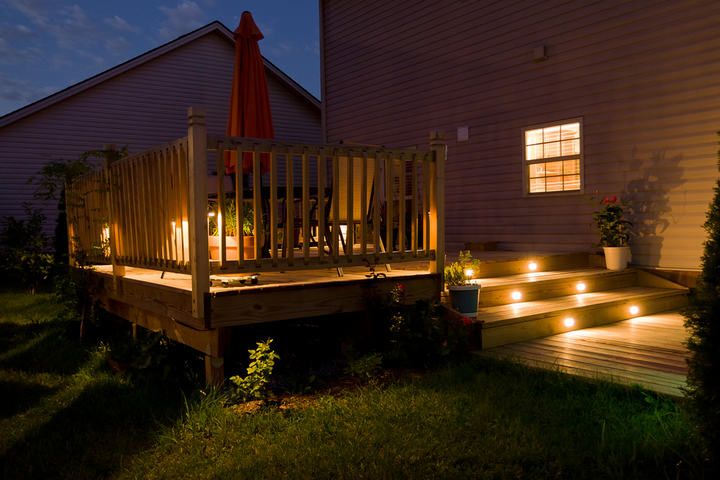
Yellow and amber bulbs — often sold as "bug lights" — are far less attractive to most insects. They emit very little of the UV and blue light that confuses insect navigation. Yellow light isn't truly invisible to bugs (true invisibility starts above ~600 nm in the orange-red range), but a warm bulb gives off much less of the spectrum that draws them in.
For practical shopping, look at the color temperature printed on the bulb:
- 2200K–2700K — Warm white / amber. The sweet spot for bug-prone areas. Cozy color, minimal UV and blue output.
- 3000K — Soft white. Acceptable, but already noticeably more attractive to insects than 2700K.
- 4000K and above — Cool white and daylight. Avoid these outdoors if bugs are an issue. Their blue-rich spectrum is a magnet.
A few caveats. Yellow bulbs aren't a deterrent — they don't actively push bugs away, they just don't pull them in as strongly. And mixing one yellow bulb in among cool-white lights won't help; the bugs will simply ignore it and swarm the others. To get the benefit, switch the whole string.
Bug Zapper: Effective, But Read the Fine Print
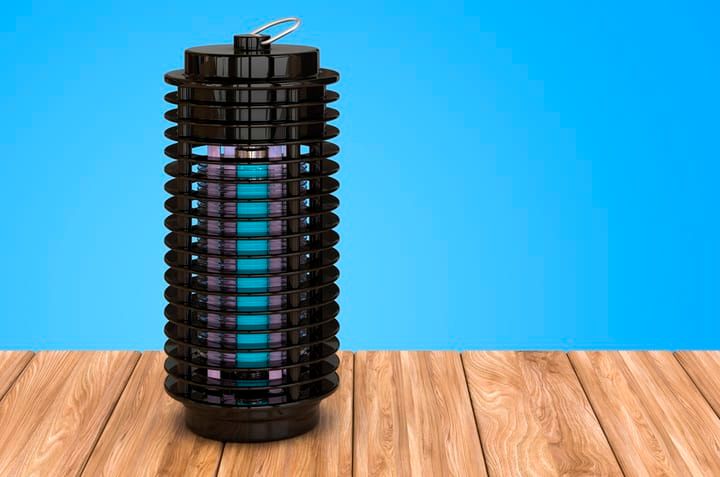
Bug zappers do kill insects on contact. The UV light pulls them in and the electrified mesh delivers a lethal current. For general flying-insect reduction around a patio, they work.
There's an important caveat, though. A widely cited University of Delaware study (Frick & Tallamy, 1996) sampled six residential bug zappers over 10 summer nights. Of nearly 14,000 insects killed, only about 0.22% were biting flies like mosquitoes. The vast majority were harmless or beneficial insects — midges, moths, beetles, parasitic wasps, and even predators that eat mosquitoes.
Mosquitoes are drawn primarily by CO₂, body heat, and skin odors, not UV. If your goal is fewer mosquito bites, a zapper is largely the wrong tool — a CO₂-baited trap or a topical repellent will do far more.
The other drawbacks worth weighing:
- You're killing insects indiscriminately, including pollinators.
- The unit itself is bright and casts a UV/violet glow that can clash with garden lighting.
- The constant snap-and-buzz is its own ambiance problem.
If a zapper still makes sense for your situation, make sure to buy one rated for outdoor use. An indoor-rated unit exposed to rain is an electrical hazard.
Patio Lights With a Built-In Zapper
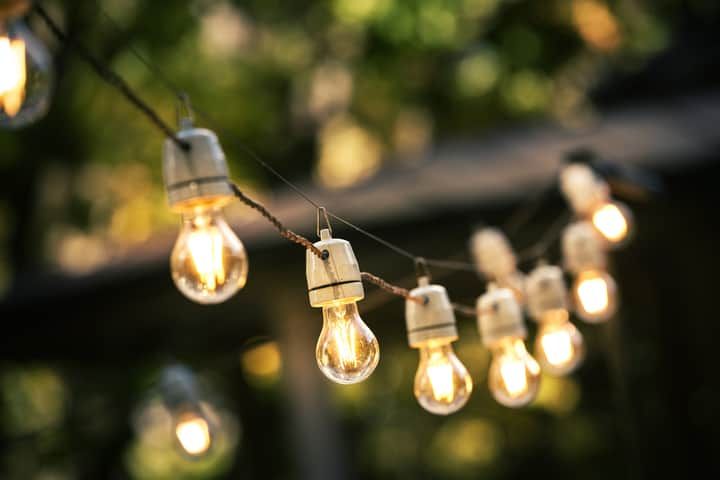
If a standalone zapper is too ugly or too loud for your space, look for combo patio string lights with an integrated UV zapper grid. The visible bulbs throw warm, useful light, and a small UV element with an electrified mesh handles the killing duty. They're more discreet than a standalone lantern-style zapper and easier to hang at different points around a garden.
The same caveat from the previous section still applies: these are general flying-insect reducers, not mosquito control.
Invite Predators: Bats and Birds
This is a slow-burn option, but it's the most ecologically friendly one on the list.
Bats are the heavy hitters here. A single bat can eat hundreds to thousands of small insects per night, including mosquitoes. Bats do not use bird boxes and are not drawn in by fruit or seeds — they need a dedicated bat box, typically mounted 12–20 feet off the ground on a pole or the side of a building with good sun exposure. If you have the space and the patience, this is probably the most effective humane option for night-flying insects.
Insect-eating birds — swallows, purple martins, wrens — work the daytime shift and target different insects. A nest box plus seed and water can attract them, though they take longer to populate and won't help much with the dusk-to-dawn swarm around your lights.
Outdoor Ceiling Fan
For a covered patio, an outdoor-rated ceiling fan is surprisingly effective. Flying insects — including weak fliers like mosquitoes — can't navigate steady airflow, so they simply give up and go elsewhere. The fan also cools you down.
It's the most expensive option on this list and only really makes sense if you already wanted the fan for comfort. If you do, it's humane, silent (compared to a zapper), and works.
Skip the Citronella Candles
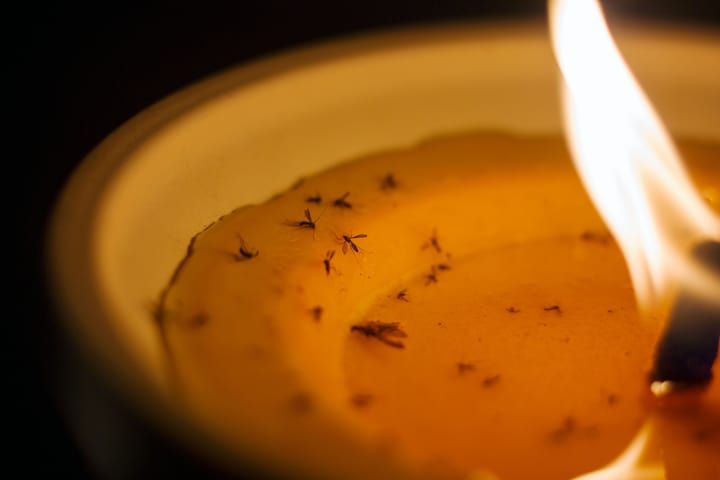
Citronella candles smell nice and look the part. As mosquito repellents in open air, they barely work.
A 2017 Journal of Insect Science wind-tunnel study tested 11 mosquito repellent products and found that a citronella candle did not significantly repel Aedes aegypti — in fact, slightly more mosquitoes were drawn to the human-plus-candle than to the human alone (though not by a statistically meaningful margin). Field research generally agrees: at typical patio distances, citronella candles offer little to no measurable protection, and any effect is limited to a tiny zone right next to the flame.
Buy them for the smell if you like the smell. Don't buy them expecting bug control.
Frequently Asked Questions
FAQ
What color temperature LED keeps bugs away?
Warm-white LEDs in the 2200K–2700K range are the lowest-attraction option for most insects. They emit very little of the UV and blue light that confuses insect navigation. Avoid anything 4000K or higher (cool white, daylight) outdoors — those bulbs are noticeably more attractive to bugs.
Do bug zappers kill mosquitoes?
Barely. A University of Delaware study found that less than 1% of insects killed by residential bug zappers were biting flies like mosquitoes. Mosquitoes are drawn to CO₂, body heat, and skin odors rather than UV light, so they're rarely the ones flying into the grid. For mosquitoes specifically, a CO₂-baited trap or a topical repellent is far more effective.
Are yellow bug lights actually invisible to insects?
No. Many insects have peak sensitivity around 550 nm (yellow-green), so they can see yellow light. The reason yellow "bug lights" work is that they emit very little of the UV and blue wavelengths that strongly stimulate insect photoreceptors. True invisibility to most insects only kicks in above ~600 nm, in the orange-red range.
Do citronella candles really not work?
They have a very small effect at very close range and essentially no effect at normal patio distances. Controlled studies show negligible repellency against mosquitoes outdoors. They're fine as ambient candles — just don't rely on them for bite protection.
Will one yellow bulb keep bugs away from my other lights?
No. Insects will just gravitate to whichever light has the most UV and blue output. To get the benefit of warm-spectrum lighting, replace the entire string or fixture group — not a single bulb.
Final Words
There's no single fix that's both humane and 100% effective, so my rule of thumb is to layer the cheapest options first.
For most people, swapping outdoor bulbs to warm-white LEDs at 2200K–2700K is the easiest first step and the biggest single improvement. If bugs still bother you, add a discreet string light with an integrated zapper, or a standalone outdoor-rated zapper if aesthetics aren't a concern. For mosquitoes specifically, skip the zapper and reach for a CO₂ trap or a topical repellent instead. Long-term, putting up a bat box does more than any single piece of hardware on this list — it just takes a season or two to pay off.