
How To Hide Floor Lamp Cords?
Sliding a floor lamp cord under a rug feels like the obvious fix — but trapped heat and hidden abrasion damage make it a fire risk the CPSC explicitly warns against.
 Eugen
EugenEugen Nikolajev
Creator of LED Lighting Info
Hi, I am Eugen. I was always one of those kids who had all sorts of weird lighting gadgets for every occasion.
Now, I want to share my knowledge and experience about lighting with you on LED Lighting Info.
Read my editorial standards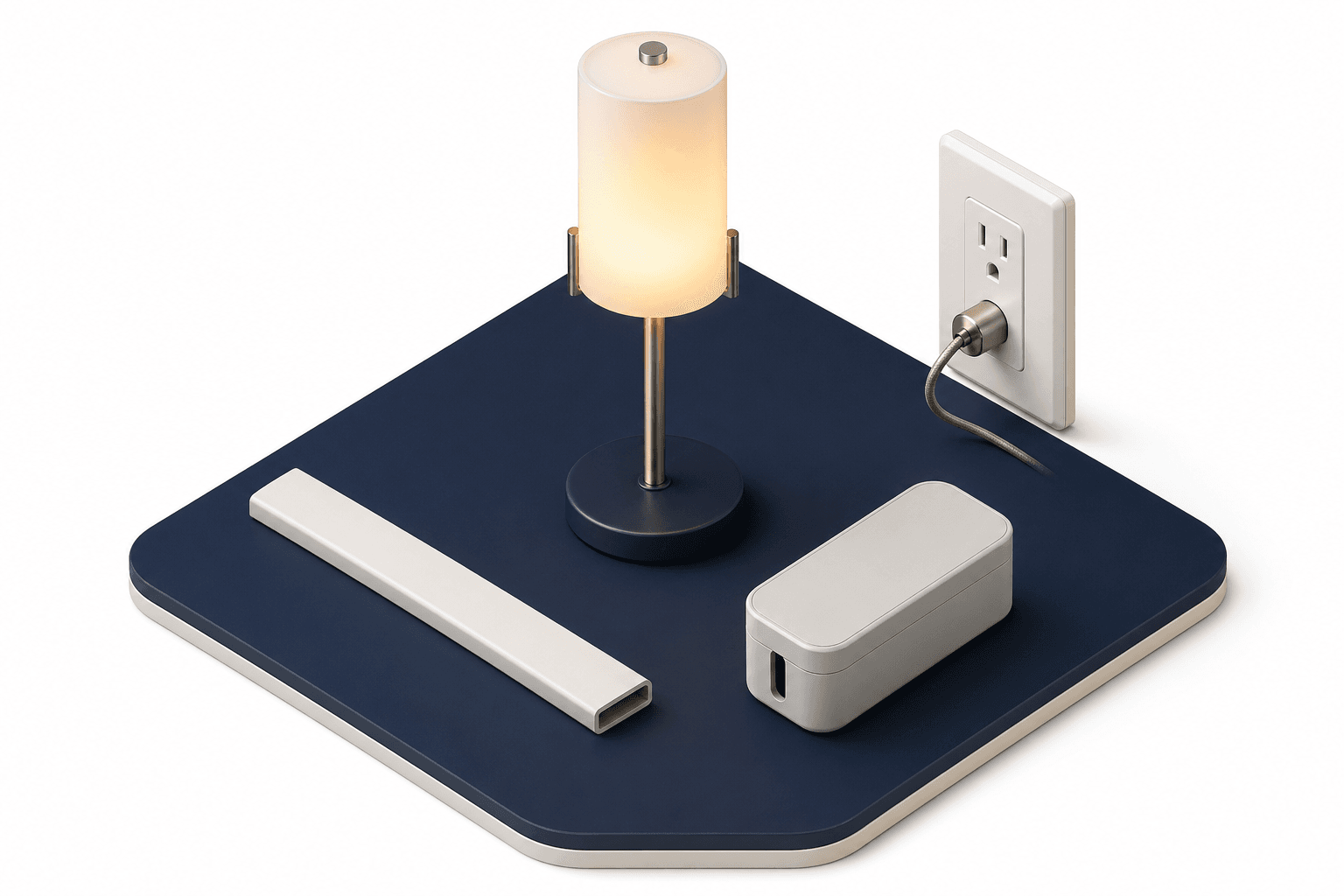
Key Takeaways
The best way to hide floor lamp cords is to run them to the nearest wall and follow the baseboard with a cable concealer that's been painted to match the wall. Avoid the temptation to tuck cords under rugs or carpets — it's explicitly prohibited by the US National Electrical Code (NEC 400.12) and a documented fire risk. Shortening a lamp cord can also help, but the polarity of the wires matters when you reconnect them.
Floor lamps are great furniture — until you spot the cord trailing across the floor. No matter how stylish the lamp, an exposed cable spoils the look, and it's a trip hazard on top of that.
So how do you hide it cleanly?
In this guide, I'll cover:
- Hiding cords in the middle of a room
- Why cords don't belong under rugs or carpets
- Hiding cords on tripod floor lamps
- Picking the right tape (and what to use instead)
- Shortening a lamp's cord — safely
How To Hide Cords In The Middle Of The Room
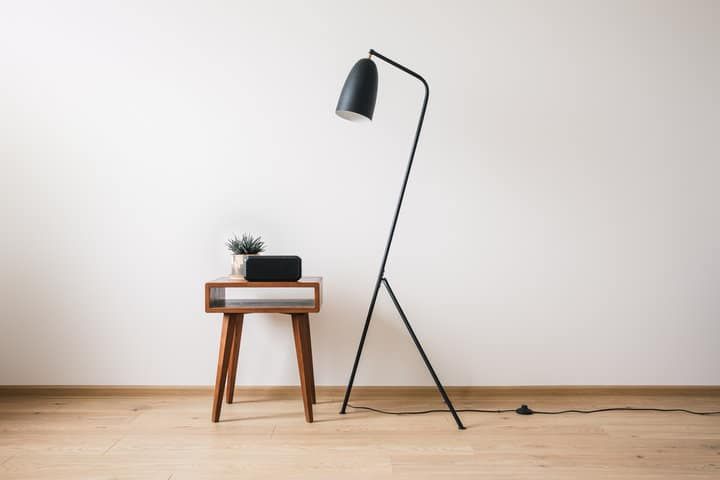
When a floor lamp sits in the middle of the room — or against a wall but far from any outlet — the priority is plugging it in without leaving a trailing cord on the floor.
There are two main principles:
- Use other furniture to obscure the cable.
- Get the cable to the nearest wall as quickly and directly as possible.
Aim for the least amount of cord exposed on the floor. Run it under side tables, sofas, or any other furniture along its path, then make a beeline for the closest wall.
Once at the wall, use a cable concealer (Amazon) to run the cord along the baseboard to the outlet. Most concealers are paintable so they can blend almost completely into the wall.
Concealers come in several styles. Choose based on whether you can drill into the wall, whether the cord needs to cross open floor, and whether you want to remove it later:
| Type | Best For | Notes |
|---|---|---|
| D-line / raceway | Wall runs along the baseboard | Self-adhesive or screw-mount; rigid; paintable |
| Fabric cord cover | Cords visible across furniture | Soft sleeve; wraps or zips around the cord; not paintable |
| Adhesive baseboard channel | Quick installs in rentals | Sticks to baseboard; less robust than rigid raceway |
| Floor cord protector | Crossing open floor (never under rugs) | Low-profile, listed for foot traffic |
Most cable concealers are self-adhesive, but some need screwing in — pick what suits your wall and your lease. Attach the concealer just above the baseboard so it isn't snagged by vacuums, furniture, or pets, and follow the manufacturer's installation instructions.
Always run it at right angles when changing height — don't chart a diagonal line to the outlet, it won't look neat.
If the room has wallpaper, papering over the concealer is fiddly with patterned designs. Painting it to match the dominant color of the paper is an easier option.
Why You Shouldn't Run Lamp Cords Under Rugs Or Carpets

It's tempting to slide a lamp cord under a rug to keep the floor clear. Don't.
Running flexible lamp cords or extension cords under rugs or carpets is explicitly prohibited by the US National Electrical Code (NEC 400.12) and UL 817. The same prohibition has been in the NEC since long before the 2017 renumbering and is unchanged through the 2026 edition.
Floor coverings trap heat from the cord during normal use, and they hide abrasion damage that foot traffic causes over time. Either alone can lead to insulation breakdown and fire — together they're a documented hazard that the CPSC and fire-safety organizations consistently warn against. Equivalent UK regulations under BS 7671 (the IET Wiring Regulations) take the same view.
If you can't reach an outlet without crossing open floor, the safer options are:
- Route the cord around the perimeter of the room with a wall-mounted cable concealer.
- Use a low-profile floor cord protector or raceway listed for foot traffic — it sits on the floor surface, not beneath a rug.
- Have an electrician install a new outlet closer to the lamp.
Whatever path you choose, secure the cable so it can't be kicked or rubbed out of position. A cord that gets tugged out of place can pull the lamp over — and a toppled lamp left switched on is a documented fire risk if a hot incandescent or halogen bulb lands against bedding, curtains, or upholstery. Halogen torchiere-style floor lamps in particular have been involved in CPSC-tracked fire incidents from exactly this scenario.
What Kind Of Tape Should You Use?
A few of the methods in this guide call for tape to hold a cable in place — against a tripod leg, the back of a sofa, or a piece of furniture you're routing the cord under. Here's how the common options compare:
| Tape | Strength | Residue | Removable | Best For |
|---|---|---|---|---|
| Scotch / Sellotape | Low | None | Easy | Light, temporary fixes |
| Duct tape | High | Heavy | Difficult | Avoid for cords |
| Gorilla tape | Very high | Heavy | Very difficult | Avoid for cords |
| Gaffer tape | Medium-high | Minimal | Easy | Recommended |
Avoid duct tape and Gorilla tape for cable management. Both use aggressive rubber-based adhesives that leave heavy residue on the cord jacket — Gorilla tape's double-thick adhesive often needs solvents like rubbing alcohol or Goo Gone to clean off, and pulling it off forcefully can tear thin insulation. Neither is a good choice anywhere you might want to reposition the cable later.
The best balance is gaffer tape (Amazon). It's strong enough to hold a cord against a tripod leg or sofa, but peels off cleanly without residue.
For an even cleaner approach, skip tape altogether and use:
- Adhesive cord clips — small plastic guides that stick to a wall, baseboard, or furniture leg and route the cable in a straight line.
- Cable saddles — semicircular clips designed to hold cord flush against flat surfaces.
- Hook-and-loop (Velcro) cable ties — reusable, residue-free, and ideal for bundling slack on tripod lamps or behind furniture.
These are especially useful in rented properties where adhesive residue is a problem.
How To Hide A Cord On A Tripod Floor Lamp

On a tripod floor lamp the cord usually hangs from the bulb fixture and trails between the legs, which can spoil an otherwise sculptural piece. Some lamps come with the cord already clipped to a leg; for the rest, you'll need to route it yourself.
Do this:
- Position the lamp where it will live and decide which leg faces away from the main viewing angle.
- Run the cord straight down the back of that leg, keeping it taut against the metal or wood.
- Secure it with a few small pieces of gaffer tape or — better — a couple of adhesive cord clips spaced along the leg.
- Once the cord reaches the floor, route it to the nearest wall using one of the methods above.
Don't do this:
Avoid wrapping the cord around a leg in a spiral. It looks messy, adds slack that flexes every time the lamp is moved, and gradually weakens the insulation.
How To Shorten A Floor Lamp Cord
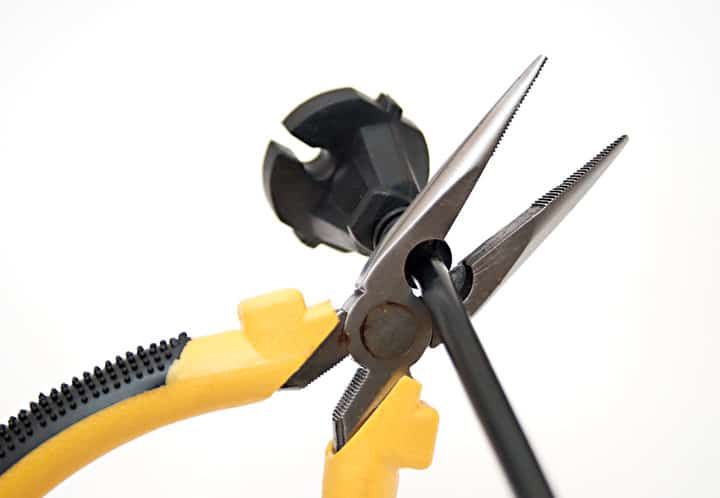
Hiding a floor lamp cord is much easier when the cable is the right length to reach the outlet. With excess cord, you have two options.
The simplest is a cable shortener (Amazon) — a small spool that gathers slack into a tidy loop. It's a no-tools, no-rewiring solution, but the spool itself is visible.
For a permanent fix, you can shorten the cord by cutting and reterminating it. Either the plug end or the bulb end will work, but read the warnings first.
Before You Start
- The cord must be unplugged for the entire job.
- Cutting the cord will void any manufacturer's warranty.
- In the US, follow NEC and UL guidance and use only listed replacement plugs and sockets. In the UK, lamp wiring should comply with BS 7671 (the IET Wiring Regulations).
- Do not splice two pieces of lamp cord together to extend the run later — splices in flexible cord aren't safe practice and aren't allowed under most electrical codes. If you cut too short, replace the entire cord with a single longer length.
- If you're not comfortable identifying live and neutral conductors, stick with a listed cable shortener or hire a qualified electrician.
Identify The Wires (Polarity Matters)
Lamp cord has two conductors, and they aren't interchangeable. One is marked — usually with ribs, a stripe, or different-colored insulation — and is the neutral (or "identified") conductor. The other, smooth one is the hot conductor.
When reconnecting:
- The neutral (ribbed/striped) conductor goes to the wider blade of the plug and the silver-colored, threaded-shell terminal of the bulb socket.
- The hot (smooth) conductor goes to the narrower blade of the plug and the brass-colored, center terminal of the bulb socket.
Reversing these energizes the metal threaded shell of the bulb even when the lamp is switched off — a serious shock hazard the next time someone changes a bulb. If the existing plug or socket isn't visibly polarized, replace it with a listed polarized one as part of the repair.
Step-By-Step
- Unplug the lamp and lay the cord out flat. Mark the new length, leaving a few extra inches for stripping and termination — measure twice.
- Decide which end to cut. The plug end is usually easier; the socket end requires disassembling the bulb fixture.
- If shortening at the plug, check whether the existing plug can be opened and reused. Many molded plugs can't — you'll need a listed replacement.
- If shortening at the socket, unscrew the fixture, then pull or unscrew the wired part away from the lamp holder. Loosen the terminal screws and free the wires.
- Cut the cord cleanly at your mark.
- Strip about ¾ inch (20 mm) of insulation from each conductor. Twist the strands tight so no whiskers are loose.
- Identify the neutral conductor (ribbed/striped) and connect it to the silver/wide-blade terminal. Connect the hot conductor to the brass/narrow-blade terminal.
- Tighten the terminal screws firmly. Loose connections cause arcing, which is a fire hazard.
- Reassemble the plug or socket housing. Make sure no bare conductor is exposed and the cord clamp grips the cable jacket — not the conductors.
- Plug in and test with the bulb installed. If anything feels warm, smells unusual, or the bulb flickers, unplug immediately and recheck the connections.
Final Words
Hiding a floor lamp cord cleanly is mostly about routing — get the cord to the nearest wall, follow the baseboard with a paintable concealer, and finish with a color that matches the wall. That's the cleanest and safest path.
Quick recap by method:
- Mid-room lamps — run the cord under furniture toward the nearest wall, then conceal it along the baseboard.
- Under rugs and carpets — don't. It's a code violation in the US and a fire risk everywhere.
- Tripod lamps — route the cord straight down the back of one leg with adhesive clips. Don't spiral it.
- Tape choice — gaffer tape, not duct or Gorilla. Better still, skip tape for cord clips or Velcro ties.
- Shortening — possible at either end, but mind the polarity, replace rather than splice, and stop if you're unsure.