
Why Do Light Bulbs Glow When Switched Off?
A few microamps — not nearly enough to warm an old incandescent filament — is all it takes to make an LED glow visibly in the dark. That tells you the bulb isn't the problem; your switch or wiring is.
 Eugen
EugenEugen Nikolajev
Creator of LED Lighting Info
Hi, I am Eugen. I was always one of those kids who had all sorts of weird lighting gadgets for every occasion.
Now, I want to share my knowledge and experience about lighting with you on LED Lighting Info.
Read my editorial standards
Key Takeaways
Most afterglow comes from a small leakage current still reaching the bulb — typically from illuminated, smart, or dimmer switches, or from long cable runs that allow capacitive coupling. Incandescent bulbs glow briefly because the filament is still hot. CFLs linger because their phosphor coating continues to emit visible light for a moment after the gas discharge stops.
Have you ever flipped a light switch off, only to notice the bulb still glowing faintly in the dark? It's an unsettling little mystery — but it has a perfectly ordinary explanation, usually rooted in your switch, your wiring, or the bulb's internal electronics.
So why does it happen?
Let's take a closer look at each of these causes.
What Types Of Bulb Can Glow After Being Switched Off?

Even a faint glow in a bedroom bulb can be enough to keep you up all night. The bulbs may flicker, pulse, or glow steadily, and there might even be a buzzing or humming noise.
LEDs, CFLs (compact fluorescent lamps), and incandescent bulbs can all show this behavior, though the cause differs in each case. The glow can last from a fraction of a second to several minutes.
It's worth noting that on a properly wired standard switch, most modern bulbs go fully dark almost immediately. A persistent or visible afterglow is usually a wiring or switch artifact rather than an inherent property of the bulb itself — and in nearly every case, there's nothing dangerous going on.
Below, we'll walk through the most common causes, then look at how each bulb type behaves in detail.
The Main Causes Of Glowing

Most afterglow comes down to a few well-understood electrical and physical effects. Here are the most common culprits, roughly in order of how often they show up.
1. Leakage Current From The Supply
The dominant cause of LED "ghosting" is a tiny leakage current that keeps reaching the bulb even after the switch is opened. That trickle charges the smoothing capacitor inside the bulb's driver, which periodically discharges into the LEDs and produces a faint glow.
LEDs are particularly prone to this because they're so efficient. A few microamps that wouldn't have warmed an old incandescent filament are easily enough to make an LED visibly glow.
2. Illuminated, Motion, Or Smart Switches
Switches with built-in indicator lights, motion sensors, timers, or Wi-Fi need a small amount of standby power. That power often passes through the bulb's circuit on its way back to neutral, leaving just enough current behind to make the bulb glow.
Smart bulbs and Wi-Fi-enabled fixtures behave similarly: their always-on radios and microcontrollers draw a constant trickle of current, which can show up as a faint visible glow on some models.
3. Incompatible Dimmer Switches
Dimmers designed for incandescent bulbs frequently work poorly with LEDs. They can leave residual voltage on the line even at the "off" position, which the LED driver picks up and converts into a faint glow. Swapping in a dimmer specifically rated for LEDs (often a "trailing-edge" type) usually solves it.
4. Wiring Faults
Wiring can also be the culprit. If the switch interrupts the neutral wire instead of the live wire, or if live and switched-live wires share a long cable run (which causes capacitive coupling between them), a small current can leak through to the bulb even with the switch off. Two-way switching with a shared or borrowed neutral can produce the same effect.
5. Hot Filament (Incandescent Only)
An incandescent bulb's filament reaches several thousand degrees in normal operation. When the power is cut, the filament needs a moment to cool — the visible glow fades within roughly a second as it loses heat through blackbody radiation.
6. Phosphor Persistence (CFL Only)
A CFL's phosphor coating doesn't stop emitting the instant the current is cut. Many fluorescent phosphors continue to release stored energy as visible light for a short time — typically milliseconds to a couple of seconds — producing a brief, fading afterglow.
Why Do CFL Bulbs Glow When Turned Off?
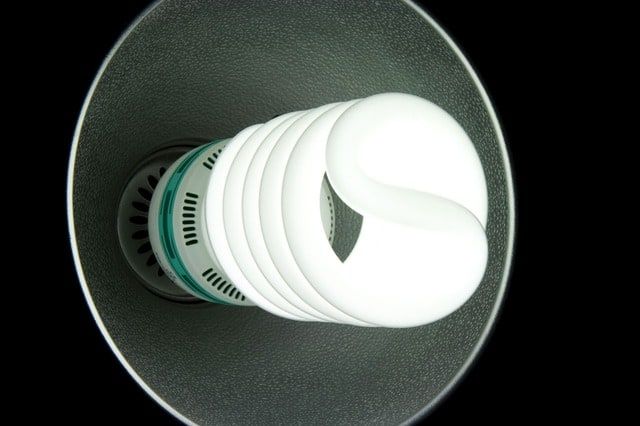
A CFL produces light through a chain reaction inside the tube involving mercury vapor and a phosphor coating on the inside of the glass. (A quick terminology note: the coating is a phosphor — a luminescent compound, typically a rare-earth-activated host crystal. It's not phosphorus, the chemical element used in fertilizers and matches; the two share a name but are unrelated.)
When current flows through the tube, free electrons accelerate and collide with mercury atoms, kicking their outer electrons up to higher energy levels. As those electrons fall back to their ground state, the atoms emit ultraviolet photons — predominantly at 253.7 nm.
That UV radiation then strikes the phosphor coating, which absorbs it and re-emits visible light. This is what gives a fluorescent tube its familiar white glow.
When you flip the switch off, the discharge ends almost instantly — mercury atoms de-excite in nanoseconds. The lingering glow you see doesn't come from the gas. It comes from the phosphor coating itself: many fluorescent phosphors continue to emit visible light for a fraction of a second to a couple of seconds after the UV stops, releasing energy they already absorbed.
Once that stored energy is depleted, the tube goes dark.
In short: the gas powers down instantly, but the coating takes a moment to fully release the energy it stored.
It's worth noting that glow-in-the-dark objects rely on a related but distinct phenomenon called phosphorescence, where energy is stored in metastable electron states and released slowly over seconds to minutes. CFL afterglow shares the broader category of luminescence but is shorter and based on a different physical mechanism.
Why Do LED Lights Keep Glowing After Switching Off?

LEDs don't rely on a chemical discharge like CFLs do. Their afterglow has a purely electrical cause.
The most common explanation is leakage current. A small amount of current — usually from an illuminated switch, smart switch, dimmer, or capacitive coupling between long cable runs — keeps reaching the bulb after the switch is opened. That trickle charges the smoothing capacitor inside the LED driver, which periodically discharges through the LEDs.
The capacitor isn't generating energy on its own; it's buffering current that's still arriving from somewhere. (You can verify this by removing the bulb and putting it back in the socket — once the line is fully isolated, the glow stops.)
LEDs are also unusually efficient. They convert even a few microamps into faintly visible light, which is why ghosting often shows up on LEDs but not on the incandescent bulbs they replaced in the same fixture.
How To Fix LED Ghosting
- Swap an illuminated, motion, or smart switch for a standard one.
- Replace an incompatible dimmer with a model rated for LEDs (often called a trailing-edge dimmer).
- Have an electrician confirm the switch interrupts the live wire (not the neutral) and that the fixture has a proper neutral connection.
- For long cable runs with capacitive coupling, a snubber or bypass capacitor wired across the bulb fixture can shunt the leakage harmlessly to neutral.
- Try a different brand of bulb. Drivers vary, and some models are notably more sensitive to leakage than others.
When Should You Be Concerned?
A faint, brief afterglow on a properly wired circuit is harmless. But a few situations are worth taking seriously and getting an electrician to look at.
Call an electrician if:
- The glow is bright enough to light the room or lasts for many minutes.
- The bulb feels unusually hot or there's a burning smell from the fixture.
- The glow is accompanied by flickering, buzzing, or sparking at the switch.
- Replacing bulbs and switches doesn't help and the issue stays tied to the fixture, suggesting a wiring fault behind the wall.
Final Words
The mystery of the glowing-off light bulb is almost always electrical, not supernatural. For LEDs and CFLs — by far the most common offenders — the cause is usually leakage current from your switch or wiring, not a flaw in the bulb itself.
The simplest first step is to look at your switch. If it has an indicator light, motion sensor, or built-in dimmer, swap it for a standard model and the glow will usually disappear. If it persists after that, your wiring is worth a closer look — and out of all the lighting technologies on the market, LEDs remain among the safest and most efficient options once these small wiring quirks are sorted out.
Have you noticed any of your bulbs glowing faintly after being switched off?
FAQ
Are glowing LED bulbs dangerous?
A faint, brief afterglow is generally harmless and just indicates a small leakage current. It's worth investigating if the glow is bright, the bulb is hot to the touch, or you notice flickering, buzzing, or a burning smell.
Why do my LEDs glow but my old incandescent bulbs didn't?
LEDs are dramatically more efficient than incandescent bulbs. The same trickle of leakage current that wasn't enough to warm an incandescent filament is plenty to make a modern LED visibly glow.
Will a glowing LED add much to my electricity bill?
No — the leakage current is far too small to make a meaningful difference on your bill. The real downsides are comfort (a glowing bulb in a dark bedroom) and the possibility of slightly shortened bulb life from constant low-level current.
Can a dimmer switch cause LEDs to glow when off?
Yes. Standard dimmers built for incandescent bulbs often leave residual voltage on the line that LEDs pick up. Swapping in an LED-compatible dimmer (typically a trailing-edge model) is usually enough to fix it.
How long should an afterglow last?
An incandescent filament fades within about a second. CFL phosphor afterglow typically lasts a fraction of a second to a couple of seconds. An LED ghost glow caused by leakage current can persist as long as the bulb is in the fixture — that's a sign of a wiring or switch issue rather than the bulb.