
Is Leaving A Light Switch In The Middle Safe?
A light switch left "in the middle" isn't actually in the middle — the snap-action spring inside forces the contacts fully on or off regardless of where the toggle sits. The danger only starts when that spring wears out.
 Eugen
EugenEugen Nikolajev
Creator of LED Lighting Info
Hi, I am Eugen. I was always one of those kids who had all sorts of weird lighting gadgets for every occasion.
Now, I want to share my knowledge and experience about lighting with you on LED Lighting Info.
Read my editorial standards
Key Takeaways
Normally, leaving a switch in the middle does nothing. The internal components snap past the center, so the switch is fully open or fully closed regardless of how the toggle looks from outside. If the switch is damaged or worn, however, leaving it in the middle can become a hazard.
A light switch is a binary device — it's either on or off. So what happens when you leave one hanging in the middle?
In this article I'll cover:
- Whether it's even possible to leave a switch in the middle
- What actually happens inside when you try
- Whether a switch left in the middle can cause a fire
Is It Possible To Leave A Switch In The Middle?
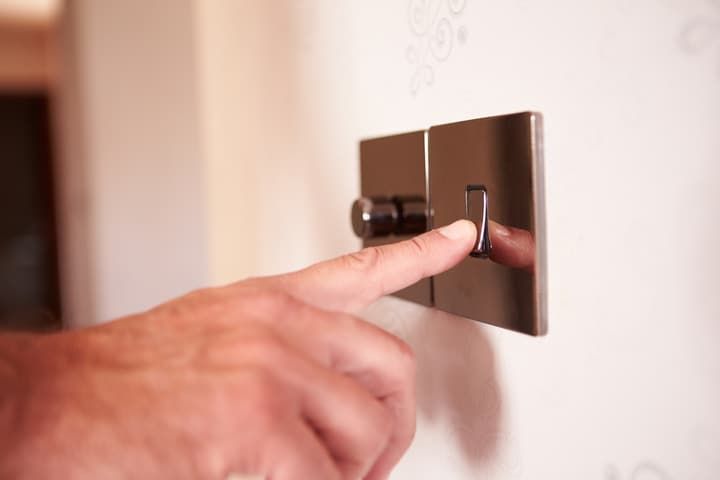
With a healthy switch, no — not really. If you try, you'll feel resistance, and the toggle will snap back to whichever position it was already in the moment you stop pressing.
That's because the internal of a light switch uses a snap-action mechanism — a small over-center spring designed to flip past a critical point. It stores energy as you press the toggle, then releases it instantaneously once that threshold is crossed, snapping the contacts firmly into the new position. (The technical term for the gap between where the switch makes and where it breaks is hysteresis — but that's a property of the snap-action mechanism, not the mechanism itself.)
In practical terms: as you start pressing a light switch, the toggle moves but the contacts inside stay completely motionless. Once you pass the threshold, the spring releases and the contacts snap into the second position, completing the circuit.
So you might be able to position the external toggle in the middle, but the components inside will still be sitting in their last stable state. Nothing has actually happened inside the switch.
What About Worn-Out Switches?
Light switches are resilient, but they don't last forever. A standard residential light switch is typically rated for 50,000 to 100,000 mechanical cycles, which translates to anywhere from a decade to several decades of normal use, depending on how often it's flipped.
Once the spring weakens, the contacts may not snap as cleanly as they once did, and they can hover. Revise the question to "is it possible for an old, worn-out light switch to be left in the middle?" and the answer becomes "maybe."
What Happens If You Leave The Switch In The Middle?
With a working switch, leaving it in the middle does nothing — the internal contacts stay in whatever state they were already in, either fully on or fully off. There's one exception worth noting: a few specialty switches use a three-position ON-OFF-ON (center-off) design, where the middle position is genuinely off. These are uncommon in residential wiring. Standard household toggle switches are two-position only.
Can A Switch Left In The Middle Cause A Fire?
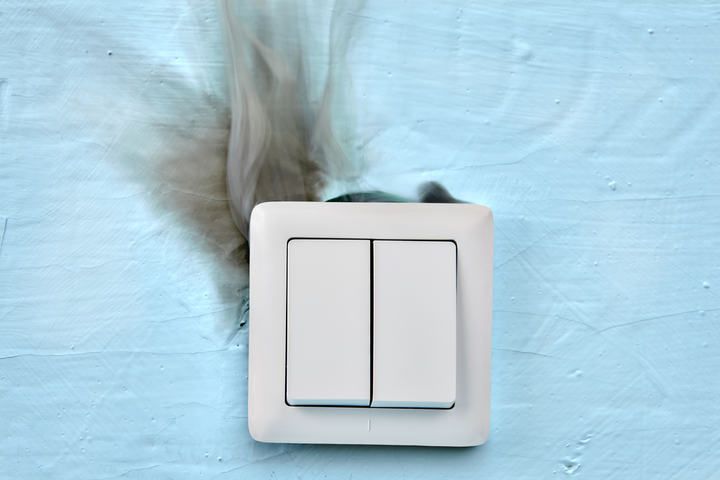
Risk At The Switch: Arcing
If a worn switch is left in a half-position, the contacts can hover just close enough to make a poor connection. The current becomes irregular and may even arc across the small gap between the contacts.
Arcing inside a switch can cause extreme heat and, in rare cases, set the switch on fire. Standard light switches are actually designed to prevent arcing entirely — the snap-action mechanism breaks the contact so quickly that an arc has no time to form. When a worn switch starts to arc, it has effectively failed and should be replaced.
Warning signs of an arcing switch: visible sparking around the toggle, a buzzing or crackling sound, a warm or discolored faceplate, or a faint burning smell. If you notice any of these, switch off the breaker for that circuit and replace the switch before using it again.
There's also a layer of protection at the panel: modern building codes (NEC) require AFCI (Arc Fault Circuit Interrupter) breakers in most living areas of new construction. AFCIs are specifically designed to detect this kind of arcing fault and cut power before a fire can start. If your home has older wiring without AFCI protection, that's worth knowing.
Even when a switch does fail, the damage tends to be contained — switches are installed inside metal or plastic boxes that shield the surrounding wall from a small internal fire.
Risk At The Bulb: Flickering
Intermittent current at the switch will also make the bulb flicker. Bulbs are designed to operate with a steady supply of power, and intermittent switching can stress the electronics — particularly LED drivers — and shorten the bulb's lifespan.
In extreme cases, a bulb running on intermittent current could overheat — but dramatic flickering will almost always alert you to the problem long before heat becomes dangerous.
How To Replace A Worn Switch
Standard toggle switches are inexpensive (a few dollars) and straightforward to swap if you're comfortable with basic electrical work. The essential safety step: turn off the breaker for that circuit at the panel before touching anything, and use a non-contact voltage tester to confirm the wires are dead before removing the old switch. If you're not confident working in an open electrical box, hire a licensed electrician — the labor on a single switch is minimal.
A Note On Dimmers And Multi-Way Switches
Not every wall switch behaves like a classic toggle. With a traditional rotary (knob) dimmer, the same snap-action principle applies to the on/off click — if that click ever feels loose or mushy, treat it as a wear sign. Modern paddle, slider, and smart dimmers (like Lutron Caseta or Leviton Decora) use rocker buttons, capacitive touch, or solid-state electronics, and don't have the same mechanical snap at all.
Three-way switches (the kind used in pairs to control one fixture from two locations) are still standard two-position toggles internally — the "three" refers to the three terminals on the back, not three positions. They wear out the same way, and the same advice applies.
Final Words
On a healthy switch, leaving the toggle "in the middle" is essentially impossible — the internal snap-action mechanism forces the contacts into one position or the other. On a worn switch, hovering between positions becomes possible, and that's when intermittent contact, arcing, and flicker can start to add up to a real safety issue.
If your switch has lost its satisfying snap, replace it. It's a cheap part, the install is quick, and you'd much rather change it on a calm Sunday than after the buzzing starts.