
Does A Blown Light Bulb Use Electricity?
A blown CFL can keep pulling around half its rated wattage — because the ballast stays live, still trying to strike a dead tube. That's also why a failed CFL can smolder.
 Eugen
EugenEugen Nikolajev
Creator of LED Lighting Info
Hi, I am Eugen. I was always one of those kids who had all sorts of weird lighting gadgets for every occasion.
Now, I want to share my knowledge and experience about lighting with you on LED Lighting Info.
Read my editorial standards
Key Takeaways
It depends on the bulb. Incandescent bulbs use no power once the filament breaks. LED bulbs may draw a trace current depending on how they failed. CFLs can keep drawing a meaningful fraction of their rated wattage. None of it adds up to much money, but the safety implications differ.
Here’s what I’ll cover:
- Why incandescent bulbs don’t draw power when blown
- Why LED bulbs may draw a trace current after failure
- Why blown CFLs can keep drawing significant power
- Whether it’s safer to leave a blown bulb in a socket or remove it
Do Blown Incandescents Use Electricity?
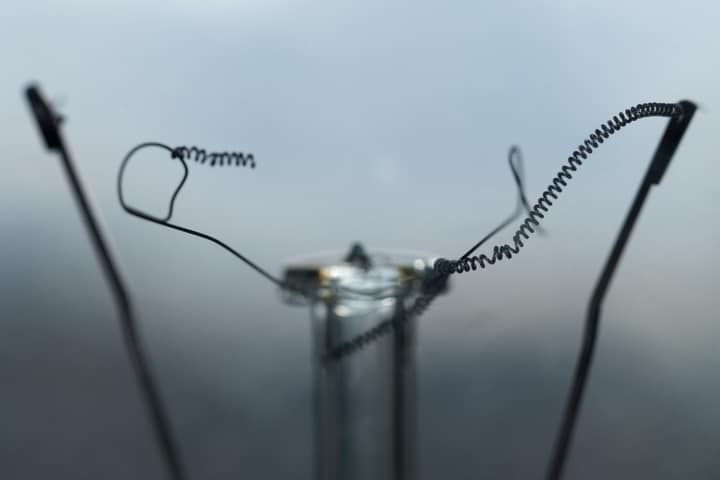
Incandescent bulbs use a tungsten filament that generates light when heated by electricity. When the bulb blows, the filament snaps — you can usually see the break if you look closely at the glass.
That snap breaks the circuit, like flipping a switch off. With nothing for current to flow through, the path has effectively infinite resistance (meaning electricity has no route to travel through). So even with the wall switch left on, the bulb draws nothing.
Incandescent bulbs are typically rated for around 1,000 hours, with longer-life types reaching 2,000+ — roughly one year of normal household use at about three hours a day (Bulbs.com). Across a typical household you’ll see a dead one fairly often, so it’s a relief that incandescents stop drawing power the moment they fail.
Can LED Bulbs Draw Electricity When Burned Out?
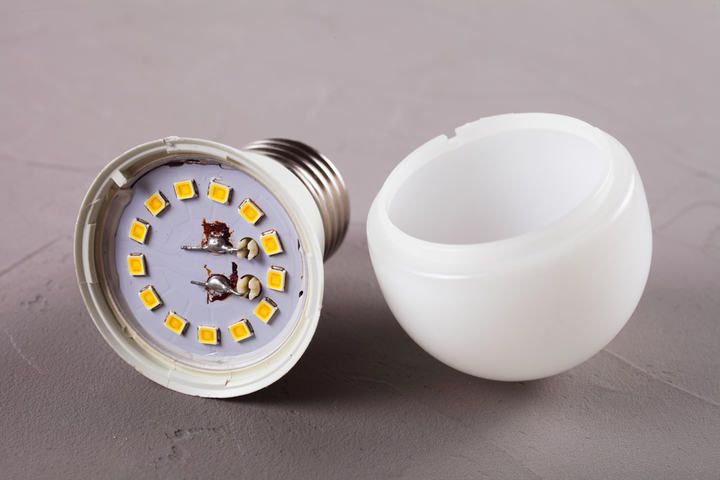
An LED bulb is a more sophisticated device than an incandescent. It has multiple parts, including a driver and one or more light-emitting diodes. The circuit isn’t physically broken when the light-emitting elements fail, so current can still reach the driver.
Whether a blown LED actually draws current depends on how it failed (LED professional). If the driver fails open — the most common pattern — consumption drops to effectively zero. If components partially fail (a shorted part, a leaky capacitor, or the driver remaining active while the diode array fails), a small leakage current can flow.
In the typical failure mode, only a tiny standby current passes through the driver — far less than the bulb’s working draw. The cost is genuinely negligible.
Take a 7.5W bulb at the U.S. residential average of about 17 cents per kWh (EIA, 2025). The arithmetic for a working bulb at full power:
Bulb wattage:       7.5 W
Convert to kW:      7.5 / 1,000 = 0.0075 kW
Cost per hour:      0.0075 × $0.17 ≈ $0.0013 (~0.13 cents)
Cost over 100 hrs:  ≈ $0.13 at full power
Blown LED draw:     Negligible — typically millionths of a cent
Even at full power, 100 hours of running this bulb costs about 13 cents. A blown bulb draws far less than full power, so the real cost is a tiny fraction of that — you’ll never notice it on a bill.
For context, LED bulbs are typically rated for 15,000–25,000 hours, with some premium products reaching up to 50,000 hours (ENERGY STAR Lamps V2.1) — vastly longer than an incandescent either way.
A Note On Smart LEDs
Wi-Fi and Bluetooth bulbs maintain a small standby draw to keep their radios alive. If the LED element fails but the smart electronics keep running, that standby continues — usually under a watt, but more than a plain LED’s failure-mode trace. If you have several smart bulbs in dead fixtures, that’s the one place this can quietly add up.
Do Burned Out Fluorescent Bulbs Still Use Electricity?
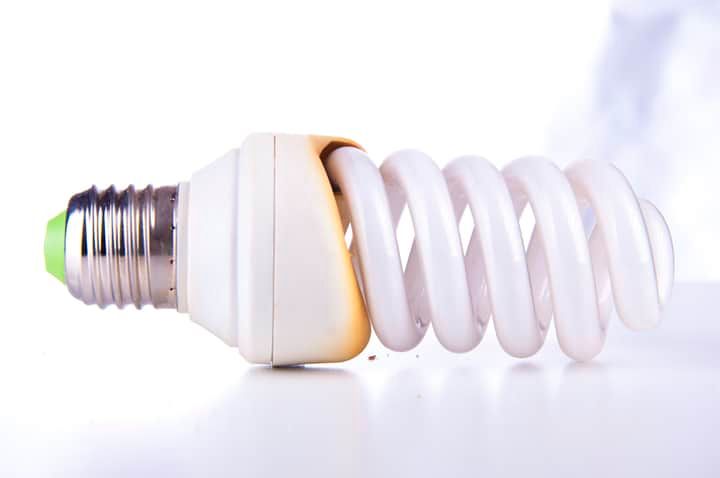
Compact fluorescent lamps (CFLs) sit between incandescents and LEDs — longer-lasting and more efficient than the former, but well behind the latter. They’re also the worst offenders when it comes to drawing power after failure.
Here’s why: a CFL is built around a gas-discharge tube driven by an electronic ballast inside the base. When the tube reaches end of life, the ballast often keeps right on operating — trying to strike the dead tube and dissipating energy in the process. The circuit through the bulb stays closed, so current keeps flowing.
How much current depends on the failure mode. In one published measurement, a failed 26W CFL still drew about 11W — roughly half its working draw (blog.MikeBourgeous, 2011). That’s an anecdote rather than a universal rule, but it shows blown CFLs can keep pulling a meaningful fraction of their rated wattage.
There’s a separate safety angle here. Failing CFL ballasts are known to give off burning odors and occasionally produce light smoke as the electronics overheat. If you smell something acrid or see haze around a CFL fixture, switch the circuit off at the breaker and replace the bulb before turning power back on.
The takeaway: replace a blown CFL promptly. The energy waste won’t hurt your wallet over a few days, but the smoldering-electronics risk is real.
| Bulb Type | Draws Power When Blown? | Approximate Draw | Risk Level |
|---|---|---|---|
| Incandescent | No | 0 W | None |
| LED | Trace only (depends on failure mode) | Less than 0.001 W typical | Negligible |
| Smart LED | Yes — Wi-Fi/Bluetooth radio standby | Under 1 W | Negligible |
| CFL | Yes — ballast keeps running | Up to ~50% of rated wattage | Low–Moderate (smolder risk) |
Should I Leave The Burned Bulb In A Socket?
If you don’t have a spare ready, leaving the blown bulb in place is generally the safest option. The empty socket is the riskier alternative.
Don’t remove a bulb and leave the socket empty — the exposed contacts are an electrocution hazard if anyone reaches in. Over time, accumulated dust, moisture, or insects on those contacts can also create a conductive path that arcs or shorts.
If you have to leave a socket empty, fit it with a non-conductive socket cap or cover. They cost almost nothing at hardware stores and act as a barrier against both accidental contact and debris.
I’ve written about this previously — for more on why a dead bulb is safer than an empty socket, check it out here.
Why Do Bulbs Burn Out Quickly?
If you’re replacing bulbs more often than the rated lifespan suggests, the bulb itself usually isn’t the problem. The most common causes:
- Enclosed fixtures. Heat builds up around the LED driver or CFL ballast and shortens lifespan dramatically. Use bulbs explicitly rated for enclosed fixtures.
- Incompatible dimmers. Older dimmers designed for incandescents can damage LED and CFL drivers. Pair LEDs with LED-rated dimmers.
- Voltage fluctuations. Spikes from the grid or aging wiring stress the driver. A multimeter reading well above 120V at the fixture is a warning sign.
- Bargain-bin bulbs. Cheap LEDs cut corners on driver components — the part most likely to fail first.
- Vibration. Ceiling fan kits and garage door openers shake fixtures enough to damage filaments and solder joints. Look for vibration-rated bulbs.
FAQ
Will a blown bulb left switched on noticeably raise my electric bill?
No. A blown incandescent uses zero power. A blown LED draws a tiny trace at most. A blown CFL is the worst case — and even there, you’d need to leave it powered for many hours to spend more than a few cents.
Are smart LED bulbs different when they fail?
A little. Smart bulbs keep their Wi-Fi or Bluetooth radio in standby, which usually pulls under a watt. If the LED element fails but the smart electronics keep running, that standby draw continues — small individually, but worth noting if you have several dead smart bulbs in fixtures.
Can a blown CFL actually catch fire?
An open flame is rare, but failing CFL ballasts can overheat, give off burning smells, and emit light smoke. If you notice either, kill power at the breaker and replace the bulb before restoring power.
Is it safe to leave a socket empty?
Not without a cover. The contacts inside an energized socket are an electrocution hazard, and over time dust or insects can bridge them and arc. If you don’t have a replacement bulb, either leave the dead one in or fit a plastic socket cap.
The Bottom Line
A blown bulb left switched on isn’t going to hurt your wallet — even a worst-case CFL is a tiny line item over a few days. The real reason to replace it promptly is safety, especially with CFLs that can smolder in the ballast.