Lighting Your Home Costs Almost Nothing Now. Unless You Live in Hawaii
I calculated what lighting a home costs in all 50 states. LED runs $9–31/year; incandescent $52–185. See your state and what you save
 Eugen
EugenEugen Nikolajev
Creator of LED Lighting Info
Hi, I am Eugen. I was always one of those kids who had all sorts of weird lighting gadgets for every occasion.
Now, I want to share my knowledge and experience about lighting with you on LED Lighting Info.
Read my editorial standards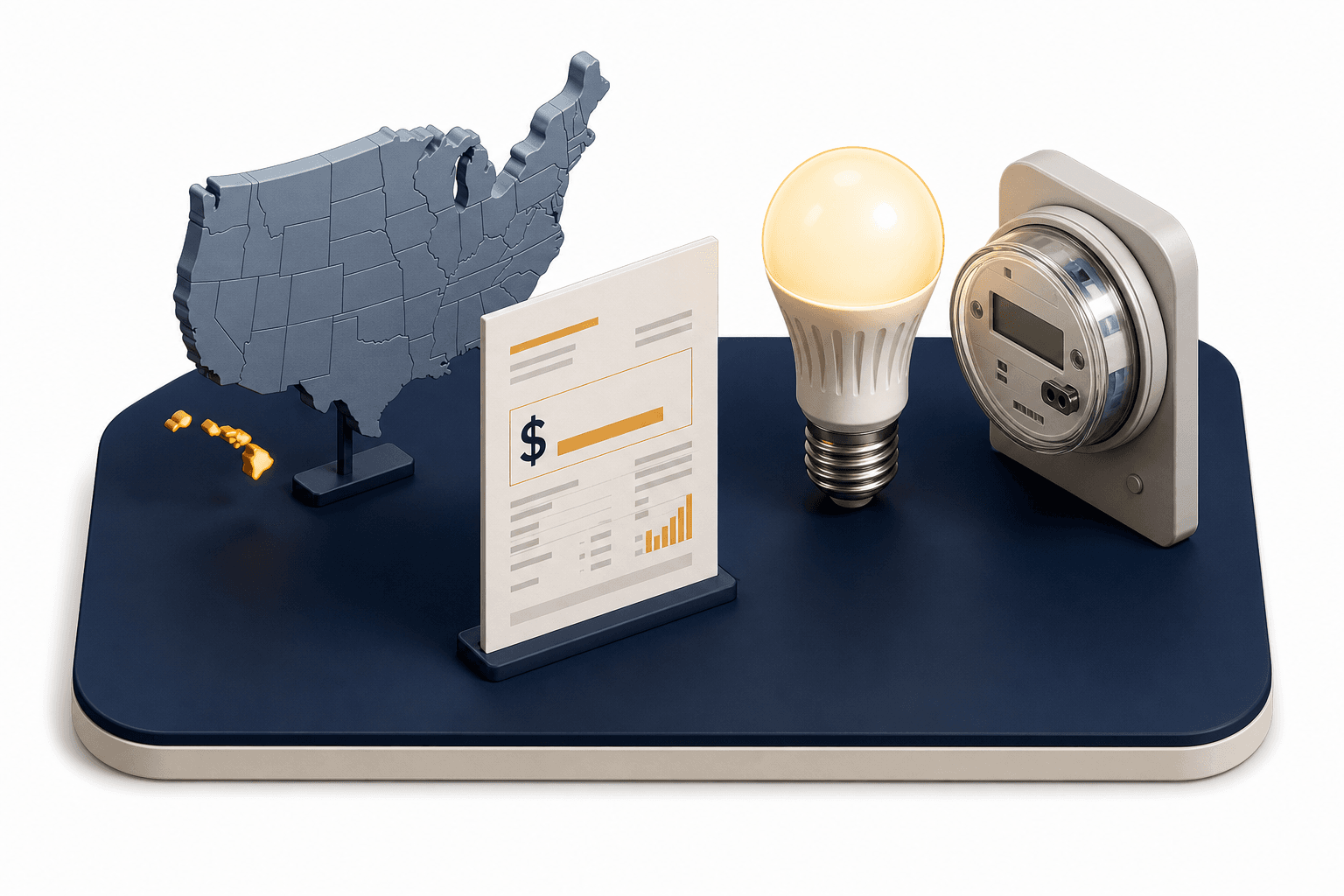
Here's something that surprises most people: lighting makes up only about 10% of the average American home's electricity use (EIA, 2015).
Not 20%, not 30% — ten.
And it's been falling, because the country has overwhelmingly switched to LEDs. As of 2024, 90% of US homes use LED bulbs, and 37% have gone fully LED (EIA, 2024), up from a tiny fraction a decade ago.
LEDs sip a fraction of the power the old incandescent bulbs did, so lighting quietly slipped from a major line on the electricity bill to a minor one.
But "10% of your bill" means something very different depending on where you live, because the price of that electricity isn't remotely the same across the country.
The same home, lit exactly the same way, costs about 3.5 times more to run in Hawaii than in North Dakota. Same bulbs, same hours, same habits and the only thing that changes is the rate your utility charges.
So I pulled the latest residential electricity prices for all 50 states (plus DC) straight from the U.S. Energy Information Administration and worked out what lighting actually costs, state by state.
I kept seeing 'LEDs save you money' repeated everywhere with no actual numbers behind it, so I pulled the real data and worked it out. Here's what I found.
Electricity rates by state: the raw numbers
This is the foundation everything else is built on — the average residential price per kilowatt-hour in each state, lowest to highest, with no assumptions baked in. It's straight from the EIA.
View data
| State | Cents per kWh |
|---|---|
| North Dakota | 11.95 |
| Idaho | 13.01 |
| Nebraska | 13.1 |
| Utah | 13.17 |
| Iowa | 13.42 |
| Missouri | 13.44 |
| Montana | 13.48 |
| Oklahoma | 13.56 |
| Wyoming | 13.59 |
| Arkansas | 13.63 |
| Louisiana | 14.16 |
| Nevada | 14.17 |
| South Dakota | 14.29 |
| Washington | 14.4 |
| New Mexico | 14.81 |
| Florida | 14.86 |
| Kentucky | 14.88 |
| Oregon | 14.89 |
| Georgia | 15.01 |
| Minnesota | 15.08 |
| Tennessee | 15.08 |
| Kansas | 15.34 |
| Arizona | 15.59 |
| North Carolina | 16 |
| Mississippi | 16.3 |
| West Virginia | 16.37 |
| Texas | 16.39 |
| South Carolina | 16.45 |
| Colorado | 16.74 |
| Virginia | 17.05 |
| Alabama | 17.15 |
| Delaware | 17.64 |
| Indiana | 17.85 |
| Ohio | 18.78 |
| Wisconsin | 18.8 |
| Illinois | 18.86 |
| Pennsylvania | 20.92 |
| Michigan | 21.2 |
| Maryland | 22.2 |
| New Jersey | 23.49 |
| Vermont | 24.11 |
| District of Columbia | 25 |
| New Hampshire | 26.92 |
| Alaska | 27.17 |
| Maine | 28.32 |
| New York | 28.55 |
| Rhode Island | 29.91 |
| Massachusetts | 30.21 |
| Connecticut | 30.47 |
| California | 33.35 |
| Hawaii | 42.23 |
| North Dakota | 11.95 | 11.11 | +7.6% | $8.72 | $52.34 | $43.62 |
| Idaho | 13.01 | 11.57 | +12.4% | $9.50 | $56.98 | $47.49 |
| Nebraska | 13.10 | 11.71 | +11.9% | $9.56 | $57.38 | $47.81 |
| Utah | 13.17 | 12.39 | +6.3% | $9.61 | $57.68 | $48.07 |
| Iowa | 13.42 | 12.48 | +7.5% | $9.80 | $58.78 | $48.98 |
| Missouri | 13.44 | 12.01 | +11.9% | $9.81 | $58.87 | $49.06 |
| Montana | 13.48 | 11.93 | +13.0% | $9.84 | $59.04 | $49.20 |
| Oklahoma | 13.56 | 12.37 | +9.6% | $9.90 | $59.39 | $49.49 |
| Wyoming | 13.59 | 12.41 | +9.5% | $9.92 | $59.52 | $49.60 |
| Arkansas | 13.63 | 12.59 | +8.3% | $9.95 | $59.70 | $49.75 |
| Louisiana | 14.16 | 13.06 | +8.4% | $10.34 | $62.02 | $51.68 |
| Nevada | 14.17 | 14.43 | -1.8% | $10.34 | $62.06 | $51.72 |
| South Dakota | 14.29 | 12.75 | +12.1% | $10.43 | $62.59 | $52.16 |
| Washington | 14.40 | 12.62 | +14.1% | $10.51 | $63.07 | $52.56 |
| New Mexico | 14.81 | 14.78 | +0.2% | $10.81 | $64.87 | $54.06 |
| Florida | 14.86 | 15.08 | -1.5% | $10.85 | $65.09 | $54.24 |
| Kentucky | 14.88 | 13.20 | +12.7% | $10.86 | $65.17 | $54.31 |
| Oregon | 14.89 | 15.16 | -1.8% | $10.87 | $65.22 | $54.35 |
| Georgia | 15.01 | 14.69 | +2.2% | $10.96 | $65.74 | $54.79 |
| Minnesota | 15.08 | 15.10 | -0.1% | $11.01 | $66.05 | $55.04 |
| Tennessee | 15.08 | 13.37 | +12.8% | $11.01 | $66.05 | $55.04 |
| Kansas | 15.34 | 14.34 | +7.0% | $11.20 | $67.19 | $55.99 |
| Arizona | 15.59 | 15.14 | +3.0% | $11.38 | $68.28 | $56.90 |
| North Carolina | 16.00 | 14.80 | +8.1% | $11.68 | $70.08 | $58.40 |
| Mississippi | 16.30 | 14.64 | +11.3% | $11.90 | $71.39 | $59.50 |
| West Virginia | 16.37 | 15.89 | +3.0% | $11.95 | $71.70 | $59.75 |
| Texas | 16.39 | 15.28 | +7.3% | $11.96 | $71.79 | $59.82 |
| South Carolina | 16.45 | 15.27 | +7.7% | $12.01 | $72.05 | $60.04 |
| Colorado | 16.74 | 15.04 | +11.3% | $12.22 | $73.32 | $61.10 |
| Virginia | 17.05 | 14.89 | +14.5% | $12.45 | $74.68 | $62.23 |
| Alabama | 17.15 | 16.56 | +3.6% | $12.52 | $75.12 | $62.60 |
| Delaware | 17.64 | 16.71 | +5.6% | $12.88 | $77.26 | $64.39 |
| Indiana | 17.85 | 16.40 | +8.8% | $13.03 | $78.18 | $65.15 |
| Ohio | 18.78 | 16.10 | +16.6% | $13.71 | $82.26 | $68.55 |
| Wisconsin | 18.80 | 17.75 | +5.9% | $13.72 | $82.34 | $68.62 |
| Illinois | 18.86 | 17.55 | +7.5% | $13.77 | $82.61 | $68.84 |
| Pennsylvania | 20.92 | 18.42 | +13.6% | $15.27 | $91.63 | $76.36 |
| Michigan | 21.20 | 19.35 | +9.6% | $15.48 | $92.86 | $77.38 |
| Maryland | 22.20 | 18.94 | +17.2% | $16.21 | $97.24 | $81.03 |
| New Jersey | 23.49 | 19.87 | +18.2% | $17.15 | $102.89 | $85.74 |
| Vermont | 24.11 | 22.38 | +7.7% | $17.60 | $105.60 | $88.00 |
| District of Columbia | 25.00 | 20.40 | +22.5% | $18.25 | $109.50 | $91.25 |
| New Hampshire | 26.92 | 22.81 | +18.0% | $19.65 | $117.91 | $98.26 |
| Alaska | 27.17 | 25.79 | +5.4% | $19.83 | $119.00 | $99.17 |
| Maine | 28.32 | 28.27 | +0.2% | $20.67 | $124.04 | $103.37 |
| New York | 28.55 | 25.45 | +12.2% | $20.84 | $125.05 | $104.21 |
| Rhode Island | 29.91 | 32.30 | -7.4% | $21.83 | $131.01 | $109.17 |
| Massachusetts | 30.21 | 30.18 | +0.1% | $22.05 | $132.32 | $110.27 |
| Connecticut | 30.47 | 32.50 | -6.2% | $22.24 | $133.46 | $111.22 |
| California | 33.35 | 32.48 | +2.7% | $24.35 | $146.07 | $121.73 |
| Hawaii | 42.23 | 41.11 | +2.7% | $30.83 | $184.97 | $154.14 |
State By State Calculator
Use the calculator below to plug in your own light bulb numbers for more precise figure
So what does that actually cost you?
A rate per kilowatt-hour is an abstract thing. So, here's something more concrete.
Let's take a typical home.
The place that runs four or five bulbs for a good chunk of the evening, the ones in the kitchen, the living room, wherever people actually spend their time. With modern LEDs, lighting those rooms costs somewhere between $9 and $31 a year, depending on which state you're in.
That's it.
Now run the same home on the 60-watt incandescent bulbs those LEDs replaced. Suddenly it's $52 to $185 a year for the exact same light. That gap between roughly $9 and $52 in the cheapest state, and between $31 and $185 in the most expensive is the switch to LED light.
It's why lighting quietly fell from a noticeable line on the power bill to a rounding error.
Most American homes have already made that switch and pocketed the difference, often without ever noticing how much it was.
Here's the part that the state-by-state data makes obvious.
The switch to LEDs paid off most exactly where electricity costs the most. In North Dakota, switching to LED saves a typical home around $44 a year. In Hawaii, where every kilowatt-hour costs three and a half times as much, the same switch saves about $154 a year for lighting alone, on the same setup.
Every unit of power you don't burn is worth more when power is expensive, so the high-rate states get the biggest reward for switching.
How I calculated this
Lighting cost isn't something you can look up directly, it has to be estimated.
So here's exactly how I built these numbers, and where every figure comes from.
The per-state rates come straight from the US Energy Information Administration's residential price data. The lighting load is modeled from EIA survey data.
To turn a rate into a dollar figure, you need to know how much lighting a typical home actually runs. For that I used EIA's most recent Residential Energy Consumption Survey (RECS, 2024), which asks how many bulbs each household runs for four or more hours a day.
The answer is lower than most people expect.
The largest group of US homes runs just 3 to 5 bulbs that heavily, and only about 3% run twenty or more. So rather than assume every socket in the house blazes all day, I modeled a typical home as running 4 bulbs for 5 hours a day, which gives the realistic heavy-use core.
The math is simple:
bulbs × watts × hours × 365 days ÷ 1,000 × your state's price per kWh
The comparison is LED versus the bulbs they replaced. I ran that same usage two ways: modern 10-watt LEDs against the 60-watt incandescent bulbs that used to do the same job. That's where the savings figure comes from — same light, same hours, different bulb.
It works out to about 73 kWh a year for the LED setup and 438 kWh for incandescent.
A few limits:
- These figures cover the heavy-use bulbs — the ones on for hours every day. Homes run plenty of other bulbs briefly too; I don't count those, which means the numbers are conservative. Your real total savings are likely a bit higher, not lower.
- This is indoor household lighting only. Outdoor, landscape, and security lighting sit on top and vary far too much between homes to model honestly.
- The incandescent column is a what-if, not a claim that you're still paying it. Most US homes have already switched to LED so it's the bill you've avoided, shown here so you can see what the switch was worth.
- Real homes vary enormously. These are typical-case estimates, not your exact bill — which is exactly what the calculator below the table is for.
Every number in this article traces back to an EIA source, and where I've made an assumption, you can see it and change it.
Why your state's rate is what it is
The 3.5× gap between the cheapest and most expensive states comes down to how each state makes its electricity and how far that power has to travel.
The cheapest states make more power than they need, from sources that cost little to run.
Take North Dakota, Nebraska, Iowa, Oklahoma, and Wyoming, they all produce more electricity than they consume and export the surplus which keeps local prices low.
The other big factor is cheap generation: hydroelectric power has essentially zero fuel cost once the dams are built, which is why the Pacific Northwest, Nebraska, and the Dakotas enjoy some of the lowest rates in the country.
Idaho's low rate, for instance, comes largely from hydroelectric power on the Columbia and Snake River systems. Add abundant wind and coal and low population density, and you get rates in the low teens.
The expensive states are expensive for the opposite reasons.
Hawaii is the extreme case: it relies on imported petroleum for most of its power generation, and its island geography means no access to mainland natural gas pipelines. Everything has to be shipped in, and that cost lands on the bill. California's rate is driven by renewable mandates, wildfire infrastructure costs, and high demand — recent grid-hardening spending after years of wildfire risk has pushed rates up sharply.
New England is expensive across the board. High population density, harsh winters, and not enough in-state generation mean the region leans on imported energy. Six of the ten most expensive states are in New England.
There's also the direction things are moving. US electricity prices rose about 7.4% year-over-year as of early 2026, and some of the steepest jumps hit states that were cheap to begin with: District of Columbia (+22.5%), New Jersey (+18.2%), and New Hampshire (+18.0%) saw the biggest increases.
Which is the quiet case for efficient lighting that runs underneath this whole piece: the price of a kilowatt-hour is creeping up almost everywhere, so the value of the ones you don't use keeps rising too.
If you're still running old incandescents anywhere in the house, that table is the bill you're paying to avoid a five-minute swap.
Related articles
Do LED Strip Lights Cost a Lot of Electricity? 2026 Calculation
A standard 5-meter LED strip running 10 hours a day costs about $4 for the entire year — less than most households spend on a single incandescent bulb.
How Much Do LED Lights Save On Energy Bills? Interactive Calculator
A 40-bulb home in Idaho saves around $5,600 over a single LED lifespan — and that's at one of the country's lowest electricity rates.
Do Motion Sensor Lights Save Electricity?
Paired with LEDs, a motion sensor can take 16–27 years to break even on electricity costs alone — making it a convenience upgrade that happens to trim your bill, not the other way around.