How Much Do LED Lights Save On Energy Bills? Interactive Calculator
A 40-bulb home in Idaho saves around $5,600 over a single LED lifespan — and that's at one of the country's lowest electricity rates.
 Eugen
EugenEugen Nikolajev
Creator of LED Lighting Info
Hi, I am Eugen. I was always one of those kids who had all sorts of weird lighting gadgets for every occasion.
Now, I want to share my knowledge and experience about lighting with you on LED Lighting Info.
Read my editorial standards
Key Takeaways
Switching a typical home of 40 sockets from incandescent to LED can save roughly $600–$900 a year on electricity, and the upfront bulb cost is usually paid back within a couple of months. LEDs are rated for 15,000–25,000 hours, while a standard incandescent lasted around 1,000 hours.
If you want to save hundreds of dollars every year, keep reading.
I'm going to walk you through how much you can save on your energy bill by swapping the incandescent or halogen lights in your home for LEDs.
In this guide, you'll learn about:
- The upfront cost of LED vs. incandescent — and why it can be misleading
- How much energy LED bulbs actually use
- Monthly and yearly savings, with worked examples and an interactive calculator
- Additional considerations: replacement costs, heat output, and dimmer compatibility
Note: Standard incandescent A-type bulbs have been banned from new sale in the U.S. since August 2023 under DOE efficiency rules, and most halogens fall under similar restrictions. The comparison below is most relevant if you still have incandescents or halogens at home, or if you're comparing against older CFLs.
LED Light Bulbs Upfront Cost Comparison
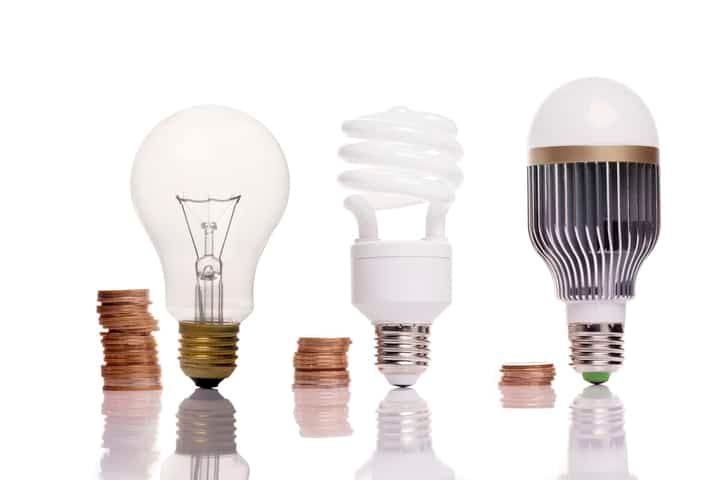
Walk down the lighting aisle and you'll spot the price gap right away. LED bulbs still cost more upfront than incandescents did — but the comparison is misleading until you factor in lifespan.
Historically, a 60W incandescent retailed for around $1 (incandescents are no longer sold new in the U.S. as of August 2023). A 9–10W LED that produces the same light output now costs around $2–$4 each in multipacks at major retailers, and as low as $1 for budget brands.
Now factor in lifespan. A typical 60W incandescent is rated at 1,000 hours. A standard A19 LED is rated at 15,000–25,000 hours (L70 — the point at which output drops to 70% of original). To match a single 20,000-hour LED, you'd need around 20 incandescent bulbs.
So on bulbs alone, 20,000 hours of light costs around $20 with incandescents, versus about $3 with a single LED.
If you run a light from 8 p.m. to 5 a.m. — about 9 hours a day — a 20,000-hour LED will last roughly 6 years. A 1,000-hour incandescent would need replacing roughly every 3–4 months at that usage level.
Side-by-side bulb cost for 20,000 hours of service:
- LED bulbs: ~$3
- Incandescent bulbs: ~$20
Incandescent vs. LED Bulbs Energy Costs
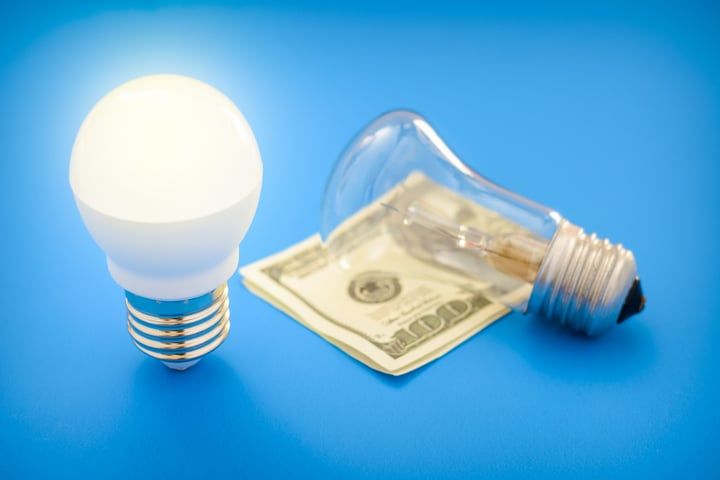
Next, the cost of running these bulbs.
The energy a bulb uses is its wattage (converted to kilowatts) multiplied by the hours it runs. That gives you kilowatt-hours (kWh) — the unit your utility bills you on.
Total Energy Cost = electricity rate ($/kWh) × kWh used
Electricity rates vary widely by region. A few examples (rates fluctuate; check your most recent utility bill for current pricing):
- Idaho, US: ~$0.12/kWh
- New York, US: ~$0.24/kWh
- U.S. average: ~$0.18/kWh
- London, UK: ~£0.25/kWh (~$0.31)
- Singapore: ~SGD 0.27/kWh (~$0.20)
- Solomon Islands: ~$1.00/kWh
A search online or a quick look at your utility bill will tell you what you're paying per kWh. Once you know the number, the rest is arithmetic.
Let's use Idaho's $0.12/kWh as the example, with a single bulb running 9 hours a day, 7 days a week. (9 hrs/day is on the high end and fits porch or security lighting; the typical residential bulb runs closer to 2–3 hours/day.)
Incandescent (60W = 0.06 kW):
0.06 kW × 9 hrs × 365 days × $0.12/kWh = $23.65/year per bulb
| Monthly (270 hrs) | Yearly (3,285 hrs) | 20,000 hrs (~6 years) |
|---|---|---|
| $1.94 | $23.65 | $144.00 |
Now the LED. Same location, same usage, 10W bulb. (Many LEDs deliver the same light output at 8W, which would push savings even higher.)
LED (10W = 0.01 kW):
0.01 kW × 9 hrs × 365 days × $0.12/kWh = $3.94/year per bulb
| Monthly (270 hrs) | Yearly (3,285 hrs) | 20,000 hrs (~6 years) |
|---|---|---|
| $0.32 | $3.94 | $24.00 |
Yearly savings per bulb: $23.65 − $3.94 = $19.71
LED technology is dramatically more efficient — but the per-bulb numbers undersell the picture. There's more to factor in once you scale to a whole house.
How Much Does Switching to LED Save? Interactive Calculator
Saving a couple of dollars a month on one bulb doesn't sound like much. The headline savings come from doing this across the whole house.
The average U.S. home has 40+ light sockets according to Energy Star, though smaller homes and apartments may have closer to 20–30. Use the calculator above to enter your actual count.
Multiplied by 40 bulbs in Idaho:
- Incandescent monthly cost: $78.84
- LED monthly cost: $13.14
- Total savings per month: $65.70
- Total savings per year: $788.40
That's roughly $66 a month you can redirect toward household expenses, savings, or anything else.
Use the calculator above to estimate your specific savings: enter your electricity rate, average hours of use, and the number of bulbs you want to swap.
The same calculator works for CFL-to-LED swaps. Switch the "Old Bulb Wattage" field to your CFL wattage (typically 13–15W to replace a 60W incandescent). CFLs are already much more efficient than incandescents, so the per-watt savings versus CFL are smaller — though LEDs still win on lifespan, dimming, and instant-on. See replacing CFL light bulbs with LED for a deeper comparison.
Additional Considerations
The numbers above cover electricity only. A few extra factors push the balance even further toward LED.
Replacement cost
At 9 hrs/day, a 1,000-hour incandescent needs replacing about 3.3 times per year. Across 40 bulbs at $1 each, that's another ~$131/year in bulb costs — on top of electricity. A 20,000-hour LED effectively never needs replacing during this window.
Here's the full picture for a 40-bulb home in Idaho at $0.12/kWh, running lights 9 hrs/day:
| Cost Category | Incandescent (40 bulbs) | LED (40 bulbs) |
|---|---|---|
| Annual electricity | $946.08 | $157.68 |
| Annual replacements | $131.40 | ~$0 |
| Total annual cost | $1,077.48 | $157.68 |
| Annual savings | — | $919.80 |
Upfront cost of 40 LED bulbs at $3 each: $120. Even using only the electricity savings, you break even in less than 2 months. Over a 20,000-hour LED lifespan (about 6 years at 9 hrs/day), the total saved comes out to roughly $5,600 for a 40-bulb home.
Cooling load bonus
Incandescent bulbs convert about 90% of their energy into heat. In an air-conditioned home, every watt of lighting you save also slightly reduces the AC load — a small but real secondary saving in summer. Conversely, in a heating-dominated climate, you'll lose a tiny bit of "free" heat from bulbs in winter, but the trade is still strongly in LED's favor.
Dimmer and smart-fixture compatibility
Not all LEDs are dimmable, and not all dimmable LEDs work with every dimmer. Check the package before buying if your fixture uses a dimmer or a smart switch — incompatible pairings can cause flicker, buzzing, or shortened bulb life.
Environmental angle
Beyond the bill, the EPA estimates that swapping a single incandescent bulb for an LED prevents roughly 1,400 lbs of CO₂ emissions over the LED's lifetime. Multiply that by 40 sockets and the impact adds up quickly.
Final Words
Switching to LED is one of the few home upgrades where the math is unambiguous: LEDs cost a few dollars upfront, last for years, draw a fraction of the electricity, and pay back the upfront cost within months at most homes' usage levels.
Use the calculator above to see your exact savings based on your home's bulb count, electricity rate, and usage hours.