Do LED Strip Lights Cost a Lot of Electricity? 2026 Calculation
A standard 5-meter LED strip running 10 hours a day costs about $4 for the entire year — less than most households spend on a single incandescent bulb.
 Eugen
EugenEugen Nikolajev
Creator of LED Lighting Info
Hi, I am Eugen. I was always one of those kids who had all sorts of weird lighting gadgets for every occasion.
Now, I want to share my knowledge and experience about lighting with you on LED Lighting Info.
Read my editorial standards
Key Takeaways
LED strip lights don't cost a lot of electricity compared to traditional incandescent lights. Consumption is directly determined by the length of the strip light and its light density. A standard 5-meter strip costs about $4 a year to run, on average.
If you've installed LED strip lighting — or you're thinking about it — the natural next question is what it'll add to your electricity bill.
Some people use strip lights during the festive season — wrapping a Christmas tree or outlining a roofline.
Others use strip lights to give a modern feel to their homes by placing them along the cornice, tracing over the vertical portion of the steps on a staircase, or backlighting drawers.
But do strip lights use a lot of power?
In this guide, we'll take a look at:
- How much electricity your LED lighting strips are using
- The cost to run your LED strip lighting
- How you can work out the consumption of the LED light strips
How Much Electricity Do LED Light Strips Use?
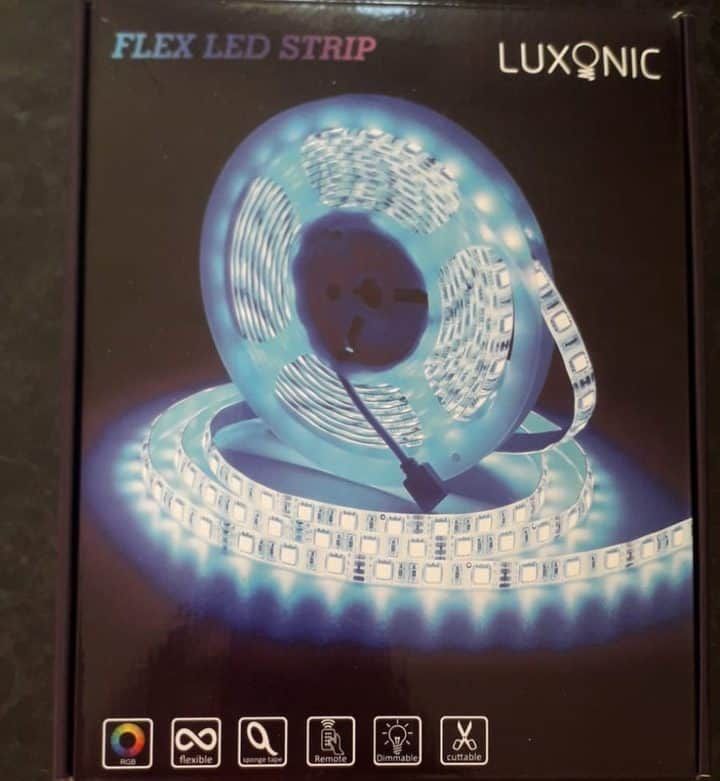
LED strip lights have low power consumption, but the exact amount of electricity they use depends on the length of the strip, how many diodes are packed on it, and the type of diode. A low-density strip can draw as little as 1.3 W/m (about 6.5 W for a 5-meter run), while a mainstream 60-LED/m strip typically runs 4.8–14.4 W/m, and high-output or COB strips can exceed 15 W/m.
The two main things you need to consider are the power consumption of the strip and the length.
Consumption is measured in watts per meter, and a few factors affect it.
Light Density
Firstly, the density of the lights. A standard density LED strip light will typically have 30 light emitting diodes every meter. A high density will likely be 60 or 120 diodes in the same length, although some go even higher.
Diode Size
Then there's the size of the diodes. These are normally given as a four-digit number that describes the width and height of the diode in tenths of a millimeter. So a 3528 diode measures 3.5 mm × 2.8 mm, while a 5050 diode measures 5.0 mm × 5.0 mm.
The smaller 3528 diodes tend to draw less power than a 5050 chip, but they also produce less light output. So a high-density 3528 strip might have a higher power draw than a standard density 5050 strip.
Measurement Standards
Power consumption should be advertised on the box or product page when you buy your strips – look for W/m (watts per meter) or, on U.S. packaging, W/ft (watts per foot). We'll stick with metric for the rest of this guide, but the same math applies either way.
Length matters too. Because power is measured per meter, a longer strip draws more total watts: a 1.3 W/m strip uses 6.5 W for a 5-meter run, but 13 W for a 10-meter run.
You'll also see brightness given in lumens per meter. A good quality strip typically provides between 800 and 1,500 lumens per meter, depending on LED density and chip type. Higher-output or COB strips can exceed this range.
While lower lumens per meter generally indicates lower power draw, this isn't guaranteed — more efficient diodes can deliver higher brightness at the same or lower wattage.
Voltage: 12V vs 24V
Almost all LED strips run on low-voltage DC — either 12V or 24V — stepped down from mains power by a driver or transformer. The voltage itself doesn't change how much energy the strip uses (watts are watts), but it does determine which power supply you can pair with the strip. Putting a 12V strip on a 24V supply will instantly destroy the LEDs; the reverse just leaves the strip dim or unlit. Always check the label before buying a PSU.
RGB and RGBW Strips
RGB and RGBW strips contain multiple color channels in each package, so their peak power draw — with every channel at full brightness producing white — is higher than a single-color strip of the same density. Running them in a single color, or at lower brightness, draws less. When sizing a PSU for an RGB strip, always use the rated maximum wattage, not the average.
Do Connected Strip Lights Use More Electricity?
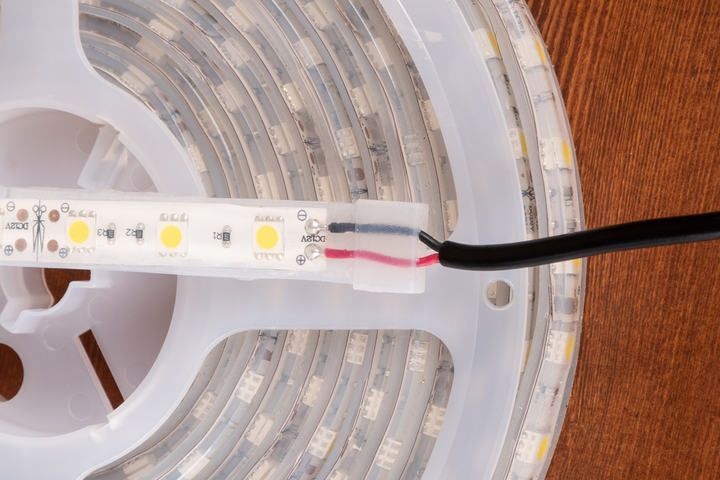
If you connect more strip lights to a circuit, total electricity use goes up — power is measured per meter, so the more meters you add, the more watts you draw.
When connecting multiple strips to a single power supply, wire them in parallel — each strip should run back to the PSU's + and − terminals rather than being daisy-chained end-to-end. A long end-to-end (series) connection causes voltage drop, so LEDs dim toward the far end, and the strip's copper traces can overheat if too much current flows through them.
Two more rules when combining strips on one PSU:
- Keep the combined wattage of all strips below 80% of the supply's rated capacity. Running a PSU at or above its limit causes flickering, overheating, and premature failure.
- Match voltages exactly. 12V strips need a 12V supply; 24V strips need a 24V supply. A 12V strip on a 24V supply will burn out instantly; a 24V strip on a 12V supply will simply run dim or not at all.
You can read more about connecting LED strip lights in my other article.
LED Bulb vs Strip Lights vs Incandescent Bulbs: Which Is Most Efficient?
A 5-meter LED strip typically draws in the same ballpark as a single LED bulb — and far less than a traditional incandescent. Here's a quick comparison:
| Type | Typical wattage | Relative cost to run |
|---|---|---|
| Incandescent bulb | Up to 100 W | High |
| LED bulb | 4–15 W (40W–100W equivalent) | Low |
| LED strip (5 m, standard density) | ~6.5 W | Low |
| LED strip (5 m, high density) | ~24–72 W | Low to moderate |
Either LED option will cut your energy bill compared to incandescent or even fluorescent lighting. Between an LED bulb and a standard LED strip, consumption is similar — pick based on the look you want, not efficiency.
Do LED Strip Lights Make Your Electricity Bill High?
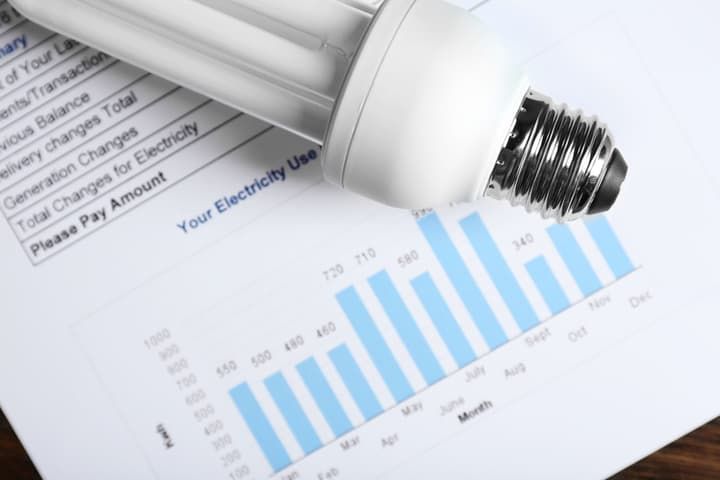
LED strip lights won't make your electricity bill high. You can leave them on for long hours without incurring big charges – even a high-density strip measuring 15 meters uses less than 1 cent per hour.
Let's use a few examples to show the costs in real terms.
For these tables, we're using the current U.S. residential average of about 17.5 cents per kilowatt-hour (kWh), per the U.S. Energy Information Administration. If your local rate is different, plug it into the same formula to get an updated number.
A kilowatt-hour is the amount of energy used by a 1,000-watt load running for an hour. To convert watts to kWh, multiply by the number of hours and divide by 1,000.
We're using 1.3 W/m as a standard-density strip and 3 W/m as a high-density strip. Some strips (COB, high-output) can draw considerably more — check your label.
| Length | Standard density (1.3 W/m) | High density (3 W/m) |
|---|---|---|
| 5 meters | 0.11 cents per hour | 0.26 cents per hour |
| 10 meters | 0.23 cents per hour | 0.53 cents per hour |
| 15 meters | 0.34 cents per hour | 0.79 cents per hour |
To be clear – those are fractions of a cent, not whole cents. A standard-density 5 m strip costs about a tenth of a cent per hour, not 10 cents.
So, even running a high-density 15-meter strip for an hour still costs less than a cent.
Here's how that extrapolates over a whole year, assuming 10 hours of use per day:
| Length | Standard density (1.3 W/m) | High density (3 W/m) |
|---|---|---|
| 5 meters | $4.15 per year | $9.58 per year |
| 10 meters | $8.30 per year | $19.16 per year |
| 15 meters | $12.46 per year | $28.74 per year |
Buy a shorter, standard-density strip and you're paying about $4 for an entire year of regular use. Even a much longer, higher-density strip comes in under $30 a year — under $3 a month.
Of course, add an LED strip to every single room – illuminating kitchen cabinets, false ceilings, coving, and more – and those costs add up.
But does a single LED strip light have high energy usage? Clearly not — they're among the most energy-efficient lighting you can install.
Do Dimmers and Smart Controllers Cut Consumption?
Yes — running a strip at reduced brightness lowers its draw roughly in proportion. Most LED strip controllers (including the PWM dimmers inside Alexa- or Google-connected controllers) rapidly pulse power on and off; a strip set to 50% brightness is drawing something close to 50% of its rated wattage. The controller itself does add a small standby draw of its own (typically under 1 W), but this is negligible compared to savings from dimming.
How To Calculate LED Strip Power Consumption
To work out how much a strip will cost to run, follow these four steps:
- Find the strip's power rating in watts per meter (W/m), listed on the label or product page.
- Multiply by the length to get total watts: W/m × length (m) = total W.
- Convert to kilowatt-hours for the time you plan to run it: (total W × hours ÷ 1,000) = kWh.
- Multiply by your electricity rate to get cost.
Combined into a single annual formula:
Annual Cost ($) = (W/m × Length × Hours/day × 365) ÷ 1000 × Rate ($/kWh)Worked example: a 10-meter strip drawing 24 W total has a power consumption of 2.4 W/m. The reverse works too — a 2.4 W/m strip that's 15 meters long draws 36 W. That total wattage is what you need when sizing a power supply.
When the Label Shows kWh Instead of Watts
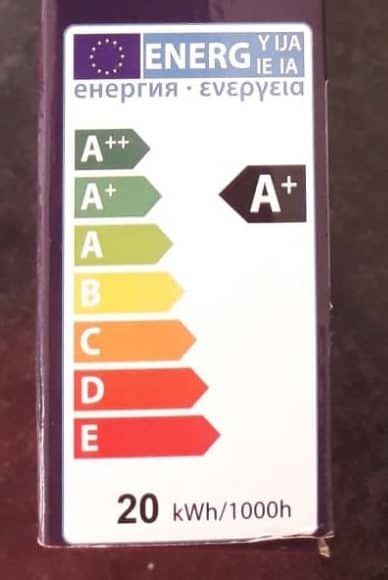
Some strip lights don't list wattage directly — they show energy consumption over a period instead. Here's an example from a strip I bought:
The label states consumption of 20 kWh per 1,000 hours. Dividing energy by time gives average power: 20 kWh ÷ 1,000 h = 20 W for the whole strip. Not too bad.
Sizing the Power Supply
When picking a power supply, it's fine — and recommended — to buy one rated for more than the strip actually needs.
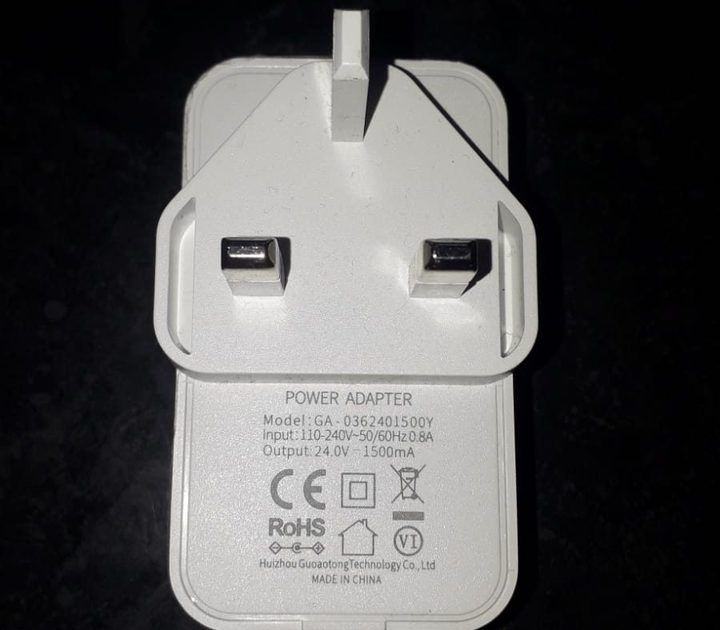
In my case, the bundled supply is 36 W. The label doesn't state wattage directly, but it gives the output voltage (24 V) and current (1,500 mA, or 1.5 A). Wattage is the product of the two:
W = V × A
36 W = 24 V × 1.5 A
I recommend keeping the strip's load below 80% of the supply's rating — a 20% headroom buffer above the strip's actual draw. For a 20 W strip, that means a supply rated at 25 W or more, so a 36 W supply is well within spec.
Never use a supply rated below the strip's consumption (e.g., a 12 W PSU driving a 20 W strip). It will overheat, and in some cases fail outright.
Final Words
A standard 5-meter strip runs for about $4 a year at 10 hours of daily use — less than many households spend on a single incandescent bulb. LED strips are among the cheapest lighting you can install and run.
Next, decide how long an LED strip you need for your room — length is the biggest driver of total wattage, and getting it right makes PSU selection straightforward.