
How To Hang Curtain Lights?
After three minutes, an LED bulb sits at around 91°F — compared to 428°F for an old incandescent. That gap is why draping curtain lights against fabric is far safer than it looks.
 Eugen
EugenEugen Nikolajev
Creator of LED Lighting Info
Hi, I am Eugen. I was always one of those kids who had all sorts of weird lighting gadgets for every occasion.
Now, I want to share my knowledge and experience about lighting with you on LED Lighting Info.
Read my editorial standards
Key Takeaways
The best way to hang curtain lights is to wrap the top wire around a curtain rod. Where that isn't possible, command hooks or adhesive clips are the next-best option since they shouldn't leave permanent damage when removed. Drilling small hooks into the wall is the most secure method but leaves holes, and tape is a last-resort option for very light strands.
Curtain lights cover a much wider area than a regular string of fairy lights, but with all those strands and connecting wires, they need a hanging method that won't sag, slip, or damage your wall.
In this guide, I'll cover:
- Where to hang curtain lights in your bedroom
- How to hang them without damaging your wall
- How to hang them on a curtain rod
- Whether it's safe to rest fairy lights against curtains
Where To Put Curtain Lights In The Bedroom
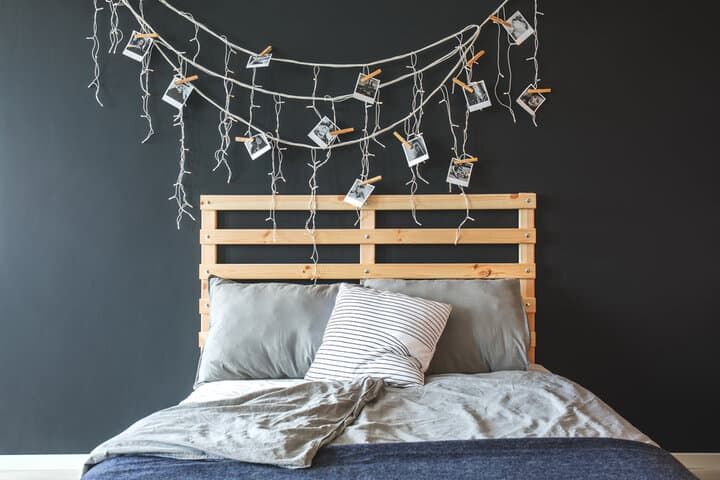
Decide on placement before you buy hardware — the right hanging method depends on where the lights will go.
Over the window
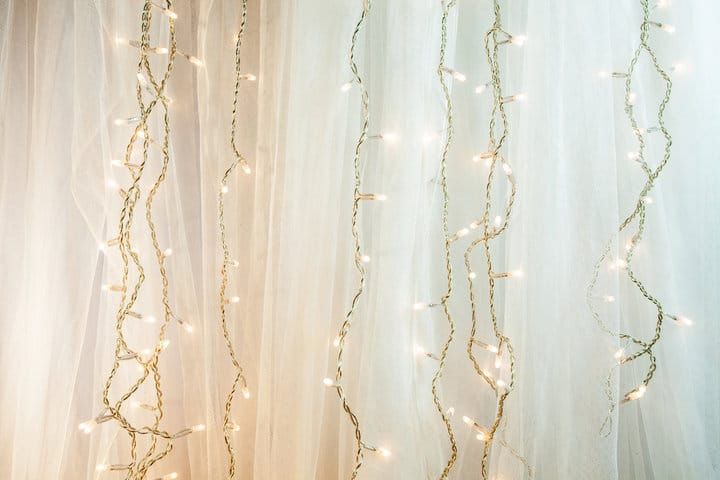
The most common spot, and the reason these are called curtain lights. Hung over the window or in front of the curtains, they add a gentle glow that mimics a softer version of daylight. If you want the effect to be more diffuse, mount them behind sheer curtains so the fabric scatters the light.
One caveat: blackout curtains block roughly 85–99% of light, so lights mounted behind them won't be visible from the room. If you have blackout curtains, hang the lights in front instead.
Behind the headboard
Curtain lights make a striking backdrop above or behind a bed. For a queen-size headboard (about 60 inches wide), a single 9.8 x 9.8 ft (3 x 3 m) curtain light panel is enough to cover the wall above and frame the bed. For king-size or wider statement walls, you'll need a larger panel or multiple linked strands.
On a bare wall
An empty wall becomes a focal point with a curtain of lights. Measure the wall first — curtain lights come in standard sizes such as 3 x 3 ft, 6.5 x 6.5 ft, and 9.8 x 9.8 ft, so pick the closest match to the area you want to cover.
Wherever you hang them, choose lights rated for indoor use. Standard indoor curtain lights are IP20-rated, which means they're for dry locations only. For a patio, pergola, or covered porch, look for IP44 or higher; for full outdoor exposure, IP65.
How To Hang Curtain Lights Without Damaging The Wall
Drilling small hooks into the wall is the most secure option, but it's overkill for curtain lights, which usually weigh under a pound (about 500 g) even with the connecting wires included. This matters especially if you rent, where wall repairs can be a headache.
For a no-damage install, scotch tape is the cheapest option, but it can lift paint when removed and won't hold much weight. The better choice is adhesive clips or adhesive hooks such as 3M Command products, which are designed to peel off cleanly by stretching the tab straight down along the wall.
A small caveat: command hooks can still pull paint off in specific conditions — walls painted within the last 7 days (paint is too uncured), flat or matte finishes, or if the tab is pulled outward rather than straight down. Test one hook in an inconspicuous spot before committing to a full row.
Check the weight rating on the package — small mini-hooks are rated for around 0.5 lb (225 g), while medium hooks handle 3 lb (1.4 kg). One mini hook per anchor point is usually plenty for a curtain light strand, but use the medium size if you're hanging a heavy net-style panel.
Step-by-step
- Hold the curtain lights up against the wall at the height you want them. Mark the top edge lightly with a pencil.
- Plan the route to the nearest outlet so the power cord can run down a corner, behind furniture, or along the baseboard without dangling across the wall. Cord clips can hide it neatly.
- Press the hooks or clips onto the wall in a straight line along the pencil mark. A spirit level or a long ruler helps keep the row even.
- Wait the time recommended on the adhesive packaging (usually about an hour) before hanging the lights, so the strips bond properly.
- Hang the top cable onto the hooks or clips.
Spacing depends on the style of curtain light:
- Cascade or icicle lights (vertical strands hanging from a single top wire) — place a hook on each side of where each vertical strand attaches, so the weight pulls down on the hook rather than sideways.
- Net-effect lights (where the cables run in a connected grid or mesh pattern across the whole panel) — space hooks evenly across the top edge to support the dispersed weight.
How To Hang Curtain Lights On A Curtain Rod

If you're hanging the lights over a window that already has a curtain rod, use the rod itself — it's faster than installing hooks, and there's nothing to remove later. The method depends on whether the lights have loops along the top wire or a single straight wire.
Lights with built-in loops
Remove the finial (the cap on one end of the rod), then slide the loops onto the rod just like curtain rings. If your curtains are already on the rod, you'll need to take them down and re-thread them alternating with the light loops, or slide the lights on next to the existing curtain hooks.
Lights with a single top wire
For a round rod, wrap the top wire loosely around the rod, making sure only the top wire is wrapped — the vertical strands should hang free. The wire may slip, so a small piece of scotch tape on the back of the rod helps anchor it. The tape doesn't have to be strong because the rod, not the adhesive, is bearing the weight.
For a flat or square rod, you can wrap the wire in the same way, or stick command hooks directly onto the rod and hang the wire from those.
Is It Safe To Put Fairy Lights On Curtains?
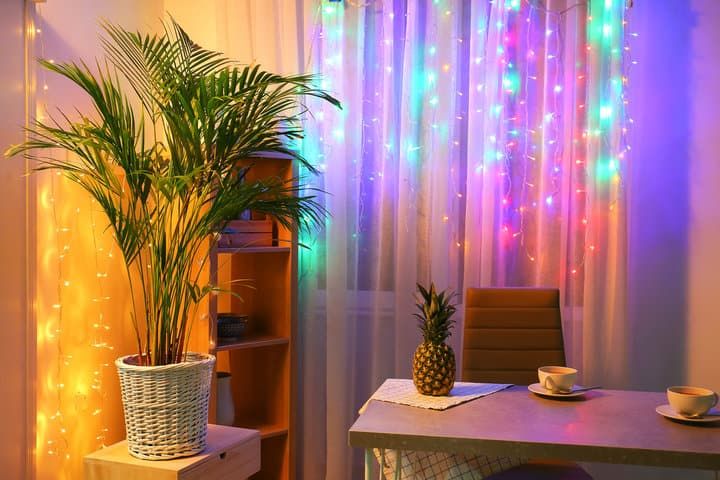
Yes, in nearly all cases. Modern fairy lights use LEDs, which run dramatically cooler than older incandescent bulbs — after three minutes, an LED bulb reaches around 91°F (33°C) while an incandescent hits about 428°F (216°C). That's well below the temperature needed to ignite curtain fabric.
The realistic failure modes for LED strings are different: heat buildup in enclosed spaces with no airflow, overheating at joint connections, and faulty wiring on cheap units. When the lights hang loosely over a curtain — not bunched or wrapped tightly — air circulates around each bulb and heat dissipates normally.
To keep things safe:
- Let the lights hang loose against the curtain — don't pin or tape every bulb flush against the fabric.
- Look for a UL, ETL, or CSA listing on the packaging. These certifications mean the product has been independently tested for electrical safety.
- Avoid cheap, unbranded LED strings — they're more likely to have poor solder joints or substandard insulation. Read reviews and stick to reputable brands.
- Don't use any strand with frayed wires, exposed copper, cracked insulation, or a damaged plug. Throw damaged sets out — don't try to repair them.
- Don't daisy-chain more strands than the manufacturer specifies. End-to-end connections add up quickly and can overload the first strand's wiring.
- Turn the lights off when you go to bed or leave the house. Even cool-running LEDs shouldn't run unattended for days.
- Check the IP rating matches the location. IP20 is fine for any dry indoor spot; use IP44 or higher anywhere damp or outdoors.
Final Thoughts
Hanging curtain lights is straightforward once you've picked the right method for the spot. If you're doing this for the first time, work through it in three steps:
- Choose the location — window, headboard, or bare wall — and measure the area so the panel size matches.
- Pick the hanging method. If there's already a curtain rod where you want the lights, use it. Otherwise, use adhesive hooks or clips at the right weight rating.
- Install along a level line, route the power cord to the nearest outlet, and let any adhesive hooks cure before loading them.
Stick to UL- or ETL-listed lights from a reputable brand, give them a little airflow against the curtain, and switch them off overnight. With that, curtain lights are one of the easiest and most flexible accent lighting projects in a bedroom.