
How Deep Should Pool Lights Be?
Under NEC 680.23(A)(5), 18 inches is the minimum depth for pool lights — and that 4-inch shallow exception only applies if the manufacturer specifically listed the fixture for it.
 Eugen
EugenEugen Nikolajev
Creator of LED Lighting Info
Hi, I am Eugen. I was always one of those kids who had all sorts of weird lighting gadgets for every occasion.
Now, I want to share my knowledge and experience about lighting with you on LED Lighting Info.
Read my editorial standards
Key Takeaways
Per NEC 680.23(A)(5), wall-mounted underwater pool luminaires must be installed with the top of the lens at least 18 inches below the normal water level. Fixtures specifically listed by the manufacturer for shallower installation may be set as little as 4 inches deep. The cord and forming shell must let you lift the fixture onto the deck for servicing without entering the water.
Pool light placement is one of those installation decisions you don't want to redo. The wiring is involved, depth affects both safety and cooling, and the National Electrical Code sets specific minimums you have to meet.
Below, you'll find:
- Where to place pool lights and at what depth
- NEC code requirements you need to meet
- Voltage classes and fixture types
- Why pool lights stay submerged
What Depth Should Pool Lights Be Installed At?
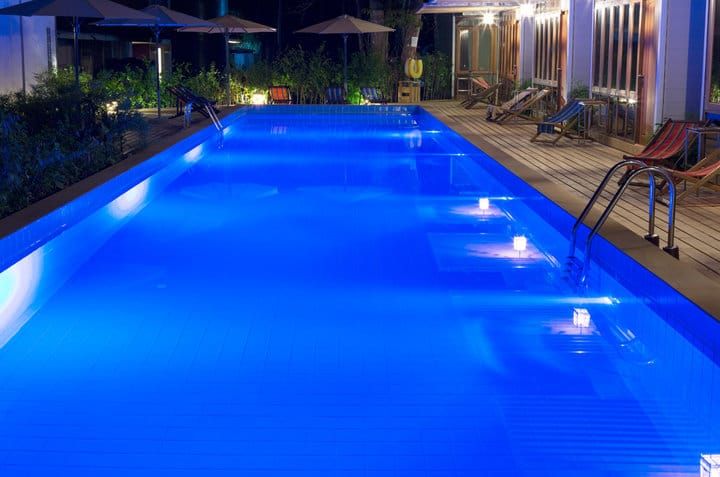
When choosing where to put your pool lights, consider pool shape, orientation, and how easy the fixtures will be to access for service.
For rectangular pools, mount lights along one of the longer sides. A single fixture at each end won't produce an even glow and tends to leave the middle of the pool dim.
For non-rectangular pools, manufacturer lighting design guides cover oval, angled, and other shapes with shape-specific recommendations.
Depth: 18 inches is the floor, not the ceiling
NEC 680.23(A)(5) sets a single minimum depth for standard wall-mounted underwater luminaires: the top of the lens must be at least 18 inches below the normal water level. The 4-inch exception applies only when a manufacturer has specifically listed a fixture for that shallower installation — it is not a generic minimum, and most fixtures on the market do not qualify.
In practice, most installations sit right at the 18-inch minimum. That's deep enough to avoid surface reflections and to keep the fixture submerged for thermal reasons, but shallow enough that you can still lift the luminaire onto the deck for service.
Going significantly deeper than 18 inches isn't necessary and creates two problems. First, maintenance becomes harder — you need extra cord slack inside the forming shell to bring the fixture all the way to the deck. Second, lights set too deep can leave the pool perimeter underlit, since the job of pool lighting is to illuminate the pool itself, not just a column of water.
NEC Pool Light Requirements
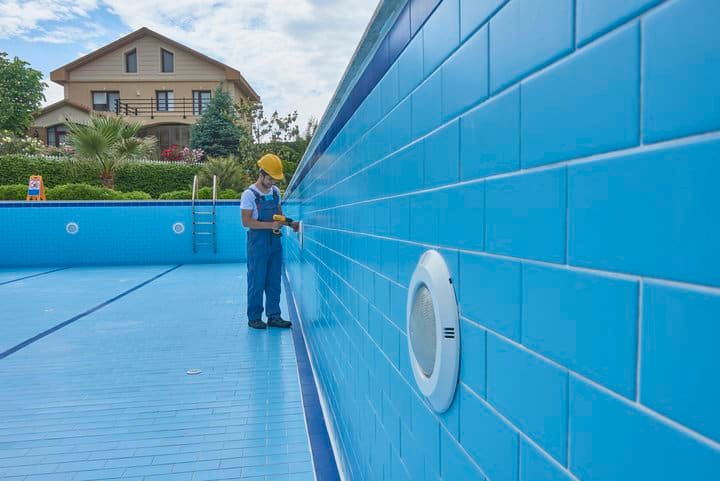
In the US, NEC Article 680 covers pool electrical work, with section 680.23 addressing underwater luminaires specifically. The compliance checklist comes down to four things:
- Depth — Top of lens at least 18 inches below normal water level. The 4-inch shallow exception applies only to fixtures specifically listed by the manufacturer for that depth (NEC 680.23(A)(5)).
- Serviceability — The forming shell location and the cord length inside it must let you lift the luminaire onto the pool deck (or another dry location) for inspection and relamping, without entering the water (NEC 680.23(B)(6)).
- GFCI protection — All branch circuits supplying pool lighting must be GFCI-protected.
- Listing — Fixtures must be listed and approved for underwater use; you can't substitute a generic outdoor fixture.
Why GFCI matters here
A ground-fault circuit interrupter cuts power within milliseconds when it detects current leaking to ground — the failure mode that turns a wet electrical fixture into a shock hazard for someone in the pool. For underwater lighting, GFCI protection isn't a nice-to-have; it's the single most important life-safety device on the circuit.
Voltage and Fixture Types
Before locking in a depth, it's worth understanding which voltage class and housing type you're working with — they affect both compliance and installation.
12V vs. 120V
- 12V low-voltage — Requires a transformer between line voltage and the fixture. Lower shock risk and common on newer LED installs.
- 120V line-voltage — Hardwired directly without a transformer. Slightly more efficient on long runs, but stricter bonding and grounding requirements apply.
Wet niche, dry niche, surface-mount
- Wet niche — Fixture sits inside a forming shell embedded in the pool wall, surrounded by water. Cord must reach the deck for service. The most common type for in-ground residential pools.
- Dry niche — Fixture is sealed behind a window in the pool wall and serviced from a dry chamber on the back side. Less common, mostly seen in commercial pools.
- Surface-mount — Fixture mounts to the wall surface itself rather than recessing into a niche. Common for retrofits and above-ground pools.
All three housing types are subject to the same NEC depth rules — the 18-inch minimum applies regardless of which one you choose.
Why Pool Lights Stay Submerged
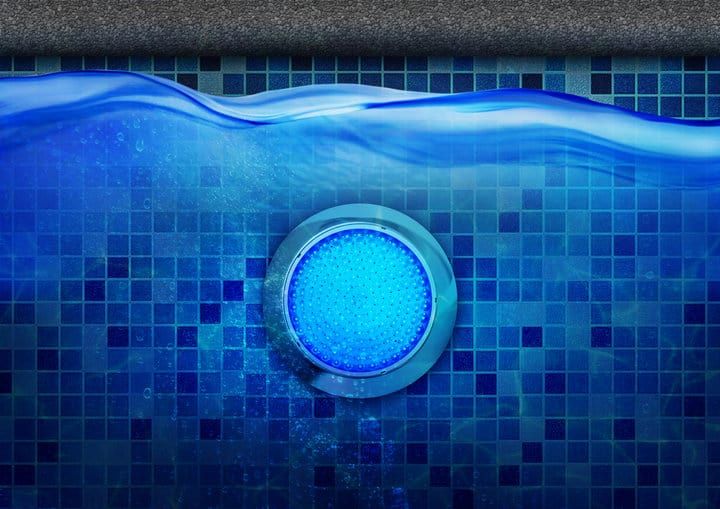
There are two reasons pool lights are designed to live underwater: surface optics and thermal management.
Surface optics
At or near the surface, water reflection sends light bouncing in unpredictable directions as the surface ripples. The result is glare instead of even underwater illumination, and the look becomes worse — not better — when someone is actually swimming.
Thermal management
Pool light LEDs need heat dissipation — running too hot shortens diode life and can damage the driver. Although water is actually a relatively poor thermal conductor, its high heat capacity and natural convection make the surrounding pool water an excellent heat sink: warmer water rises away from the fixture and cooler water replaces it. The large volume carries heat away from the lamp far faster than air would, which is why pool fixtures are designed without active cooling components — the pool itself is the heat sink.
This matters less for modern LED fixtures than it did for older halogen and incandescent pool lights — LEDs run much cooler — but LED junction temperature still limits diode life, so submersion remains the standard.
Read more: Can Pool Lights Electrocute You?
The Bottom Line
My rule of thumb: install standard wall-mounted pool lights at the NEC minimum of 18 inches below the normal water level, and only go shallower if the manufacturer has specifically listed the fixture for that depth. Pair that with GFCI-protected circuits and enough cord slack inside the forming shell to lift each light onto the deck for service, and depth becomes a solved problem.