
Can A Laser Pointer Set Off A Motion Detector?
That cheap green laser pointer can emit over 20 mW of invisible infrared — more than ten times its visible output — and that's exactly what a PIR motion sensor is built to react to.
 Eugen
EugenEugen Nikolajev
Creator of LED Lighting Info
Hi, I am Eugen. I was always one of those kids who had all sorts of weird lighting gadgets for every occasion.
Now, I want to share my knowledge and experience about lighting with you on LED Lighting Info.
Read my editorial standards
Key Takeaways
Most laser pointers won’t trigger a motion sensor. The exception is cheap green (DPSS) pointers, which can leak invisible infrared strong enough to set off a PIR sensor — but only if the beam is aimed directly at the lens.
It’s frustrating when your home’s motion sensors fire a false alarm — especially when they’re tied to a security system and the alarm actually goes off.
The whole point of a motion sensor is to trip only when there’s real motion in your home, not to send you running to reset an alarm for nothing.
A handful of things can cause false triggers, but the question here is whether laser pointers belong on that list. Should you worry about kids playing with one near your home?
To answer this properly, this article covers:
- The different types of motion sensor and how each one detects movement
- Whether — and how — a laser pointer can actually set one off
- Other causes of false alarms, and how to reduce them
How Motion Sensors Work: Active vs. Passive
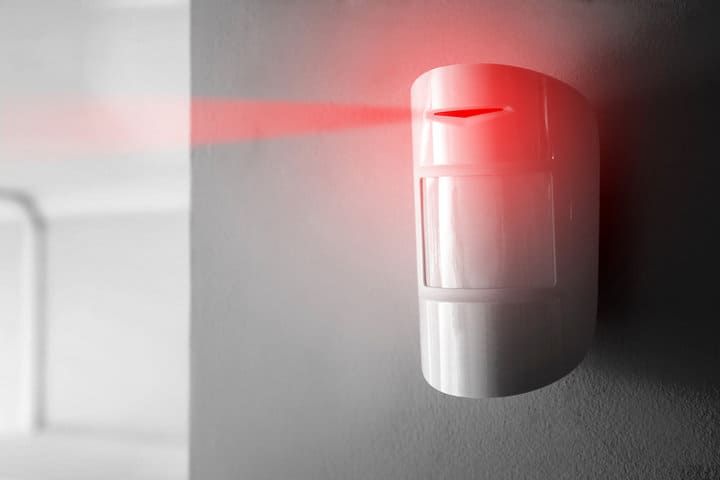
Motion sensors fall into two broad groups: passive and active.
Passive sensors don’t emit anything. They monitor a space and react when something in their field of view changes. The most common — and the type used in nearly all home security systems and outdoor security lights — is the Passive Infrared (PIR) sensor.
Active sensors emit a signal of their own (microwave or ultrasonic) and watch for changes in the reflections that come back.
Here’s how the three common types compare:
| Sensor Type | Active or Passive | Detection Method | Laser Trigger Risk |
|---|---|---|---|
| PIR | Passive | Change in infrared (heat) across the field of view | Possible — only this type |
| Microwave | Active | Doppler shift in reflected microwaves | None |
| Ultrasonic | Active | Doppler shift in reflected high-frequency sound | None |
Which Sensor Type Can a Laser Pointer Trigger?

Of the three main types, only PIR sensors are vulnerable. Microwave sensors fire microwaves at GHz frequencies and look for Doppler shifts in the reflections — a laser beam can’t produce that signal. Ultrasonic sensors listen for sound waves bouncing back at slightly shifted frequencies. A laser is light, and an ultrasonic sensor listens for sound, so the two simply can’t interact.
How PIR sensors actually detect motion
A PIR sensor doesn’t measure absolute heat — it measures changes in infrared radiation across two pyroelectric elements behind a segmented Fresnel lens. When a warm body (or a quickly changing IR source like a sweeping laser beam) crosses the field of view, one element registers a change before the other, and the difference between them triggers the alarm. That’s why a hot radiator that has been on for an hour stops re-firing the sensor — but the moment the radiator switches on and starts heating up, the rapid IR change can trip it.
Do laser pointers actually emit infrared?
Whether a laser pointer emits any infrared depends on its construction, not just its color:
- Direct-emission diode lasers — most red, blue, and violet pointers — emit only at their visible wavelength. They don’t produce meaningful infrared.
- DPSS lasers — most green pointers — can leak significant invisible infrared if their internal IR-blocking filter is missing or weak.
Green pointers use a frequency-doubling process: an 808 nm infrared pump diode excites a crystal that lases at 1064 nm, and a second crystal then halves that wavelength to produce 532 nm green light. Both the 808 nm pump and the 1064 nm fundamental are normally trapped by an internal filter — but cheap units often skip that filter to save cost.
NIST tested 122 laser pointers and found nearly 90% of green pointers and about 44% of red pointers were out of compliance with federal safety regulations. One green unit in their sample emitted around 20 mW of infrared while delivering only dim green light — more than ten times more invisible IR than visible green.
What about laser safety classes?
Most retail laser pointers sold legally in regulated markets are Class 2 — under 1 mW of visible output — and pose negligible risk of triggering a PIR sensor at any practical distance. Class 3R pointers (1–5 mW) and uncertified imports often labelled Class 3B or higher are the units of concern, both for sensor false alarms and for eye safety.
Can someone deliberately set off your sensor with a laser?
In theory, yes — particularly with a cheap green pointer leaking IR. In practice, you’d need a clear line of sight, a steady aim directly at the sensor lens, and a powerful enough unit. From across the street, that’s difficult to do consistently. A standard red Class 2 pointer almost certainly won’t register at all.
Can a laser blind or defeat a motion sensor?
This is the question most people are actually asking, and the honest answer is: not really. Saturating a PIR sensor with a steady infrared signal could in theory mask smaller IR changes, but PIR sensors detect change — a static beam aimed at the lens produces one trigger and then settles. There’s no realistic way to “blind” a PIR sensor with a consumer laser the way films suggest. Dual-technology sensors that cross-check PIR with microwave detection are even harder to fool, since you’d need to spoof two completely different physical principles at once.
Other Causes of Motion Sensor False Alarms

A laser pointer is only one item on a longer list of PIR false-detection causes. The more common culprits:
- Pets and small animals. Pet-friendly motion sensors use a combination of techniques to ignore small animals: specially shaped lens optics that mask out lower zones near the floor, multiple pyroelectric elements that compare signals against each other, and signal-processing algorithms that judge the heat signature against a weight threshold (commonly 40 lb / 18 kg). These aren’t perfect — an animal that climbs onto furniture, or two pets passing the sensor at once, can still trip them.
- Heat sources. Radiators emit substantial infrared radiation — that’s a core part of how they heat a room, and it’s what the word “radiator” literally refers to. When one switches on, the rapid change in IR can easily trip a PIR sensor. Heating vents, fireplaces, tumble-dryer exhausts, and direct sunlight on a wall can do the same thing.
- Damaged or cracked housing. Once a motion sensor develops a crack, air drafts, light leaks, and moisture can reach the sensor element directly, causing it to register thermal changes that the housing was supposed to shield it from. This is more common on outdoor units, where wind, debris, and weather take a toll even on rated enclosures.
- Laser pointers. Covered in detail above — a real but minor risk, mostly limited to cheap green DPSS units aimed directly at the sensor lens.
How to Reduce PIR False Alarms
If your sensor is firing without a clear cause, work through these in order — easiest and cheapest first:
- Reposition the sensor away from radiators, heating vents, windows that get direct sun, and large reflective surfaces.
- Lower the sensitivity if your unit has an adjustment dial. Most outdoor security lights and alarm sensors do.
- Mask part of the lens with a PIR cover or a strip of opaque tape over the zones you don’t want monitored. This narrows the field of view without moving the sensor.
- Trim back foliage. Branches and tall grass moving in the wind are a frequent cause of outdoor false alarms.
- Use a dual-technology sensor that requires both PIR and microwave detection (AND logic) to trigger. These are dramatically less prone to single-source false alarms.
- Replace cracked or weathered housings. Once the seal is broken, no amount of sensitivity tuning will fix it.
Conclusion
In my experience, laser pointers sit near the bottom of the list of things that actually cause motion sensor false alarms. Most consumer pointers — especially the cheap red ones — don’t emit enough infrared to register on a PIR sensor, and microwave or ultrasonic sensors are immune to laser interference outright. The realistic concern is a cheap green DPSS pointer aimed directly at a PIR lens, and even that is easy to address with better sensor placement, a dual-technology setup, or a simple lens mask.