
Do Motion Sensor Lights Emit Radiation?
A microwave oven packs around 1,000 watts into a shielded cavity — a motion sensor emits roughly 10–20 mW into open air. That gap is why one cooks food and the other simply can't.
 Eugen
EugenEugen Nikolajev
Creator of LED Lighting Info
Hi, I am Eugen. I was always one of those kids who had all sorts of weird lighting gadgets for every occasion.
Now, I want to share my knowledge and experience about lighting with you on LED Lighting Info.
Read my editorial standards
Key Takeaways
Some motion sensors emit radiation, including radio waves and microwaves, but at power levels that are completely safe for humans. Other sensors are passive – they only receive the natural infrared radiation that people and animals already emit.
Motion sensors work in various ways, and most of them rely on some form of radiation to do their job. The word "radiation" conjures up all kinds of unsettling images, so it's a fair question: are these sensors actually safe to live with?
To clear up any concerns, this article covers:
- The different types of motion sensors and what they emit
- How infrared motion detectors work
- Whether each type of motion sensor is safe to use at home
Which Types Of Motion Sensors Emit Radiation?

There are two main families of motion sensors: passive and active.
Passive motion sensors don't emit anything – they are purely detectors. The most common is the Passive Infrared (PIR) sensor, which detects changes in the infrared energy emitted by people and animals moving through its field of view.
Active sensors are named that way because they actively emit a signal. That signal is usually bounced back to the sensor from any object that moves into the detection area – or, in some setups, aimed at a separate receiver where the sensor is triggered when the receiver is blocked.
Passive sensors can be ruled out as a source of emitted radiation immediately, because they don't transmit any signals at all. They are purely receivers.
Active sensors do emit forms of non-ionizing radiation, and the type depends on the technology:
- Microwave sensors emit microwaves and detect motion from the reflected signal.
- Tomographic sensors create a mesh of low-power radio waves between paired nodes and detect disturbances in the field.
- Ultrasonic sensors emit high-frequency sound waves (above human hearing) and listen for changes in the returning echo.
Microwave Sensors
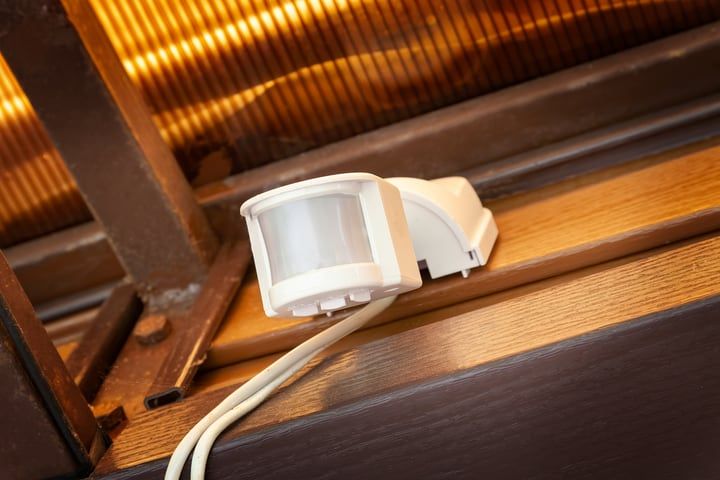
Microwave sensors flood a room with microwaves and watch for changes in the reflected signal. Because microwaves travel at the speed of light, the sensor can react the moment someone steps into the detection area.
Most microwave motion sensors operate at either 10.525 GHz (the X-band, used in modules like the HB100) or 24.125 GHz (the K-band, used in newer presence sensors). Both sit in the unlicensed ISM band.
Microwave sensors have one big advantage over PIR sensors: they don't depend on temperature contrast, so they work reliably in environments where PIRs struggle. Because PIR sensors detect the difference between body heat and the surroundings, their sensitivity drops as ambient temperatures climb toward human skin temperature (around 30–34°C / 86–93°F). Most PIRs are rated to operate up to 60–70°C, but they become noticeably less reliable on very hot days. Microwave sensors don't have that limitation.
Tomographic Sensors
Tomographic sensors use multiple paired nodes to create a mesh of radio waves through a space. When something disturbs that field – including motion behind walls or furniture – the system detects it. They're typically deployed for whole-area security coverage rather than single-room lighting.
These systems usually broadcast in the 2.4 GHz band – the same unlicensed band used by Wi-Fi, Bluetooth, and Zigbee.
Ultrasonic Sensors
Ultrasonic sensors emit high-frequency sound waves (above the range of human hearing) and listen for the echo. When something moves in the detection area, the frequency of the returning echo shifts slightly – the Doppler effect – and the sensor triggers. Standalone ultrasonic motion sensors are reflective devices, not beam-break: a single transducer both emits the sound and listens for changes.
Dual-Technology and Camera-Based Sensors
Many modern security and smart-home sensors combine two detection methods, most often PIR + microwave. The light only triggers when both technologies agree, which dramatically cuts false alarms from heating vents, sun glare, or moving curtains.
A growing number of devices – video doorbells, security cameras, robot vacuums – use cameras or LiDAR for motion detection instead of (or in addition to) PIR. These don't raise additional radiation concerns (cameras are passive; LiDAR uses very low-power infrared laser pulses), but they do introduce privacy considerations worth being aware of.
How Do Infrared Motion Detectors Spot Radiation?
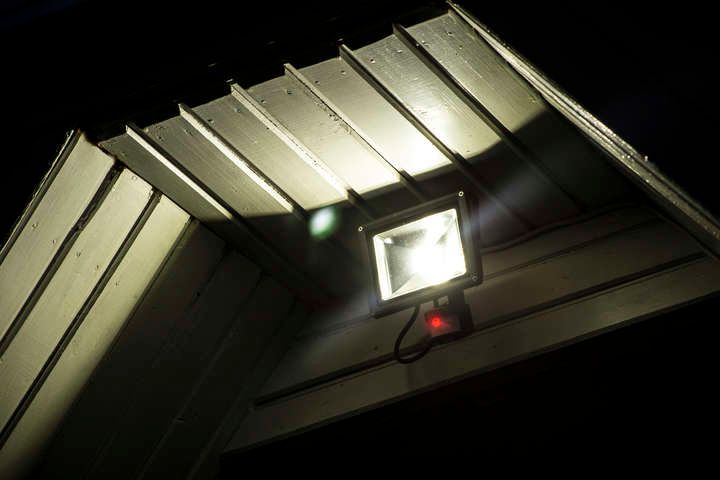
Humans and animals give off heat in the form of an infrared signal – the same kind of signal you see in footage from a thermal imaging camera.
PIR sensors don't measure absolute temperature. Instead, they detect a change in the amount of infrared energy across their field of view. When a warm body moves through the scene, the contrast between that body and the cooler background trips the sensor.
This makes PIR sensors simple and effective in outdoor spaces, because they don't need a separate transmitter and the elements can't easily obstruct an infrared signal. Their main drawbacks are that they require line-of-sight and can't reliably distinguish humans from animals – any change in infrared inside the detection field will trigger them.
Related: Do Motion Sensors Only Work At Night?
Are Motion Sensors Safe?
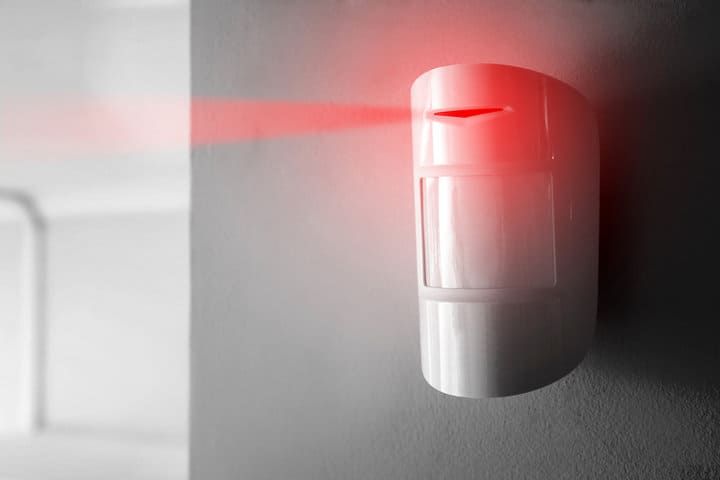
Before getting into specific sensor types, one concept does most of the heavy lifting in this conversation: every form of radiation a motion sensor uses – microwaves, radio waves, infrared, and ultrasound – is non-ionizing. Unlike X-rays or gamma rays, non-ionizing radiation doesn't carry enough energy per photon to break chemical bonds or damage DNA. It can only deposit energy as heat, and only in meaningful amounts at high power levels.
PIR (Infrared) Sensors
PIR sensors are completely safe because they don't emit anything – they only read the infrared that you already give off naturally. From a radiation standpoint, they're equivalent to a camera or microphone: a passive receiver, nothing more.
Microwave Sensors
Microwave motion sensors share the general microwave band with kitchen ovens – but the comparison stops there. A microwave oven concentrates roughly 1,000 watts of microwave energy inside a shielded metal cavity, which is what makes it dangerous. A motion sensor emits only a few milliwatts (typically around 10–20 mW), broadcast openly into a room. That's tens of thousands of times less power, which is why a motion sensor produces no measurable heating effect on human tissue.
It's the power, not the frequency, that matters. The components inside a motion sensor only have enough power budget to produce a few milliwatts. Even a malfunctioning unit physically can't generate anything close to harmful levels.
Tomographic Sensors
Tomographic sensors broadcast in the 2.4 GHz ISM band – the same band used by Wi-Fi, Bluetooth, and Zigbee. The exposure level inside a room with a tomographic sensor is comparable to what you already get from any nearby Wi-Fi router or wireless device.
The World Health Organization's IARC classifies radiofrequency electromagnetic fields as "possibly carcinogenic" (Group 2B) based on limited evidence from heavy mobile phone use.
The mainstream scientific consensus, including the FDA's review of the evidence, finds no clear link between typical RF exposure and cancer. Either way, the RF dose from a tomographic sensor is a small fraction of what an average phone or Wi-Fi user already receives.
Ultrasonic Sensors
Ultrasonic sensors emit sound rather than electromagnetic radiation, so the cancer/RF conversation doesn't apply. For most installations, they cause no problems at all.
⚠️ Note: Standing directly underneath an ultrasonic sensor for hours or days at a time has been linked to mild side effects such as headaches and nausea in sensitive individuals. This only applies to continuous, long-term, uninterrupted exposure – occupying a room with one for normal periods is fine.
Regulatory Approval
Any RF-emitting motion sensor sold in the US must meet FCC Part 15 emission limits, and equivalents sold in Europe carry the CE mark indicating compliance with EU radio equipment and EMC directives. These frameworks cap maximum allowable emissions well below any level shown to cause biological harm. A sensor on a retail shelf has already passed those tests.
Final Words
The word "radiation" sounds alarming, but the emissions from motion sensors are non-ionizing and produced at power levels regulated to be safe. Most are completely undetectable to the human body. The only realistic exception is heavy, sustained exposure directly underneath an ultrasonic unit, which can cause mild discomfort in some people.
When choosing a motion sensor for your home, you can pick based purely on its detection performance, range, and false-alarm behavior. Health risk shouldn't be a factor.
Also read: How To Make Motion Sensors Stay On