
Can You Use Socket Cable For Lighting?
Per NEC 240.4(D), putting 14-gauge wire on a 20-amp circuit means it can overheat long before the breaker trips — and that's the real risk hiding in that leftover reel.
 Eugen
EugenEugen Nikolajev
Creator of LED Lighting Info
Hi, I am Eugen. I was always one of those kids who had all sorts of weird lighting gadgets for every occasion.
Now, I want to share my knowledge and experience about lighting with you on LED Lighting Info.
Read my editorial standards
Key Takeaways
Socket cable is heavier-gauge than standard lighting cable, so using it on a 15-amp lighting circuit won’t overload the wire, it’s code-compliant as long as the breaker still matches the smallest conductor on the run.
The trade-off is that 12-gauge cable is stiffer, harder to fold into shallow boxes, and a pain behind crowded switches with dimmers or motion sensors.
Whether you’re adding new fixtures or rewiring a room, the cable you pull matters. Use the wrong gauge for the wrong load, and you risk tripped breakers, failed inspections, or in worst cases, electrical fires.
Most people asking this question are mid-renovation and staring at a leftover reel of socket cable, weighing whether to use it on the lighting circuit or pick up something thinner.
Before going any further, a quick scope note. This article covers US residential wiring under the National Electrical Code (NEC). UK readers will see different cable designations (1.0mm², 1.5mm², 2.5mm²) and a ring main system that doesn’t apply here. And in nearly every US jurisdiction, branch-circuit work requires a permit and inspection — and in some states such as Texas and New York City, a licensed electrician. Confirm requirements with your local authority having jurisdiction (AHJ) before starting any work.
I’ll cover:
- The type of cable used in standard sockets
- The type of cable you need for lighting
- Whether lights can be safely connected with socket cable
What Type Of Cable Is Used For Standard Sockets?
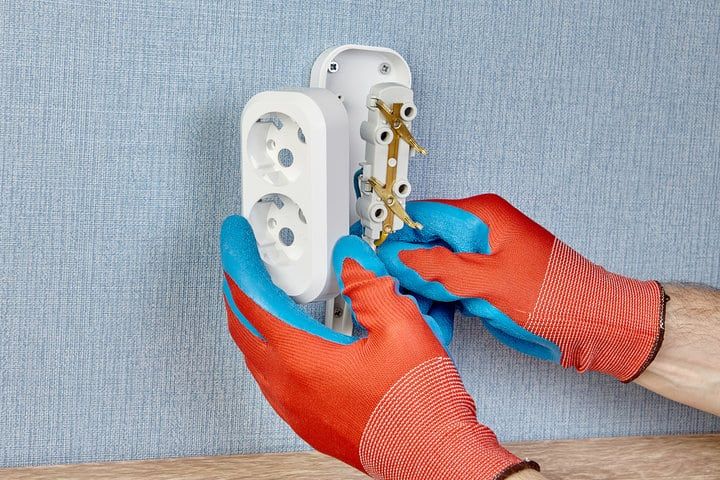
Cable in US homes is sized using the American Wire Gauge (AWG) system. The smaller the AWG number, the thicker the conductor — and the more current it can safely carry. Thicker wire has lower resistance per foot, which is why long runs and higher-current loads call for heavier gauges.
The two cables you’ll see most often in residential walls are 12/2 and 14/2 NM-B (commonly called Romex). 12-gauge cable handles 20-amp circuits; 14-gauge cable handles 15-amp circuits.
| Wire Gauge | Conductor Diameter | Max Amperage | Typical Use |
|---|---|---|---|
| 12 AWG | 0.081" / 2.05 mm | 20 A | Receptacle circuits, kitchen and bath |
| 14 AWG | 0.064" / 1.63 mm | 15 A | General lighting circuits |
Per NEC 240.4(D), 14 AWG copper must be protected at no more than 15 amps and 12 AWG at no more than 20 amps. The breaker on the panel matches the smallest conductor anywhere on the circuit — that’s the rule that drives most of what follows.
What the “/2” and “/3” designations mean
The “/2” in “12/2” or “14/2” refers to the two insulated current-carrying conductors inside the cable — typically a black hot and a white neutral. Standard NM-B cable also includes a bare copper equipment grounding conductor, which the NEC has required on residential branch circuits since the 1960s. So a 12/2 cable contains three wires inside the sheath (hot, neutral, and bare ground), but the “/2” counts only the insulated pair.
You’ll also see 12/3 and 14/3 cable in homes — but not because the circuit carries more current. Three-conductor cable adds a red conductor and is used for two specific cases:
- 3-way and 4-way switch wiring, where the extra conductor carries a traveler between switches
- Multi-wire branch circuits (MWBCs), where two hots from opposite phases share a single neutral, requiring a 2-pole breaker or handle tie
The amperage stays the same — a 12/3 MWBC is two 20-amp circuits sharing a neutral, not a single higher-amperage circuit.
Which gauge is actually used at sockets?
Contrary to a common DIY myth, US homes don’t run 12-gauge cable to every receptacle. 14-gauge is cheaper, more pliable, and used widely on 15-amp general-purpose receptacle circuits in bedrooms, living rooms, and hallways. 12-gauge shows up on 20-amp circuits where the NEC requires it: kitchen small-appliance circuits, bathroom receptacles, garages, laundry, and dedicated outlets for high-draw equipment.
The rule is simple: the cable matches the breaker. 15-amp breaker, 14-gauge minimum. 20-amp breaker, 12-gauge minimum.
What Cable Size Is Required For Lighting?

Most US residential lighting circuits run on a 15-amp breaker with 14-gauge cable. Lights draw far less current than appliances or kitchen receptacles, so a 15-amp circuit is plenty of headroom.
That said, NEC 210.23 also permits 20-amp lighting circuits, and they’re common for kitchens, bathrooms, and high-load fixture banks. Kitchens in particular often need a dedicated 20-amp lighting circuit separate from the small-appliance circuits.
There’s a practical reason most lighting stays on 14-gauge instead of just defaulting to 12: it’s significantly more pliable. Behind a crowded switch box with dimmers, motion sensors, or 3-way wiring, the extra flex matters. The thicker cable’s lower resistance is wasted on a short, low-current run, while the install gets meaningfully harder.
What about LED and low-voltage lighting?
On standard 120 V indoor lighting circuits, voltage drop isn’t much of a concern — the runs are short relative to the supply voltage. Lose a couple of volts on a 120 V feed and the bulb still lights normally.
Low-voltage indoor LED systems are a different story. Under-cabinet strips, cove lighting, toe-kick lights, and most decorative LED tape run on 12 V or 24 V DC behind a driver or transformer. At those voltages, even small drops translate to visible dimming at the far end of a long run.
GL LED’s design guidance recommends keeping voltage drop under 0.75 V on 12 V systems and 1.5 V on 24 V systems, and switching to 24 V or heavier-gauge feed wire once runs pass roughly 10 meters. If you’re feeding LED strip from a driver, the gauge question lives entirely on the secondary side — and socket cable is irrelevant to it.
Outdoor landscape lights also run low-voltage and are sensitive to drop. Longer runs may need a thicker wire gauge to keep brightness consistent end-to-end.
Can Lighting Be Safely Connected With Socket Cable?
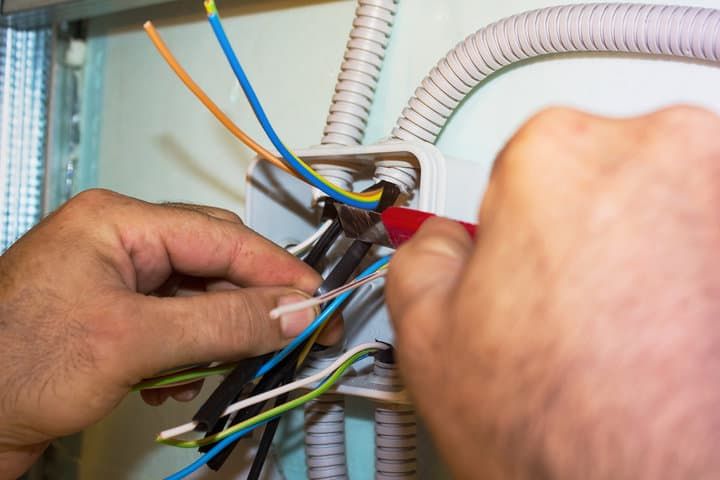
Short answer: yes. Using 12-gauge cable on a 15-amp lighting circuit is safe and code-compliant. The breaker still matches the smallest conductor (12 AWG, well above the 15-amp minimum), the wire is over-sized for the load, and nothing about the install becomes more dangerous. The only downside is that the cable is harder to work with.
Going the other direction is where it gets dangerous. Putting 14-gauge cable on a 20-amp circuit means the wire could overheat well before the breaker trips. That’s why you should avoid wiring a socket onto a lighting circuit without first confirming the breaker rating and the existing cable gauge.
- No safety penalty — 12-gauge on a 15-amp lighting circuit is fully NEC-compliant
- Lower resistance per foot, so voltage drop on long runs is reduced
- Saves a trip to the hardware store if you have leftover reels from another job
- Stiffer and harder to fold into shallow boxes, especially behind dimmers and 3-way switches
- More expensive per foot if you’re buying it new
- Bulks up wire-fill calculations in crowded boxes
Splicing in a different gauge
If you’re extending an existing 14-gauge lighting circuit and only have 12-gauge cable on hand, you can splice in the heavier section without issue. The 15-amp breaker is still protecting the smallest conductor on the run, which is the existing 14-gauge.
The reverse is unsafe. Splicing 14-gauge into a 20-amp circuit leaves part of the run under-protected — the 20-amp breaker won’t trip in time to save the lighter wire from overheating.
- ✅ Safe: Adding 12 AWG to a 14 AWG circuit on a 15 A breaker (oversized wire, same breaker)
- ❌ Not safe: Adding 14 AWG to a 12 AWG circuit on a 20 A breaker (undersized wire, breaker won’t trip in time)
One more reminder: branch-circuit work falls under the NEC and almost always needs a permit and inspection. If your jurisdiction requires a licensed electrician, hire one — an inspector won’t care that the splice was technically code-compliant if the work was done without a permit.
Final Words
If I’ve got a half-reel of 12-gauge left over from a kitchen rewire and I’m running a new lighting circuit, I’ll use it. There’s no safety penalty, and it saves a trip to the store.
For a brand-new install where you’re buying cable fresh, 14-gauge for lighting and 12-gauge for receptacles is the standard for a reason — both meet code, and the lighter cable is much easier to fold into a switch box. And if you’re working with low-voltage LED strip, the gauge question lives entirely on the secondary side of the driver, not the line side.
FAQ
Is it against code to use 12-gauge cable on a 15-amp lighting circuit?
No. NEC 240.4(D) sets a minimum conductor size for a given breaker — a 15-amp breaker requires at least 14 AWG copper, but you can always go heavier. 12 AWG on a 15-amp circuit is over-sized and fully compliant.
Can I extend a 14-gauge lighting circuit with 12-gauge cable?
Yes. The breaker still matches the smallest conductor on the circuit (the existing 14 AWG, protected by a 15-amp breaker), so adding a heavier section doesn’t change the safe ampacity. Don’t try the reverse — splicing 14 AWG into a 20-amp run leaves the lighter section under-protected.
What gauge wire do I need for LED strip lights?
For 12 V or 24 V LED strip, gauge depends on run length and load, not on what gauge supplies the driver. Short runs (under 10 feet) usually work on 18 AWG, but longer runs may need 14 or 12 AWG to keep voltage drop under 0.75 V on 12 V systems or 1.5 V on 24 V systems. When in doubt, switch to 24 V or shorten the run.
Do I need a permit to extend a lighting circuit?
In most US jurisdictions, yes. Branch-circuit modifications generally require a permit and inspection, and some states require a licensed electrician for any branch-circuit work. Check with your local authority having jurisdiction (AHJ) before starting.