When LED Lights Were Invented? A Brief History Of LED Lighting
The science behind LED lighting dates back to 1907 — more than five decades before Nick Holonyak produced the first visible LED in 1962. That gap tells the real story.
 Eugen
EugenEugen Nikolajev
Creator of LED Lighting Info
Hi, I am Eugen. I was always one of those kids who had all sorts of weird lighting gadgets for every occasion.
Now, I want to share my knowledge and experience about lighting with you on LED Lighting Info.
Read my editorial standards
Key Takeaways
Electroluminescence, the principle behind LEDs, was first discovered in 1907 by Henry Joseph Round. But it wasn't until 1962 that engineer Nick Holonyak used the science to create visible LEDs as we know them today.
Most people assume LEDs are a recent innovation. They're not — the science behind them dates back to 1907.
From street lights and calculators to TV remotes and traffic signals, LEDs are everywhere today. But the journey to this point wasn't linear.
Let's travel back to the early 1900s and explore the complete history of LEDs — who invented them and how they became so popular.
When Was LED Light Invented? Quick Timeline
First observed glow
Henry Joseph Round (Marconi Labs, UK) reports light emission when electricity is applied to silicon carbide — the first observation of electroluminescence.
- 1924–1930
Losev's early diodes
Russian researcher Oleg Vladimirovich Losev publishes papers and a 1927 patent outlining LEDs and their potential applications, decades ahead of practical hardware.
Electroluminescence named
French physicist Georges Destriau coins the term "electroluminescence."
Infrared from semiconductors
Rubin Braunstein (RCA) reports infrared emission from GaAs, GaSb, and InP semiconductors.
The first infrared LED
Robert Biard and Gary Pittman (Texas Instruments) produce and patent the first infrared LED. Its light is beyond the spectrum visible to humans.
Visible red light
Nick Holonyak Jr. (General Electric) invents the first LED to emit visible red light, using gallium arsenide phosphide (GaAsP).
LEDs reach computers
IBM begins using red LEDs as indicators on its computer circuit boards.
Calculators and mass production
Hewlett-Packard integrates LEDs into its handheld calculators. Monsanto begins mass-producing GaAsP LEDs.
Brighter, and now yellow
M. George Craford (Monsanto) creates the first yellow LED, plus red and orange LEDs ten times brighter than Holonyak's originals.
LEDs for fiber optics
Thomas P. Pearsall develops high-brightness LEDs for fiber-optic telecommunications.
- 1980s
The brightness race
Several large corporations race to create brighter and more reliable LEDs using newly developed gallium aluminium arsenide.
The breakthrough blue
Shuji Nakamura (Nichia Corporation) produces the first high-brightness blue LED using indium gallium nitride (InGaN) on a gallium nitride (GaN) base — the missing piece for white light.
White light, at last
Yoshinori Shimizu and colleagues at Nichia patent a white-light LED that combines a blue InGaN chip with a yellow YAG:Ce phosphor — the approach still used in most white LEDs today.
White LEDs go commercial
White LEDs become commercially available for $80–$100 per bulb.
100 lumens per watt
The first LEDs producing 100 lumens per watt are demonstrated.
Incandescent phase-out begins
The U.S. signs the Energy Independence and Security Act, beginning the phase-out of inefficient incandescent bulbs in favor of efficient alternatives, including LEDs.
A benchmark for quality
The DesignLights Consortium's Qualified Products List (QPL), launched in late 2009, becomes a key benchmark for commercial LED products eligible for utility rebates.
Philips wins the L-Prize
Philips wins the U.S. Department of Energy L-Prize for an LED equivalent to a 60W incandescent bulb.
Mainstream savings
More than 49 million LEDs are in use across the U.S., delivering an estimated $675 million in annual energy savings (per the U.S. Department of Energy).
Lasers on the road
Laser-diode headlights debut on production cars (BMW i8 and Audi R8 LMX), with BMW beginning customer deliveries first.
A Nobel Prize for light
Shuji Nakamura, Isamu Akasaki, and Hiroshi Amano share the Nobel Prize in Physics for the invention of efficient blue light-emitting diodes.
Surprisingly, LED technology is more than a century old.
Back in 1907, British scientist Henry Joseph Round discovered the phenomenon of electroluminescence. He noticed that when 10 volts of electric current is applied to a silicon carbide crystal, it emits light. This happens because negatively charged electrons recombine with positively charged electron holes, releasing energy as photons.
The discovery was ground-breaking, but the yellow light Round produced was too dim to be of any practical use.
Scientists continued to study electroluminescence throughout the first half of the 20th century. The term was officially coined by Georges Destriau in 1936, in honor of Marie Curie's laboratory where he worked — the effect is sometimes called the "Destriau effect."
The technology's potential was first noted by Russian researcher Oleg Vladimirovich Losev. After observing light emission from zinc oxide and silicon carbide, Losev published a series of papers between 1924 and 1930 that outlined the LED and its possible applications, including a 1927 patent for a "Light Relay." His work predicted the first practical LED by more than three decades.
Nick Holonyak: The Father of Visible LEDs
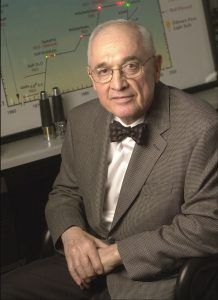
While the development of LEDs was a collective effort spanning more than a century, one engineer changed everything: Nick Holonyak Jr.
Holonyak grew up in Zeigler, Illinois, the son of a Ukrainian immigrant coal miner. He pursued electrical engineering at the University of Illinois, where he earned his bachelor's, master's, and doctorate.
In 1957 he joined General Electric, the company behind fluorescent and halogen bulbs. His big breakthrough came in 1962, when he was tasked with creating an infrared laser. While experimenting with gallium arsenide phosphide (GaAsP), he produced the first LED to emit light in the visible spectrum — the first electroluminescent device a human being could actually see.
Holonyak nicknamed his creation "the magic one, GaAsP," and reflecting on the invention 50 years later, he called it the "ultimate lamp" — explaining that "the current itself is the light."
How Did LED Light Become Popular?
If the first LED was created in 1962, why didn't they become popular until the mid-2000s? It came down to money.
When General Electric started selling red LEDs in 1963, they retailed at $260 each — extortionate compared to the $5–$20 people were used to paying for incandescent and fluorescent bulbs. They weren't even available in white. The price drop took decades:
| Year | Approximate Price per LED Bulb |
|---|---|
| 1963 | ~$260 (red, GE) |
| Mid-1970s | Production cost as low as 5¢, but small batches kept consumer prices high |
| 2002 | $80–$100 (first commercial white LEDs) |
| Today | A few dollars per bulb, less in multi-packs |
It was difficult to break into the market. People were happy with the lighting they had and weren't willing to gamble hundreds of dollars on something new.
By the mid-1970s, Fairchild Optoelectronics had developed an LED that cost just 5 cents to produce — but small production batches kept consumer prices stubbornly high.
Once major firms like IBM and Hewlett-Packard started designing LEDs into their products, demand picked up. As production volumes scaled, manufacturers enjoyed economies of scale and the cost per unit fell drastically. Today, basic LED bulbs typically sell for just a few dollars each, and often less in multi-packs.
The Blue LED Breakthrough and the 2014 Nobel Prize
By the early 1990s, engineers had built efficient red, green, and yellow LEDs — but a bright blue LED remained out of reach. This was the missing piece. Without blue, you couldn't make white light, and without white light, LEDs couldn't replace household bulbs.
That changed in 1993, when Shuji Nakamura at Nichia Corporation produced the first high-brightness blue LED using indium gallium nitride (InGaN) on a gallium nitride (GaN) base. Three years later, his Nichia colleague Yoshinori Shimizu patented a white-light LED that paired a blue InGaN chip with a yellow YAG:Ce phosphor. The blue chip pumps the yellow phosphor, and the mixed light appears white — the dominant approach still used in white LEDs today.
In 2014, Shuji Nakamura, Isamu Akasaki, and Hiroshi Amano shared the Nobel Prize in Physics for the invention of efficient blue light-emitting diodes — recognition that this single breakthrough enabled the LED lighting revolution that followed.
Why LEDs Won: Efficiency and Energy Savings
The economic case for LEDs goes well beyond bulb price. A typical 60-watt incandescent bulb produces around 14 lumens per watt; a modern LED equivalent delivers 80–100 lumens per watt or more, while drawing roughly 10 watts to produce the same brightness. Over the life of the bulb, that gap dwarfs any difference in upfront cost.
By 2012, more than 49 million LEDs were already in use across the U.S., delivering an estimated $675 million in annual energy savings, according to the U.S. Department of Energy. That math is what drove utility rebate programs, the 2007 federal incandescent phase-out, and the eventual takeover of the residential bulb aisle.
Final Words
From a dim yellow flicker in a 1907 lab to a Nobel Prize in 2014, the path to modern LED lighting took more than a century — and it isn't over. Researchers are now pushing further with micro-LED displays, ultra-efficient horticultural lighting, and Li-Fi data transmission, while general-lighting LEDs continue to climb past 200 lumens per watt.
There is almost certainly an LED in the room you're sitting in right now — perhaps in the screen you're reading on. The next time you flip a switch, you're benefiting from a chain of breakthroughs stretching back to Henry Joseph Round, Oleg Losev, and Nick Holonyak — paid for in pennies of electricity instead of dollars.