
Why Are Street Lights Yellow And Not White?
Under low-pressure sodium light, a red car and a green car look the same dirty brown — LPS has a Color Rendering Index of essentially zero. That physics quirk, not aesthetics, defined a century of orange streets.
 Eugen
EugenEugen Nikolajev
Creator of LED Lighting Info
Hi, I am Eugen. I was always one of those kids who had all sorts of weird lighting gadgets for every occasion.
Now, I want to share my knowledge and experience about lighting with you on LED Lighting Info.
Read my editorial standards
Key Takeaways
Street lights are yellow or orange because the legacy installed base is mostly low-pressure sodium (LPS) or high-pressure sodium (HPS) lamps, and sodium gas emits an almost monochromatic ~589 nm yellow light. For most of the 20th century, sodium-vapor lamps were by far the most efficient practical light source available — which is why utilities chose them and why their amber color still dominates older streetscapes.
Drive home on any older highway and you’re bathed in the same warm amber glow that has defined nighttime cityscapes for nearly a century. So why orange — and not the cooler, whiter light we now associate with sharp visibility?
Why Are Street Lights Orange?
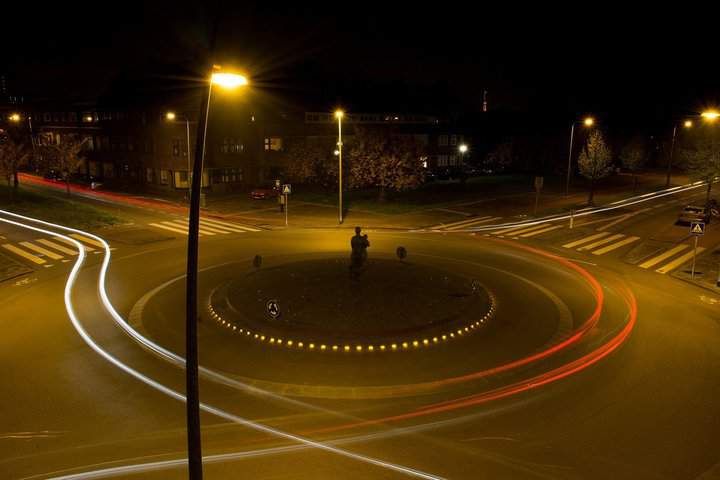
The orange glow isn’t a styling choice — it’s a physics consequence of the bulb chemistry. Sodium atoms, when energized in a vapor discharge, emit nearly all their light at the sodium D-line near 589 nm, which the eye perceives as a deep yellow-orange. Two flavors of sodium-vapor lamp end up on poles: low-pressure sodium (LPS) and high-pressure sodium (HPS).
How LPS Lamps Make Light
An LPS lamp contains solid sodium plus a neon-argon starter gas mixture. When current first flows, the neon and argon ionize and produce a dim red glow — that’s the warm-up phase. Heat from that discharge vaporizes the solid sodium over a few minutes. Once vaporized, sodium dominates emission, and the lamp settles into its characteristic monochromatic 589 nm yellow output. The argon (typically up to about 1%) is there to lower the starting voltage by as much as 50%.
How HPS Lamps Make Light
An HPS lamp uses a translucent ceramic arc tube containing a sodium-mercury amalgam plus xenon as a starter gas. A high-voltage pulse (around 2.5 kV) from the ballast ignites the xenon, which produces a soft grayish-white glow that warms and vaporizes the amalgam. In steady operation, sodium emission dominates — but the higher pressure broadens the sodium D-line (with mercury further pressure-broadening the spectrum), so HPS appears noticeably whiter than LPS and renders colors better. The blue-white cast you see at startup fades once the lamp is hot.
LPS vs. HPS at a Glance
| Property | Low-Pressure Sodium (LPS) | High-Pressure Sodium (HPS) |
|---|---|---|
| Luminous efficacy | ~100–180 lm/W (highest of any electric lamp) | ~80–140 lm/W |
| Color | Deep monochromatic yellow-orange (589 nm) | Warm amber-white, less monochromatic |
| Color rendering (CRI) | ≈ 0 (cannot distinguish color) | ≈ 20–25 (poor, but usable) |
| Typical lifespan | ~18,000 hours | ~24,000 hours |
| Common application | Tunnels, bridges, observatory zones; popular in Europe | General street and roadway lighting worldwide |
Note that color-corrected sodium-vapor lamps exist, but they cost more and have shorter lifespans, so they were never widely deployed.
What About Fog Penetration?
Yellow light scatters less in fog than blue-rich white light, which is why amber has long been associated with bad-weather visibility. Whiter light, on the other hand, supports better peripheral vision and slightly faster reaction times in clear conditions. There’s no single authority that has settled the trade-off, which is why fog lights on cars can be yellow, amber, or white — different national road authorities and standards bodies allow different choices.
Why Is Sodium Used In Street Lighting?
The Efficiency Argument
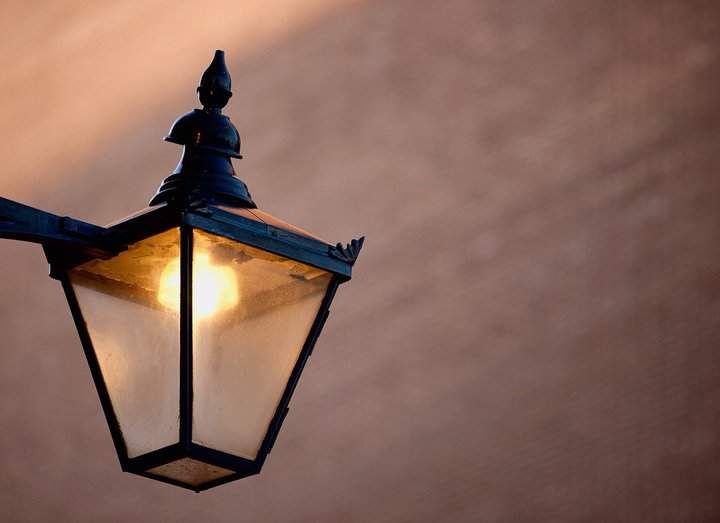
Sodium lamps win on raw lumens-per-watt because they emit almost all their energy at a single wavelength near the peak of the human eye’s sensitivity. Incandescent bulbs, by contrast, radiate across the full spectrum from infrared through UV — most of that output is wasted heat the eye can’t use.
The lumens per watt gap is dramatic:
- Incandescent: ~12–18 lm/W
- HPS: ~80–140 lm/W
- LPS: ~100–180 lm/W
That puts an HPS lamp roughly 5–10 times more efficient than an incandescent, and an LPS lamp even further ahead. When you’re buying power for millions of fixtures that run from dusk to dawn, that gap is the entire ballgame.
The Historical Context
Low-pressure sodium street lighting was first commercialized by Philips in 1932, with the first installation lighting the Beek–Geleen road in the Netherlands. High-pressure sodium followed in 1965, when General Electric introduced its Lucalox line — a breakthrough enabled by a new translucent aluminum-oxide ceramic arc tube that could survive the chemically aggressive sodium discharge at high pressure. Through the 1970s and 1980s, sodium lamps largely replaced earlier mercury vapor and incandescent street lights, and by the late 20th century the orange glow of HPS had become the default look of cities at night.
| Bulb Type | Lifespan | Lumens per watt |
|---|---|---|
| Incandescent | ~2,000 hours | 12–18 |
| HPS | ~24,000 hours | 80–140 |
| LPS | ~18,000 hours | 100–180 |
| LED (modern) | 50,000–100,000+ hours | 120–200+ |
These are typical ranges — exact figures vary by manufacturer, fixture, and operating conditions.
Why Weren’t Street Lights LED All Along?
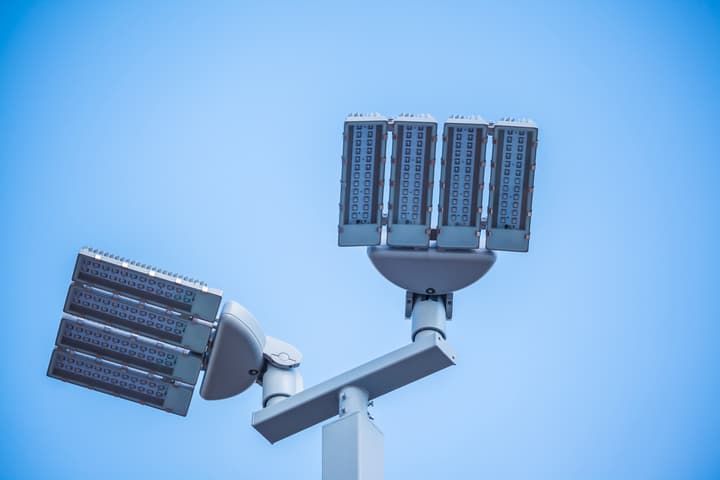
If LEDs are now more efficient and longer-lived than HPS, why aren’t they what was bolted to every pole in the first place? The answer is timing. The first visible LED was demonstrated by Nick Holonyak Jr. at General Electric on October 9, 1962 — but it was a tiny red indicator chip emitting milliwatts, not a roadway lamp. For decades after that, LEDs were status indicators on electronics, not light sources. High-brightness white LEDs suitable for street lighting didn’t exist commercially until the mid-2000s, and even then early fixtures cost hundreds of dollars apiece.
By the time LED street fixtures became viable, the world already had tens of millions of HPS poles in service, working reliably and cheap to keep running. Cities don’t replace working infrastructure on a whim — sodium lamps stayed because they were good enough and the up-front cost of swapping them out couldn’t be justified.
The Switch to LED Has Already Happened
That economic logic flipped a decade ago. Modern LED street lights now reach 120–200+ lm/W and last 50,000–100,000+ hours, so the lifetime energy and maintenance savings dwarf the install cost. Major retrofits are largely done:
- Los Angeles completed its 140,000-fixture cobra-head conversion by 2013, with decorative fixtures finishing around 2018–2019.
- New York City — which today maintains nearly 400,000 street lights — has effectively completed its LED retrofit, the largest such program in the U.S.
- New York State hit its 500,000 LED street light goal in 2022, ahead of its 2025 target.
- China and India lead globally, with LED penetration exceeding 85% and 75% of their installed bases respectively.
Industry projections from the IEA suggest LEDs will account for roughly 87% of global lighting installations by 2030. Where you still see orange glow today, you’re mostly looking at HPS fixtures that haven’t reached end of life yet — most municipalities only swap them as they fail or as funding cycles allow.
LEDs Bring More Than Just Efficiency
The case for LED isn’t just lumens-per-watt. Modern street-light fixtures are platforms for smart controls — motion-triggered dimming, scheduled output curves, and remote monitoring through networked nodes that report failures before crews are dispatched. A single utility can save 20–40% on top of the raw lamp efficiency just by dimming low-traffic streets after midnight.
Color rendering also flips entirely. LPS has a Color Rendering Index (CRI) of essentially zero — under it, a red car and a green car look the same dirty brown, which is the real reason witnesses struggle to identify vehicles in older sodium-lit zones. HPS is barely better at CRI ~20–25. Modern LED street lights typically rate CRI 70–90+, so faces, clothing, and vehicle colors actually look like themselves.
The Trade-Offs Worth Knowing
LED isn’t a clean win on every axis. The narrow-spectrum sodium lamps are actually friendlier on two fronts:
- Light pollution and skyglow. Blue-rich white LEDs scatter more in the atmosphere than monochromatic 589 nm sodium light, so a poorly chosen LED retrofit can worsen skyglow and disrupt astronomical observation. This is why dark-sky areas (and many observatory towns) still favor LPS, or specify warm-white LEDs at 2700 K or below with full cutoff fixtures.
- Wildlife and human health. Cool-white LED street lights with strong emission below 500 nm can suppress melatonin production and disrupt circadian rhythm in nearby residents, and have documented impacts on insects, sea turtles, and migratory birds. Warm-white spectra (≤3000 K) and well-shielded fixtures mitigate most of this — and the AMA has formally recommended these limits for residential street lighting.
These trade-offs don’t reverse the LED transition, but they do explain why the modern best-practice spec is a 2700–3000 K, full-cutoff, dimmable LED — not the harshest, brightest, coolest option.
Also read: Can LED Lights Power Solar Lights?
Final Words
The amber color of street lights is a fingerprint of one specific physical fact: sodium atoms emit almost all their light at 589 nm. That property made sodium lamps the most efficient option available for decades, which is why they ended up everywhere. The LED transition that finally displaced them isn’t a future event — it’s already done in most major cities, and the orange glow you still see is mostly the slow tail of fixtures running out their last hours before crews replace them with warm-white LEDs.