
Do LED Strip Lights Need To Be Plugged In?
Ten NiMH AA batteries in series deliver the same 12V as your AC adapter — and that swap is all it takes to cut the cord on a standard LED strip.
 Eugen
EugenEugen Nikolajev
Creator of LED Lighting Info
Hi, I am Eugen. I was always one of those kids who had all sorts of weird lighting gadgets for every occasion.
Now, I want to share my knowledge and experience about lighting with you on LED Lighting Info.
Read my editorial standards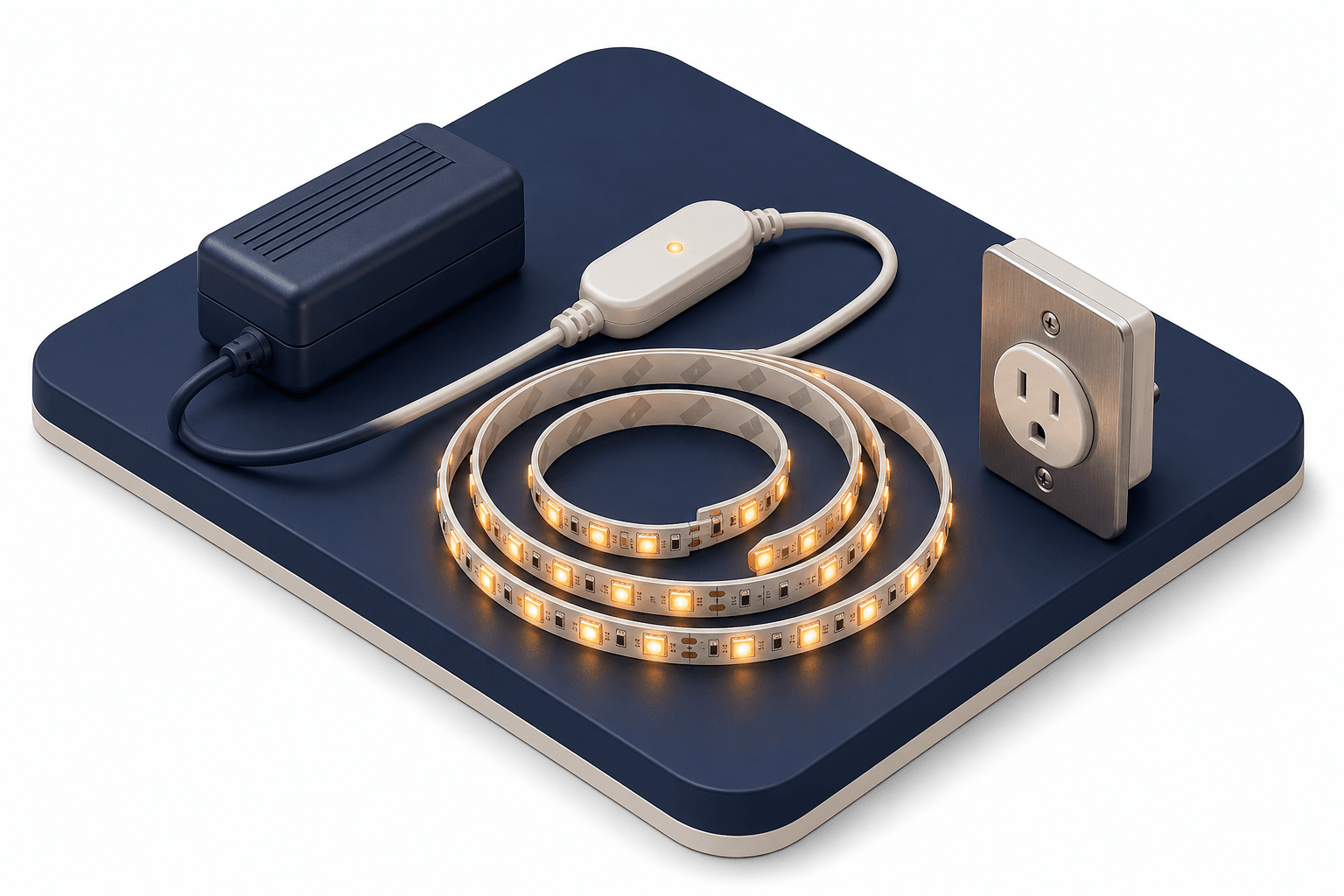
Key Takeaways
You can power LED strips without plugging them in. Some are designed to be battery-powered, others run from a USB power bank, and you can convert most plug-in strips to run from batteries with some rewiring. The trade-off is lifespan, batteries only last so long.
LED strips are perfect for spots where a traditional fixture won't fit — accent lighting on a shelf, coving along a ceiling, or under a kitchen cabinet. But every strip needs power, which raises an obvious question: does it always have to be plugged in?
Here's a quick reference for matching a power method to your situation. The rest of this guide walks through each option in detail.
| Situation | Recommended Power Method |
|---|---|
| Permanent install near an outlet | Mains-powered strip with an LED driver |
| Short-term or portable use, 5V strip | USB power bank |
| Awkward location, no nearby outlet | Battery-powered strip (AA or rechargeable pack) |
| Outdoor accent lighting | Solar-charged battery pack |
| Fairy or string accent lights | Coin cell (CR2032) battery pack |
Can LED Strip Lights Work Without A Plug?
Most LED strip lights sold are designed for plug-in use — many already have a plug attached or come bundled with an AC/DC adapter. But strips can run without one, because most don't need mains-level voltage in the first place. Common strips run on 5V, 12V, or 24V DC.
The strips most people buy for indoor accent lighting would be destroyed instantly if connected directly to mains. (There are specialty high-voltage AC LED strips for long architectural runs, but those are a different product category and aren't what's in the typical 5-meter Amazon reel.)
That's why plug-in strips don't connect to mains directly. They use a small power supply — properly called an LED driver or AC/DC adapter — that converts mains AC down to the low DC voltage the strip needs (commonly 12V or 24V). Replace that driver with a battery pack at the same voltage, and the strip works fine. (You'll see these called "transformers" in casual writing, but technically a transformer is just one component inside the driver, and the term will trip you up when shopping for a replacement.)
Why use batteries when mains is available? It comes down to lifespan versus location. If there's an outlet next to the install spot, mains makes sense — you get constant power. But many spots have no outlet within reach, and running cables behind walls or drilling through furniture might not be worth the effort. In those cases, a battery pack tucked behind the strip is far easier to hide than a long extension cord.
The trade-off is runtime. Even with rechargeables, there will be times you can only use the lights if the pack is charged.
Strip Lights That Don't Require To Be Plugged In
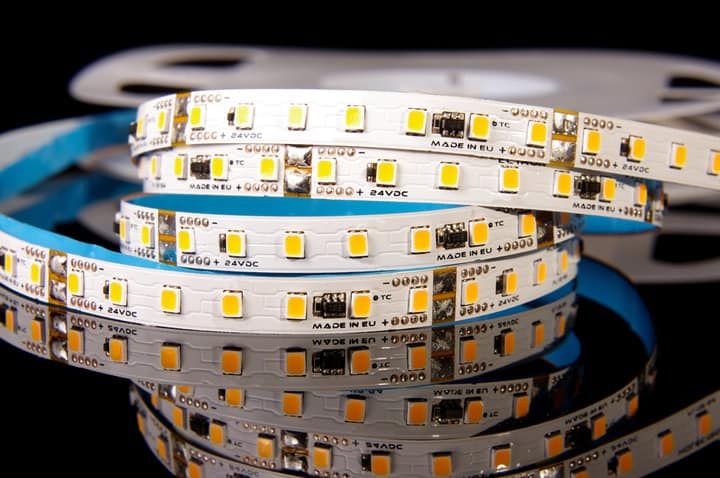
The simplest option is to buy a strip designed for batteries from the start. Most LED strips in stores ship with plugs, but battery-powered versions are easy to find. Here's how a few popular options compare.
| Product | Batteries | Voltage | Estimated Runtime | Notes |
|---|---|---|---|---|
| JUNWEN white strip | 3× AA | ~4.5V | Up to 50 hrs (claimed) | White light, low-power LEDs |
| Dervacle 2-pack (20 ft) | 4× AA | 5V | ~4–6 hrs | Colored (RGB) |
| RUISHINE smart strip | 3× AA | 5V | ~3–5 hrs | Smartphone control |
| RTGS fairy lights | 2× CR2032 | ~3V | ~24 hrs | Decorative, non-rechargeable cells |
Product links: JUNWEN white strip, Dervacle 2-pack, RUISHINE smart strip, RTGS fairy lights (all Amazon).
A note on the runtime column: those figures assume continuous use at full brightness. For real-world accent lighting — say, two hours an evening — a strip rated for 16 hours of runtime gives you about a week between charges. That's the lens to apply when comparing claimed runtimes. Manufacturer "up to" numbers are usually measured under ideal low-drain conditions, so treat them as a ceiling.
Also worth flagging: the RTGS fairy lights use disposable CR2032 cells rather than rechargeables. If you'd rather not keep buying batteries (and for everything else in this article, I'd recommend NiMH rechargeables), that's an exception. The cells are cheap, but you'll be replacing them.
One more thing to weigh upfront: battery-powered strips tend to be noticeably dimmer than their mains-powered cousins. That's a combination of lower voltage tolerances, simpler driver circuits, and cheaper LED binning to keep current draw down. If full brightness matters — say, for a kitchen task light — go with a mains-powered strip or a USB power bank instead.
USB Power Banks: The Underrated Option
For any 5V strip, a standard USB power bank is the cleanest battery-free-but-unplugged solution. The strip plugs in exactly as it would to a USB wall charger — the difference is that the power bank is portable and rechargeable. A 10,000 mAh bank stores roughly 37 Wh of energy, which at a typical 3W strip draw works out to around 10–12 hours of runtime. Recharge it like a phone.
Solar Battery Packs
For outdoor accent lighting, small solar battery packs are increasingly common. A panel charges an integrated battery during the day; the strip runs off the battery at night, often switching on automatically via a light sensor. They suit low-power accent strips much better than full-brightness indoor lighting, but for a deck rail or garden path they remove the wiring problem entirely.
Important Safety Warning
⚠️ A 5V strip must be powered by a regulated 5V source, that means a USB battery pack, a computer USB port, or a USB wall charger (the small cube-style adapter that converts mains to 5V DC). Plugging a 5V USB strip into a real USB wall charger is safe and normal. What is not safe is stripping the USB cable and wiring it directly into a mains outlet, or running the strip from an unregulated source. Check the wall charger's amp rating, too, it must meet or exceed what the strip needs, otherwise the strip will be dim and the adapter may overheat. And cheap battery-powered strips without UL, CE, or ETL certification can be a genuine fire hazard, so look for those marks before buying.
How To Power Plug-In Strip Lights With Batteries
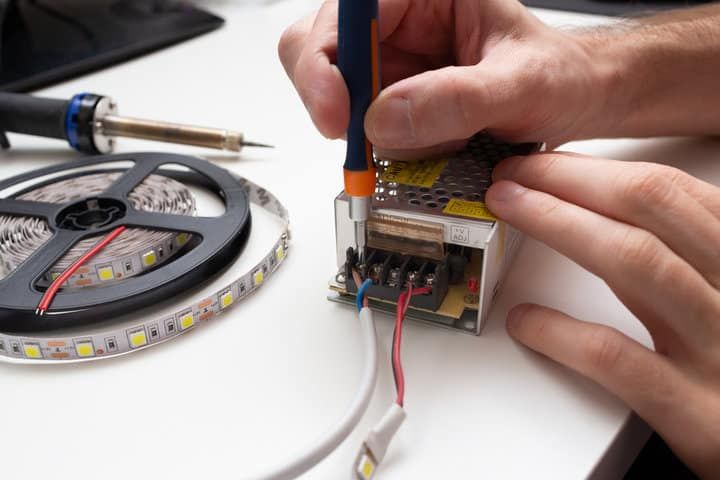
Converting a plug-in strip to run on batteries is doable, but it involves some rewiring. The most important rule: match the battery pack's total voltage to whatever the strip is rated for.
Disposable alkaline AA and AAA cells provide a nominal 1.5V each, so eight in series add up to the 12V a typical 12V strip needs. Rechargeable NiMH cells — which I'd recommend, so you're not constantly buying disposables — only put out about 1.2V per cell, so you'll need ten in series (10 × 1.2V = 12V) to drive the strip at full brightness. In either case the cells must be wired in series (positive to negative, all the way down the chain). Wiring them in parallel just gives you the voltage of a single cell.
The basic process:
- Identify your strip's required voltage and current draw — both are usually printed on the reel or on the original AC adapter.
- Calculate the number of batteries needed in series: 8× alkaline AA or 10× NiMH AA for a 12V strip, for example.
- Choose a battery holder (or a USB power bank, for 5V strips) with the right output connector — typically a barrel DC plug.
- Connect the holder to the strip. If the strip has a DC barrel jack, plug straight in. Otherwise, solder a matching connector onto the strip's input wires, carefully cutting away the old cable.
- Test the strip before permanent installation: verify the polarity is correct and that the strip runs at expected brightness.
For a deeper walkthrough, see my guide on powering LED strip lights with batteries.
Final Words
If you'd rather not drill through furniture or trail long power cables, a battery- or power-bank-powered strip is often the right call. Match the power source to the strip's voltage, lean on rechargeables where you can, and make sure any USB cable feeds into a proper 5V source — never directly into mains.