
How To Power LED Strip Lights With Batteries? (Connection Diagram)
Eight AA cells in series make 12V but still hold the capacity of just one — about 28.8 Wh, not the 230 Wh you might expect. That single math trap explains most battery-powered LED strip disappointments.
 Eugen
EugenEugen Nikolajev
Creator of LED Lighting Info
Hi, I am Eugen. I was always one of those kids who had all sorts of weird lighting gadgets for every occasion.
Now, I want to share my knowledge and experience about lighting with you on LED Lighting Info.
Read my editorial standards
Key Takeaways
LED strip lights can run on batteries, but the pack's output voltage must match the strip — too much will damage it, too little leaves it dim or dark. A 3-meter low-density 12V strip lasts roughly 2 hours on 8 AA alkaline batteries. Higher-density strips drain them in well under an hour.
Battery-powered LED strip lights are a real option for outdoor accents, RVs, boats, camping setups, or anywhere mains wiring isn't practical. The catch: batteries drain fast, and the math for sizing them is easy to get wrong.
Can you power LED strip lights from batteries? Yes — but you need to match the strip's voltage exactly and budget realistically for runtime.
Common reasons to go battery-powered:
- Outdoor accent or garden lighting where running a cable is impractical
- RV interiors, boat cabins, and camping setups
- Under-shelf or cabinet lighting without a nearby outlet
- Temporary event or party lighting
- Emergency or power-outage backup lighting
How To Connect LED Strip Lights To A Battery Pack
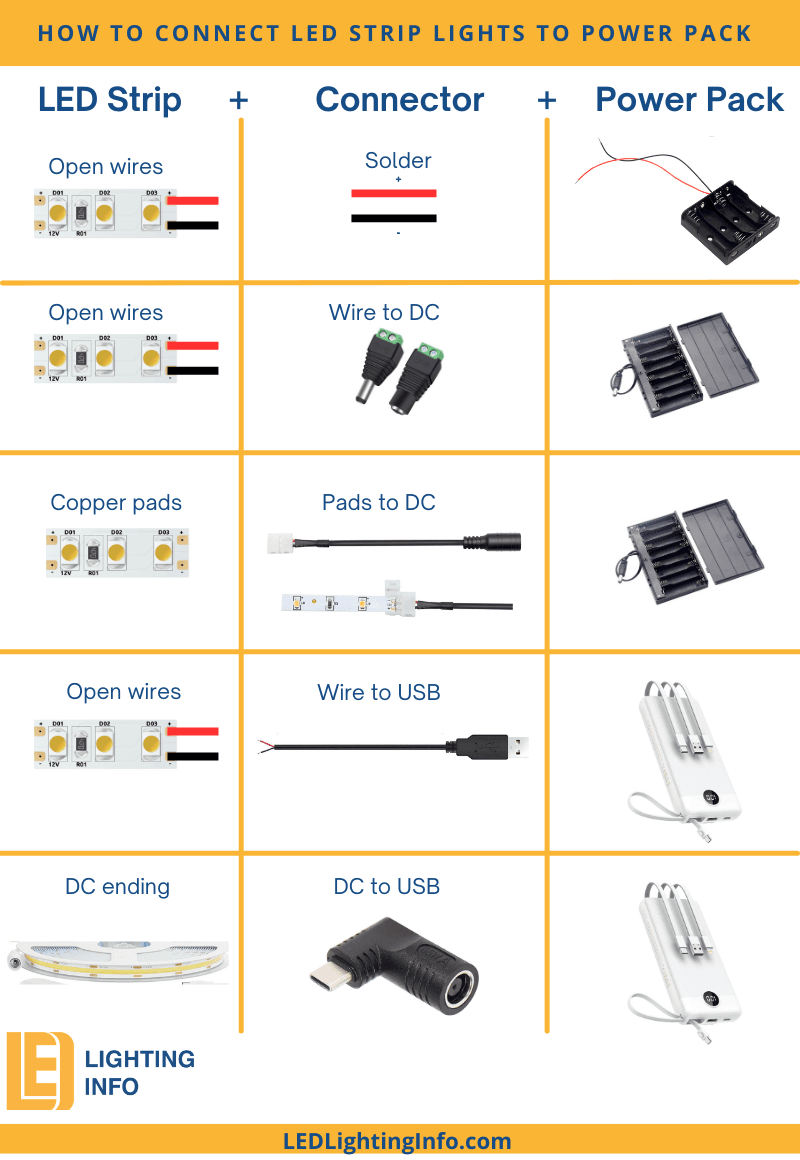
How you connect depends on whether your strip uses a DC barrel plug, exposed copper pads, or loose wires.
Here is a simple visual diagram.
Strips Designed For DC Power
The easiest option is a strip that uses a DC barrel jack. Instead of plugging it into a wall adapter, plug it into a battery box or a power bank with a DC output. No rewiring — it just works.
Strips With Exposed Copper Pads
If your strip ends in exposed copper pads, you'll need a clip-on connector. Use a 2-pin adaptor for a DC battery pack, or these connectors for an open-wire battery source. Match the connector's pin count to the strip's pad count.
Strips With Loose Wires
For a strip with loose wires, pair it with a battery pack that also has loose wires. Connect positive (+) to positive and negative (−) to negative. LED strips are DC, so there is no "neutral" wire as you'd see in AC home wiring.
You can join the wires with a low-voltage connector, or solder them and insulate the joint with heat-shrink tubing.
Safety Notes
- Polarity: connect (+) to (+) and (−) to (−). Reversed connections usually won't damage modern strips, but the strip won't light.
- Avoid short circuits: never let bare positive and negative wires touch. Use proper connectors or insulate solder joints with heat-shrink.
- Lithium cells (especially unprotected 18650s) can fail dangerously if over-discharged. Use a pack with built-in protection or add a low-voltage cutoff.
- For outdoor or damp locations, use an IP65 (or higher) rated strip and house the battery pack in a dry, ventilated enclosure.
How To Estimate Runtime

Three short steps gets you a runtime estimate:
- Total Strip Wattage (W): watts per meter (or per foot) × strip length.
- Total Watt-Hours (Wh): battery mAh × battery output voltage ÷ 1,000.
- Estimated Runtime (hours): Wh ÷ W.
Worked example: a 12W LED strip on a dedicated 24,000 mAh / 12V battery pack → 24,000 × 12 ÷ 1,000 = 288 Wh; 288 ÷ 12 = 24 hours of theoretical runtime. In practice, expect 70–85% of that under real load.
Two Caveats That Trip Up Most Calculations
AA/AAA cells in series: only voltage adds, not capacity. Eight AA cells wired in series make 12V but still hold the capacity of a single cell — about 2,400 mAh on a quality alkaline, or roughly 28.8 Wh, not 230 Wh. Multiplying capacity requires parallel strings stacked alongside the series chain, which means a lot more cells.
USB power banks: the printed mAh is rated at the 3.7V cell voltage, not the 5V output. A 12,000 mAh power bank typically delivers around 44 Wh at its 5V port after conversion losses. Standard banks output 5V only; getting 12V requires a USB-PD or QC bank with a 12V trigger cable, or a dedicated 12V battery pack.
Here are realistic runtime estimates for common setups:
| Strip | Total wattage | Battery pack | Watt-hours | Estimated runtime |
|---|---|---|---|---|
| Kasa 16.4 ft strip | 12W | 8 × AA in series (12V, ~2,400 mAh) | ~28.8 Wh | ~2.4 hours |
| Kasa 16.4 ft strip | 12W | 24,000 mAh @ 12V battery pack | 288 Wh | ~24 hours |
| Hue 6 ft 8" strip | 20W | 8 × AA in series (12V, ~2,400 mAh) | ~28.8 Wh | ~1.4 hours |
| Hue 6 ft 8" strip | 20W | 24,000 mAh @ 12V battery pack | 288 Wh | ~14.4 hours |
| 3 × Kasa 16.4 ft chained | 36W | 8 × AA in series (12V, ~2,400 mAh) | ~28.8 Wh | ~0.8 hours |
| 3 × Kasa 16.4 ft chained | 36W | 24,000 mAh @ 12V battery pack | 288 Wh | ~8 hours |
AA packs are cheap but short-lived. For anything longer than a couple of hours, a dedicated 12V lithium pack is dramatically more practical.
Battery Requirements For LED Strips
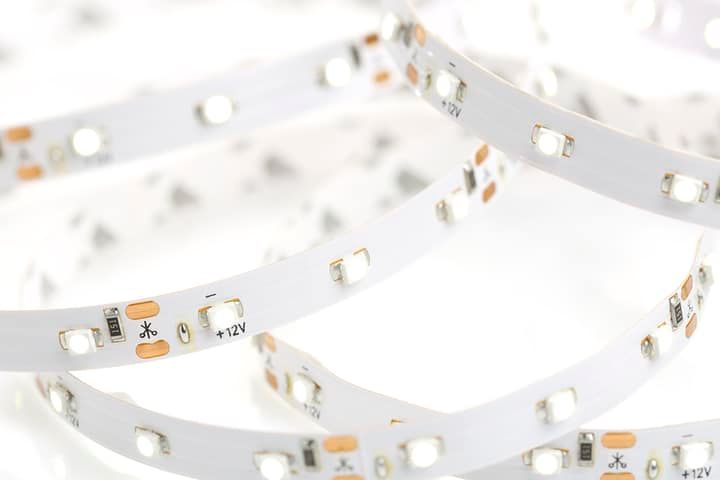
Two things drive battery sizing: the strip's voltage rating, and its total wattage.
Match The Voltage
LED strips come in three standard low-voltage ratings: 5V, 12V, and 24V.
- 5V strips run from a USB cable — by far the easiest match for a battery, because any standard USB power bank works.
- 12V is the most common rating for indoor and under-cabinet installations.
- 24V strips are typically used for longer runs where voltage drop matters — and they're the hardest to feed from batteries.
Mains-powered strips include a small transformer that drops AC down to the strip's DC voltage. Battery packs don't, so the pack's output voltage must match the strip exactly. Underpower it and the strip is dim or won't light at all (its current-limiting resistors are sized for the rated voltage). Overpower it and you'll over-drive the LEDs and shorten their life — or destroy them outright.
Here are typical battery output voltages:
| Battery type | Output voltage |
|---|---|
| AA / AAA | 1.5V each |
| 9V (rectangle) | 9V |
| Coin cell | 1.5V or 3V (depending on chemistry) |
| Standard USB power bank | 5V |
| USB-PD / QC power bank with trigger cable | 5V / 9V / 12V / 15V / 20V |
| Dedicated DC battery pack | 12V (often selectable) |
Coin cells are fine for an LED strip remote but not for the strip itself — they're hard to chain and have very little capacity. The other types can all work with the right setup.
Powering A 5V LED Strip
5V strips are the simplest battery option. Plug the strip's USB cable into any standard USB power bank and you're done. Brightness is modest, but installation is trivial — and a typical 10,000–20,000 mAh power bank will run a short 5V strip for several hours.
Powering A 12V LED Strip
For an inexpensive route, buy a battery box (or holder) sized for 8 AA or AAA cells — chained in series, that gives 12V. Runtime will be short — typically 1–2 hours for a low-density strip — because AA cells in series share the capacity of a single cell.
Skip the single 9V battery. Its tiny ~550 mAh capacity gives only minutes of runtime, and at 9V the 12V strip will be very dim or fail to light at all because its resistors are sized for 12V input.
For longer runtime, the best option is a dedicated 12V lithium battery pack or a USB-PD power bank paired with a 12V trigger cable. Some packs offer selectable output voltage so you can power 12V or 24V strips from the same hardware.
Powering A 24V LED Strip
24V is trickier. You can put two 12V battery packs in series, or chain 16 AA cells (typically two 8-cell holders connected end to end).
Charging 16 rechargeable AAs is a logistical hassle: most consumer chargers are 4-slot, with 8-slot models commonly available — so plan on two charging cycles or two chargers.
9V batteries don't help here either. Two in series only give 18V (under-volting the strip), and three give 27V — slightly above a 24V strip's spec, which can shorten LED life. And at ~550 mAh per battery, runtime is measured in minutes regardless. Coin cells stay ruled out at any voltage.
12V vs 24V At A Glance
If you want to power an LED strip from a battery, life is much easier if you stick with 12V.
| Factor | 12V strip | 24V strip |
|---|---|---|
| Battery sourcing | Easy — 8 AAs, common 12V packs, USB-PD with 12V trigger | Harder — 16 AAs or two 12V packs in series |
| Voltage matching | Many off-the-shelf options | Requires series wiring or a specialty 24V pack |
| Charger logistics | Standard 4-slot AA charger covers it | Two charging cycles or a multi-slot charger |
| Recommended for battery use | Most home and DIY setups | Long runs needing low voltage drop, with a robust battery solution |
There are also ready-made battery-powered strip lights that skip the wiring entirely. Most of these run on 3 or 4 AA batteries — 4.5V or 6V — so brightness is modest. Convenient, but no substitute for a proper 12V install when you want serious output. (More on why most LED strips are 12V or 24V here.)
FAQ
Can I use a USB power bank for LED strips?
Yes — a standard 5V USB power bank works directly with 5V LED strips. For 12V or 24V strips, you'll need a USB-PD or QC power bank paired with a 12V trigger cable, or a dedicated DC battery pack.
What happens if I use the wrong voltage?
Too low: the strip is dim or doesn't light at all, because its current-limiting resistors are sized for the rated voltage. Too high: the LEDs are over-driven and can be damaged immediately or burn out faster than rated. Always match the strip's voltage exactly.
How do I know if my LED strip is 5V, 12V, or 24V?
The voltage is usually printed on the strip itself between the cut marks, on the connector or driver, and on the original packaging or product listing. Don't guess — measure or check the documentation before connecting a battery.
Can I recharge AA batteries while the strip is running?
Not in the same circuit — you'd need to disconnect the pack to charge it. Some setups use a pass-through power bank that can charge over USB while powering a 5V strip from its output.
Can you convert plug-in LED strips to battery power?
Yes. Strips that use a DC barrel plug aren't usually hardwired to it, so you can swap the wall adapter for a matching battery pack. Just make sure the pack's output voltage matches the strip exactly.
Final Words
Battery-powered LED strips earn their keep in specific situations — outdoor accents where running a cable is impractical, RVs and boats, camping, under-cabinet runs without a nearby outlet, temporary event lighting. For an always-on installation in a room with available outlets, mains power is far more practical: longer runtime, no recharging, and no voltage matching headaches.
If you do go battery, the two non-negotiables are matching the strip's voltage exactly and budgeting honestly for the runtime. AA packs in series are cheap but short-lived; a dedicated 12V lithium pack or a USB-PD bank gives you much more useful time per charge.
Once you've chosen your strip, see my guide on sticking LED lights to the wall for a hassle-free install.