
What Does A 2-Way Dimmer Switch Mean?
A UK '2-way' dimmer and a US '3-way' dimmer are the exact same hardware — different continents, different label. Order by terminal count instead and you'll always get the right switch.
 Eugen
EugenEugen Nikolajev
Creator of LED Lighting Info
Hi, I am Eugen. I was always one of those kids who had all sorts of weird lighting gadgets for every occasion.
Now, I want to share my knowledge and experience about lighting with you on LED Lighting Info.
Read my editorial standards
Key Takeaways
A 2-way dimmer switch (called a 3-way in the US) lets you control a light from two locations — typically paired with a second switch at the other end of the circuit. It's the standard setup for staircases, hallways, and rooms with multiple entrances, so you never have to cross a dark space to reach the only switch.
Shop for dimmer switches online and you'll see the same product listed as a '2-way' on a UK site and a '3-way' on a US site. The hardware is identical — only the naming convention differs. Ordering the wrong one for your circuit means a return trip and a stalled project.
That naming confusion is the reason this guide exists. Here's what each term actually means, when you need each type, and how to wire one safely.
There's a bit more to unpack, so this guide covers:
- The different types of dimmer switches and their wiring
- The benefits of a 2-way/3-way switch
- How to wire a 2-way/3-way switch
- LED compatibility and load limits
Different Types of Dimmer Switch Wiring
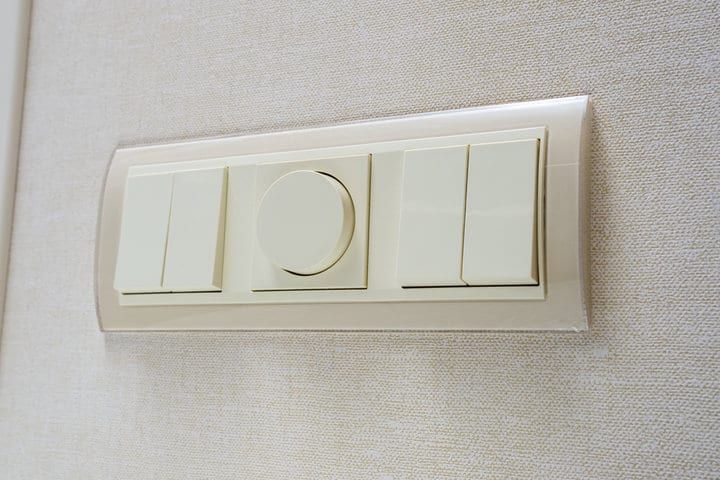
Despite the three labels you'll see on packaging — 1-way, 2-way, 3-way — there are really only two functional types of single-circuit switch (plus a third intermediate type for chains of three or more control points). The labels just differ by region:
| Region | Single Location | Two Locations | Three+ Locations |
|---|---|---|---|
| UK / EU | 1-way | 2-way | Intermediate |
| US | Single-pole | 3-way | 4-way |
In US electrical terminology (NEC), a single-location switch is called single-pole — there is no '2-way' label on Eaton, Leviton, or Lutron packaging or at major US retailers. The UK/EU equivalent is '1-way.' These have two terminals: line in and load out.
For two-location control, the UK/EU '2-way' switch is functionally identical to the US '3-way' switch (both are SPDT — single-pole, double-throw). They have three terminals: one common and two travelers.
For three or more control points, you'll need an intermediate switch (UK/EU) or a 4-way switch (US) wired in the middle of the chain between two end switches.
Practical tip: when ordering from a global retailer like Amazon, ignore the regional naming and check the terminal count. Two terminals means single-pole/1-way; three means 3-way/2-way; four means 4-way/intermediate.
Benefits Of 2-Way/3-Way Switch Wiring
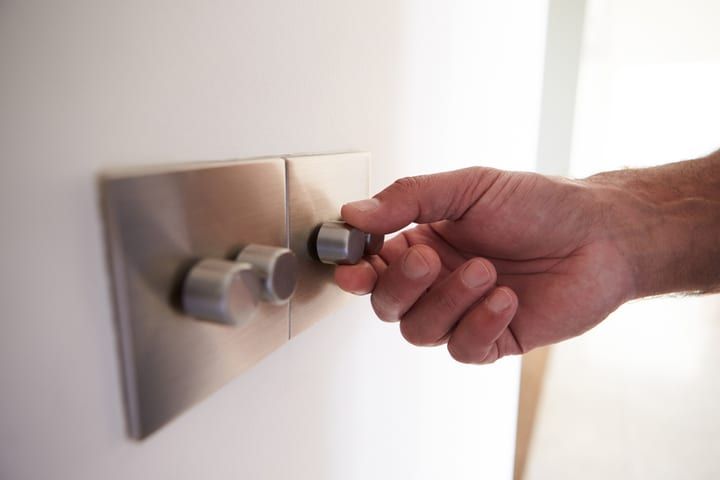
How the circuit works
Each 3-way switch (SPDT) routes current down one of two traveler wires — like a railway switch sending a train onto one of two tracks. The light is on when the path through both switches is connected end-to-end, and off when either switch breaks the path. Flipping either switch toggles the state.
A common misconception is that both switches must be in the 'same position' for the light to come on. That depends entirely on how the travelers are connected at each end — the toggle labels don't fixed-map to on/off. The defining behavior is simply that either switch toggles the light.
Practical benefits
- Convenience — control the same light from either end of a hallway, staircase, or a room with multiple entrances.
- Safety — no need to walk through a dark space to reach the only switch.
- Dimming flexibility — set the brightness once at the dimmer, then use the companion switch for normal on/off.
Can you use two dimmers?
Brightness can normally only be adjusted from the dimmer end. You can't simply install two standard single-pole dimmers in a 3-way circuit — they aren't designed to coordinate through the traveler wires, and doing so causes flickering, premature failure, or overheating.
To dim from both locations, use a 3-way dimmer kit — a master dimmer plus a matching companion accessory from the same manufacturer (for example, a Lutron Maestro 3-way kit). Multi-location dimmer systems also exist for setups with three or more control points.
Wireless alternatives
If you don't already have traveler wires pulled between the two boxes, smart dimmer systems like Lutron Caseta or Leviton Decora Smart let you add a wireless companion control without running new cable. The master dimmer goes in the existing single-pole box, and a battery-powered remote or pico acts as the second control point. The rest of this guide covers traditional wired 3-way setups.
How To Wire A 2-Way/3-Way Dimmer Switch
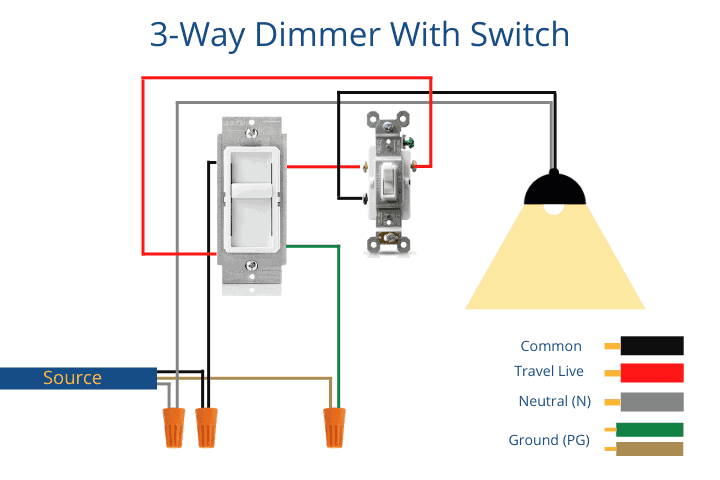
Before you start: Switch off the breaker for the circuit and confirm the wires are dead with a non-contact voltage tester. In some jurisdictions, electrical work inside the wall box must be done by a licensed electrician — check your local code before opening the plate.
Wiring a 3-way dimmer is straightforward if you take it slowly and label each wire before disconnecting it.
For most 3-way dimmer kits, the dimmer (master) must be installed on the line side of the circuit — the box where the hot wire arrives from the breaker panel — with the companion switch on the load side. Installing the dimmer on the wrong end can damage the unit or cause it to malfunction. Always check the manufacturer's installation guide for the kit you've bought.
- Connect the mains hot wire to the common terminal on the dimmer switch (line side).
- Connect one traveler terminal on the dimmer to one traveler terminal on the companion switch.
- Connect the second traveler terminal on the dimmer to the second traveler terminal on the companion switch.
- Connect the common terminal on the companion switch to the load — the wire running to the light fixture.
If the switches have ground terminals, connect them to the ground cable in each box (bare copper or green in US installs, green-and-yellow striped in UK/EU installs).
Older analog dimmers often don't require a neutral wire, but most modern smart and LED-compatible dimmers do — the Lutron Caseta PD-5NE and Leviton Decora Smart line both need one. Check the spec sheet before buying: installing a neutral-required dimmer in a box without a neutral conductor won't work and can be unsafe. If your switch has a neutral terminal, connect it to the neutral wire in the box. (More on dimmer switch wiring.)
LED Compatibility And Load Limits
Not every dimmer plays nicely with LED bulbs. Two things to check before you buy:
- LED-rated dimmer — older incandescent dimmers often cause LEDs to flicker, buzz, or fail to dim smoothly. Look for 'LED compatible' or 'CL' (CFL/LED) on the packaging.
- Minimum load — many dimmers have a minimum wattage requirement (often 25–40W). Driving a single low-wattage LED below that threshold causes flickering or unstable behavior. Either add a higher-wattage bulb or pick a dimmer rated to a lower minimum.
Lutron and Leviton both publish searchable bulb-compatibility databases for their dimmers — worth a check before you buy a six-pack of bulbs.
Final Words
The naming difference between '2-way' (UK/EU) and '3-way' (US) is just a regional convention — the underlying SPDT switch is the same hardware on both sides of the Atlantic. Match the terminal count to your circuit, pick a dimmer rated for your bulb type, install the master on the line side, and a multi-location dimmer setup is well within reach for a careful DIYer.