
Can A Dimmer Switch Cause A Breaker To Trip?
Random trips and instant trips look the same from across the room, but they point to completely different faults — and fixing the wrong one won't stop the tripping.
 Eugen
EugenEugen Nikolajev
Creator of LED Lighting Info
Hi, I am Eugen. I was always one of those kids who had all sorts of weird lighting gadgets for every occasion.
Now, I want to share my knowledge and experience about lighting with you on LED Lighting Info.
Read my editorial standards
Key Takeaways
A bad dimmer switch can definitely trip a breaker. A loose connection inside the dimmer can arc, tripping an AFCI breaker at random intervals. If the breaker trips instantly when you turn the lights on, the dimmer is most likely overloaded. Other dimmer faults won’t trip a breaker, but they will cause flickering, buzzing, or overheating.
Dimmer switches are more complex than standard light switches, and that complexity occasionally causes problems — including tripped breakers.
Signs Your Dimmer Switch Is Failing
Even when the breaker isn’t tripping, a failing dimmer usually announces itself. Watch for these symptoms:
- The dimmer not dimming all the way down, cutting the lights out early
- A loud buzzing sound coming from the dimmer
- Excessive heat — a warm dimmer is normal, but ‘hot’ is a bad sign
- Visible physical damage to the dimmer, including cracking
- The switch on the dimmer losing its snap or feeling loose
If you notice any of these issues, replace the dimmer before the problem escalates into a tripped breaker or worse.
Can A Bad Dimmer Switch Trip The Circuit Breaker?
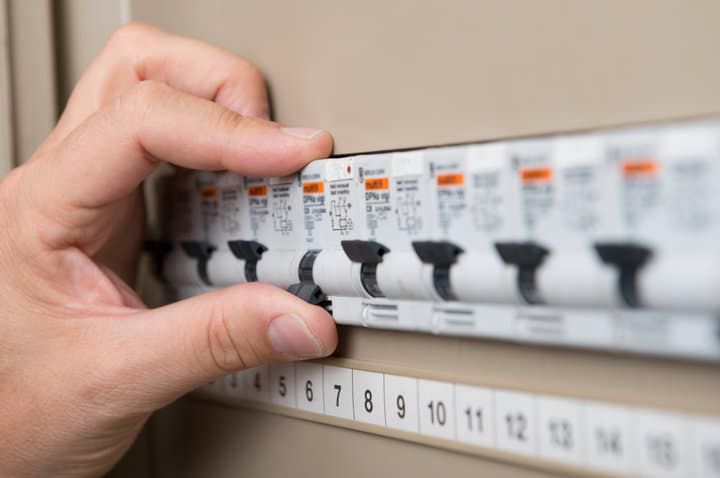
Dimmer switches generally last many years — often a decade or more — but they aren’t infinite. An unsuitable model for your load, a low-quality unit, or simple wear can shorten that life considerably.
When a dimmer does fail, it can trip the breaker in two distinct ways: randomly (a sign of arcing) or instantly (a sign of overload). The two have different causes and different fixes, both of which are covered below. In many cases, the dimmer fails without tripping the breaker at all — instead producing the symptoms listed above.
What Causes A Breaker To Randomly Trip When Dimmer Is On?

It’s frustrating when the lights cut out for no apparent reason and reset themselves the moment you flip the breaker back on. The most common cause of repeated random tripping on a dimmer circuit is a loose connection somewhere — but a single, isolated trip is usually something less serious.
A one-off trip is most often a nuisance trip: a brief inrush from another appliance starting up on the circuit, or an AFCI reacting to electrical noise from a motor or power supply. If it only happens once and never repeats, you can usually ignore it. Repeating random trips, however, point to a loose connection arcing somewhere in the circuit.
With a loose connection, current normally flows fine, but a small or intermittent gap exists in the circuit. When that gap reaches a certain distance, the current jumps across it — a phenomenon called arcing — to maintain its flow. Arcing produces heat and small surges, and is one of the leading causes of electrical fires.
This is exactly what an AFCI (Arc-Fault Circuit Interrupter) is designed to catch. AFCIs detect the electrical signature of arcing and flip the breaker before a fire can start. Modern US homes are required to have AFCI protection on most habitable-room circuits, including hard-wired lighting, under current NEC rules — so a randomly tripping breaker is often the AFCI doing its job.
If your AFCI breaker is tripping randomly, investigate for a loose connection — likely at the dimmer itself, a junction box, or a light fixture.
It may not be a loose wire that you can see; it could be a loose internal connection inside the dimmer. If so, you’ll often feel heat coming from the dimmer or notice the switch has lost its snap. Replacing the dimmer should stop the tripping.
Breaker Keeps Tripping When Light Switch Is Turned On
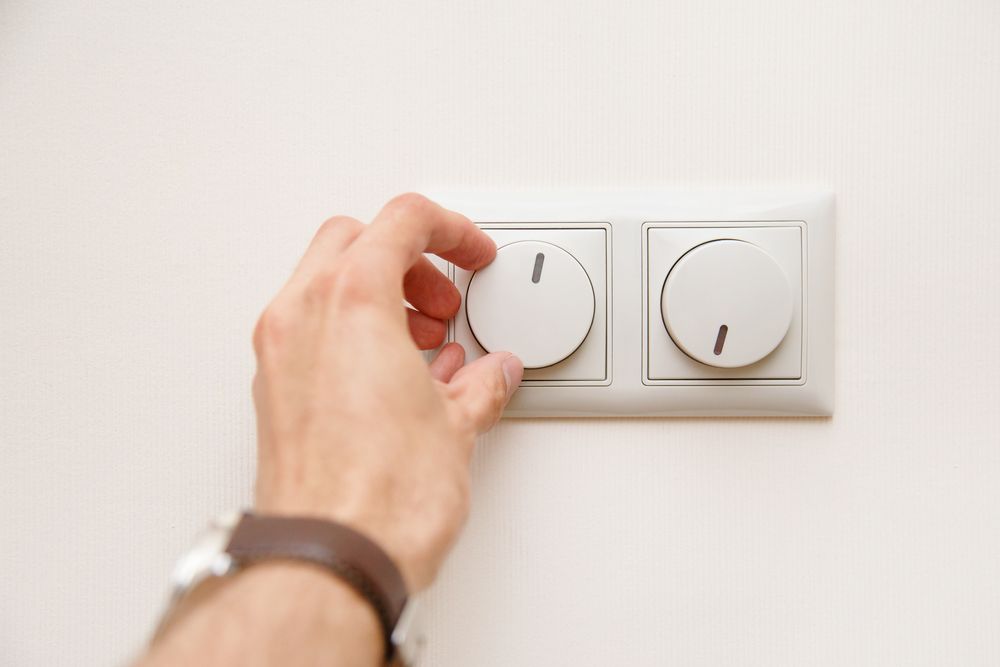
If the breaker trips immediately every time you flip the dimmer on, the most likely cause is that you’ve overloaded your dimmer switch.
A typical US lighting circuit is fed by a 15-amp breaker on 120V, giving a theoretical maximum of 1,800W (15 × 120). However, the NEC’s 80% rule for continuous loads means the practical safe ceiling is 1,440W (12A × 120V). Loading a circuit above that risks nuisance trips and overheated wiring.
But while a regular light switch isn’t wattage-limited (it’s just a mechanical break in the circuit), a dimmer is — and most dimmers can’t handle anywhere near 1,440W on their own. Common dimmer ratings are 150W, 300W, 600W (the most common), and 1,000W.
Here’s how those ratings translate into bulbs of different types:
| Dimmer Rating | Max Incandescent (60W) | Max Halogen (50W) | Max LED (10W) |
|---|---|---|---|
| 150W | 2 | 3 | 15 |
| 300W | 5 | 6 | 30 |
| 600W | 10 | 12 | 60 |
| 1,000W | 16 | 20 | 100 |
Modern LEDs draw only 6–10 watts each, so a 600W dimmer can theoretically handle 60–100 LED bulbs (600W ÷ 8W ≈ 75 bulbs). A small 150W dimmer, by contrast, can be overloaded by as few as 15–20 LEDs. Older incandescent or halogen bulbs reach the limit far faster — six 100W incandescents already overload a 600W dimmer.
There’s one commonly missed factor: multi-gang derating. When you install multiple dimmers in a single wallbox, the heatsink fins on each unit usually need to be broken off to make them fit. That reduces their thermal capacity, and manufacturers require you to derate the maximum wattage — sometimes by as much as 50% in a three-gang or larger box. Always check the manufacturer’s derating chart before ganging dimmers.
If the breaker is tripping immediately, check that your bulbs aren’t overloading the dimmer. Every time you turn an overloaded dimmer on, you damage the dimmer switch further. Even after swapping in lower-wattage bulbs, you may still need to replace the dimmer itself.
If overloading isn’t the problem, an instantly-tripping breaker points to a more severe fault — typically a short circuit somewhere in the wiring. That kind of fault needs a licensed electrician to inspect the entire circuit.
Dimmer-Bulb Compatibility
Not every LED bulb is dimmable, and even among dimmable LEDs, not every bulb works smoothly with every dimmer. Most older dimmers are TRIAC-based, designed for the resistive load of incandescent bulbs — and the small, capacitive load of an LED can confuse them.
Mismatched LED-and-dimmer combinations can produce many of the same symptoms as a failing dimmer:
- Flickering or strobing at low dim levels
- Buzzing from the dimmer or the bulb itself
- Bulbs refusing to dim below 30–50% brightness
- The dimmer running unusually hot
- Occasional nuisance trips of an AFCI breaker
Before assuming the dimmer itself is bad, verify that:
- The bulbs are explicitly marked “dimmable”
- The dimmer is rated for LED loads (look for an “LED/CFL” marking or a published LED minimum-load specification)
- The bulbs appear on the dimmer manufacturer’s compatibility list — Lutron, Leviton, and other brands publish these online
A non-dimmable LED on a dimmer circuit can mimic the exact symptoms of a worn-out switch, so this is one of the first things to rule out.
When To Call A Licensed Electrician
Replacing a dimmer is generally a job a competent DIYer can handle — provided you switch off the power at the breaker first and verify it with a non-contact tester. But some situations call for a professional:
- An AFCI breaker keeps tripping after you’ve already replaced the dimmer — that points to active arcing somewhere else in the circuit
- The breaker trips instantly even with verified-compatible bulbs and a correctly rated dimmer
- You smell burning, see scorch marks, or notice melted insulation at any switch, outlet, or fixture
- The wiring in the box is aluminum, brittle, or shows discoloration
- You’re not 100% certain you can identify the line and load wires correctly
Persistent tripping after a dimmer swap usually means the fault isn’t in the dimmer — and chasing a fault through finished walls without proper test equipment is risky.
Final Words
A bad dimmer can trip a breaker, but it isn’t the most common cause of a tripping circuit. Usually it’s either an overloaded dimmer (instant trips) or a loose internal connection causing arcing (random trips). Both are fixable, and most of the time replacing the dimmer is enough.
Just remember to switch off the power before doing anything electrical, and don’t hesitate to call a licensed electrician if the problem persists after you’ve checked the basics covered above.