
How To Find Buried Landscape Lighting Wire?
Tilt your wire locator to 45° and walk perpendicular to the cable — the distance you travel equals the burial depth, thanks to the equal legs of a 45-45-90 triangle.
 Eugen
EugenEugen Nikolajev
Creator of LED Lighting Info
Hi, I am Eugen. I was always one of those kids who had all sorts of weird lighting gadgets for every occasion.
Now, I want to share my knowledge and experience about lighting with you on LED Lighting Info.
Read my editorial standards
Key Takeaways
The easiest way to find buried wire is with an underground wire locator. DIY-grade units run roughly $50–$500, which is plenty for residential landscape circuits. The most common alternative is to cut power and probe carefully with a hand shovel, but that risks the wire and is rarely necessary.
Say you've moved into a home that has existing landscape lighting, or you installed your own long ago. But, unfortunately, you've since forgotten everything about it.
One day there will come a time when you need to find out where the buried wire is, and you might not have a clue.
It could be that you're about to renovate your garden or add a new landscape feature, and you want to avoid damaging the wire, or there may be a fault with the circuit that you need to investigate.
Where do you start?
In this article I'll take you through:
- Three methods to find buried wire
- Three ways to estimate the depth of that wire
Before You Start
Before any shovel hits the ground or any clip touches a conductor, do three things.
Call 811. In the U.S., 811 is the free national hotline that dispatches utility companies to mark buried gas, water, electric, and telecom lines on your property. Even a careful low-voltage wire hunt can clip a gas or water line by accident — 811 exists to prevent exactly that. Most utility-marking services need two to three working days' notice, so plan ahead. Outside the U.S., look up your country's equivalent (e.g., Dial Before You Dig in Australia, LSBUD in the UK).
Start at the transformer. Every low-voltage landscape circuit traces back to a transformer — usually a small box mounted on an exterior wall near a GFCI outlet. Find it first. The wire layout almost always becomes obvious once you trace each run from the source, and the transformer is also where you'll cut power and (for direct-connect locators) attach the transmitter.
Cut power at the transformer — or unplug it from the GFCI outlet — before you dig or attach a transmitter's direct-connect clips to a conductor. If you can't find the transformer, switch off the breaker that feeds the outlet it's plugged into.
3 Methods to Locate Buried Landscape Wire
1. Hand Shovel

Trial-and-error digging is risky because you don't know how well protected the wiring is. Start with a full-sized shovel and you're likely to slice the cable — not only does that destroy the circuit, but if the power is still on, it's a serious shock hazard.
If you do dig, cut power first, then use a hand shovel and gently work the soil rather than plunging the blade in.
If you're lucky, the original installer used warning tape — a strip of brightly colored plastic buried a few inches above the wire. That makes the job much easier.
Dig at a 45-degree angle, not straight down — if the blade does meet the wire, an angled stroke is far less likely to shear it in half.
2. Metal Detector
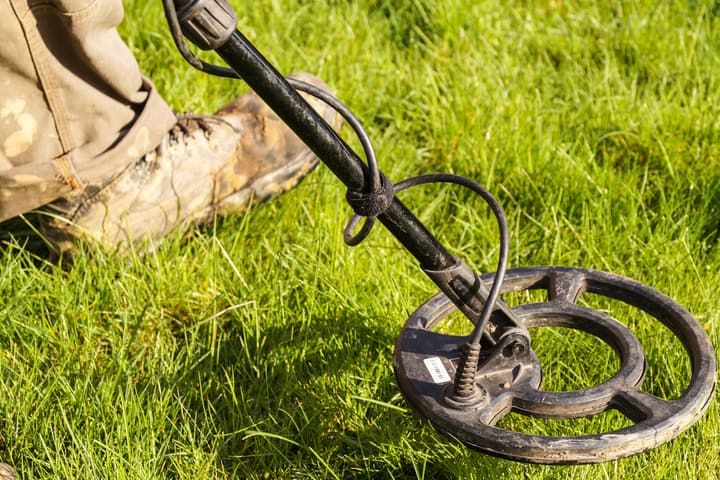
A metal detector can work if you already own one — provided it's reasonably good quality, has the range to reach the wire, and the cable jacket isn't too thick.
That said, most metal detectors have a wide search head — they're not designed for thin wires like landscape cable. Expect to narrow the location down rather than pinpoint it.
Even quality detectors struggle with low-voltage landscape cable because the copper conductors are thin and non-ferrous. A consumer detector can sometimes pick up bundled runs at shallow depth, but it's far less reliable than an active wire locator that energizes the cable with its own signal.
Don't buy a metal detector for this purpose — buy a wire locator instead.
Also read: How To Waterproof Landscape Lighting Connectors
3. Underground Wire Locator
The best option by far is an underground wire locator — a dedicated tool built explicitly for tracing buried conductors.
These come in two parts: a transmitter that energizes the wire with a signal, and a receiver that picks up the signal at the surface.
How you energize the wire depends on the transmitter type:
- Direct-connect clips attach metal-to-metal to the conductor and a ground stake. Always de-energize the circuit at the transformer before clipping on, since you're touching live copper.
- Inductive clamp transmitters wrap their jaws around the cable's insulation. They don't require disconnection and many models can work on live cables — but for landscape lighting, it's still safer to cut power first.
- Built-in induction coil transmitters need no contact at all. You set the unit on the ground above a suspected run and it induces a signal into nearby buried lines.
Once the transmitter is energizing the wire, you walk the receiver across the ground. The receiver is typically a wand-style probe with an LED bar or numeric signal-strength display, plus an audible tone. Better models have built-in speakers; budget units rely on headphones.
When the receiver passes over the wire, the signal strength peaks. Trace the line and mark it as you go — landscape flags or marking paint work well — so you end up with a clear map of the cable's path.
If your fixtures run on 120V line-voltage (some path lights and transformer feeds use UF-B at line voltage), NEC Table 300.5 requires 24 inches of cover for direct burial — or 12 inches if the circuit is GFCI-protected, ≤20A, and in a residential area without vehicle traffic. Pick a locator with the range to reach whichever applies.
After basic depth, look at extra features. A flashlight helps in low light, and headphones make signal peaks easier to hear in noisy environments.
Depth estimation has trickled down into consumer locators in the $150–$500 range (VEVOR, Noyafa, and similar). GPS plotting — recording the wire's position data as you walk — and high-precision multi-frequency depth measurement remain professional features and start around $1,000, running up to $5,000+ for units like the Schonstedt u-LOCATE, Amprobe AT-3500, and Radiodetection RD8200.
Here's a well-reviewed and reasonably priced wire detector (Amazon) that works up to 3 feet down.
Related: How To Protect Landscape Lighting Wire?
Method comparison at a glance
| Method | Typical Cost | Accuracy | Physical Effort |
|---|---|---|---|
| Hand shovel | Free | Low | High |
| Metal detector | Free if owned | Medium | Medium |
| Wire locator | $50–$500 | High | Low |
How To Determine Depth Of Buried Wire?
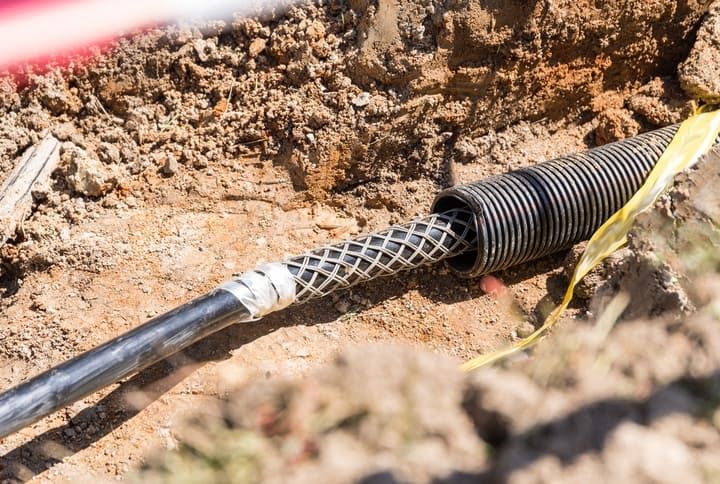
There are three ways to estimate how deep a buried wire sits:
- Use a wire locator with a built-in depth-estimation display — the most accurate option.
- Hand-dig down to the wire at one spot and measure with a tape — accurate but destructive.
- Use the 45-degree triangulation technique with a standard locator — no extra hardware, no digging.
The first option is the simplest if your locator has the feature. Depth estimation is now common on consumer locators in the $150–$500 range — well worth it if you'll use the tool more than once.
The second option is reliable but defeats the purpose of locating without digging. Save it for when you've already lost a fixture and need to splice anyway.
The third method costs nothing extra and works with any standard locator. Here's how:
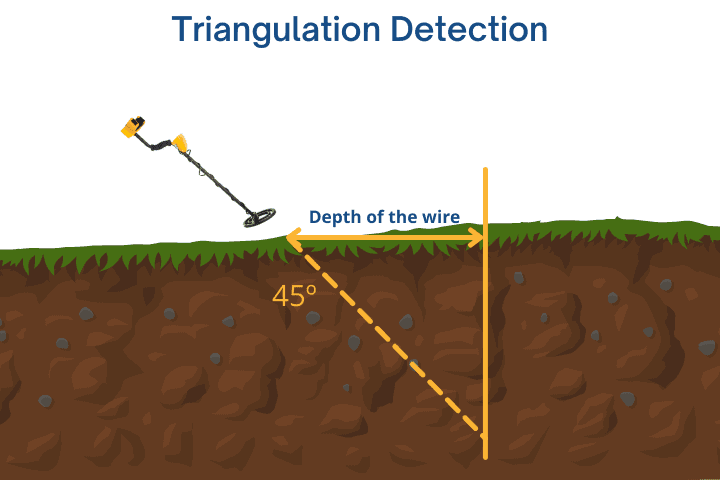
- Use the locator to find the wire, then mark the spot. Hold the receiver vertically — straight up and down — for the cleanest signal peak.
- With the receiver still over the wire, tilt it to a 45-degree angle.
- Walk perpendicular to the wire's path until the receiver picks up the wire again at the new angle.
- Measure the distance you walked from the original mark — that distance equals the wire's estimated depth.
Why it works: holding the receiver at 45° creates a 45-45-90 right isosceles triangle between the wire (vertical), the ground line you walked (horizontal), and the receiver's line of sight. In a 45-45-90 triangle the two legs are equal — so the horizontal distance you measured equals the wire's depth.
(Earlier versions of this article called it an equilateral triangle. That's incorrect — equilateral triangles have three 60° angles and three equal sides, which would not produce the 1:1 horizontal-to-depth relationship.)
The 45-degree method is the fastest no-dig estimation technique, but a locator with a built-in depth display removes the guesswork entirely.
Also read: Can You Bury A Landscape Lighting Wire?
Final Words
Finding underground wire without tearing up the entire garden isn't always easy, but the safest, fastest path is almost always the same: call 811, locate the transformer, cut power, then use a wire locator to trace the run.
Skip the wild digging — it's slow, it ruins gardens, and it puts you at risk if power is still on.
An underground wire locator gives you an accurate trace and, on most modern units, a depth estimate too — no manual labor required.