
Can You Bury Landscape Lighting Wire?
Under NEC 334.12(B), burying standard Romex in conduit still violates code — the conduit interior counts as a wet location. Only UF-B rated cable belongs underground.
 Eugen
EugenEugen Nikolajev
Creator of LED Lighting Info
Hi, I am Eugen. I was always one of those kids who had all sorts of weird lighting gadgets for every occasion.
Now, I want to share my knowledge and experience about lighting with you on LED Lighting Info.
Read my editorial standards
Key Takeaways
Direct-burial-rated cable (UF-B) can be buried as-is. Other underground-rated cable needs conduit or trunking. Low-voltage 12V landscape circuits can be buried as shallow as 6 inches when GFCI-protected; 120V circuits require 12–24 inches depending on the wiring method.
Yes — landscape lighting wire can be buried, but how deep and whether it needs conduit depends on the wire's rating and the voltage of the circuit. Direct-burial-rated cable can go straight into the ground. Other cable needs conduit. And 120V circuits follow much stricter NEC rules than the 12V low-voltage systems most homeowners install.
What Kind Of Wires Can Be Buried Underground?
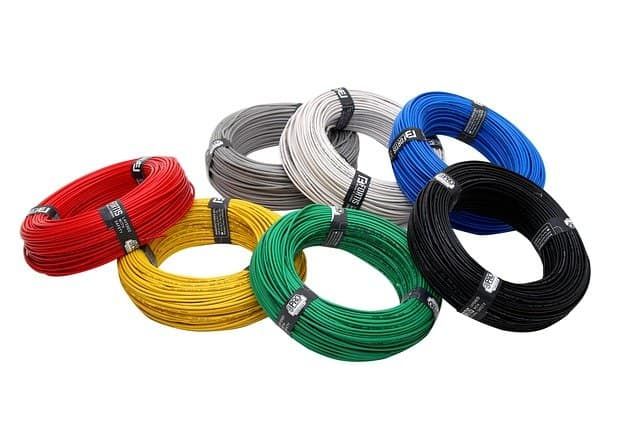
You can run a 120V line directly to outdoor fixtures, but most residential landscape lighting uses a transformer to step 120V down to a low-voltage 12V system. The transformer route is safer to handle and easier to install — 120V circuits require deeper burial, GFCI protection, and often a permit.
Most low-voltage landscape transformers actually output 12–15V AC. The higher taps exist so installers can compensate for voltage drop on long wire runs and still deliver about 12V at the fixture.
Low-voltage wiring comes in a range of thicknesses indicated by AWG (American Wire Gauge). Landscape wire commonly ranges from 8-gauge (thickest) to 18-gauge (thinnest), with 10, 12, 14, and 16 being the most popular sizes for residential use. Thicker wire carries current over longer distances without voltage drop, but it costs more.
Most lighting kits come packaged with 16-gauge wire because it's inexpensive. Its safe run length depends on the total wattage of the fixtures — roughly 60 ft at ~60 W of load to keep voltage drop under 3%. Light LED loads can stretch further; heavy loads need a thicker gauge.
If you plan to install more than 20 fixtures or run cable a long distance, 12-gauge is usually the better choice. It handles roughly 100 ft at 100 W of total load, stretching to ~200 ft when the load is only 50–60 W. Most LED landscape fixtures consume between 1–4 W (path lights) and 7–15 W (spotlights), so the safe distance scales with total fixture wattage on the run.
| Gauge | Typical Max Run | Best For |
|---|---|---|
| 10 AWG | 500+ ft at light LED loads | Long runs, large installations |
| 12 AWG | ~100 ft at 100 W; ~200 ft at 50–60 W | 20+ fixtures, longer runs |
| 14 AWG | ~150 ft at moderate LED loads | Mid-size installations |
| 16 AWG | ~60 ft at 60 W; further with light loads | Small kits, short runs |
Some wiring is rated for "direct burial." This means the cable can go straight into wet or dry ground, with no extra protection, sheathing, or piping required. The protective jacket shields the conductors from moisture, sunlight, and fungus. As long as you use UF-B (underground feeder) listed direct-burial cable, you don't need conduit on the low-voltage side.
How Deep Should You Bury Landscape Lighting Wire?
While you can connect cables and lay them on the surface, that's neither practical nor attractive. Burying the wiring is the better choice.
For low-voltage landscape circuits (≤30V), the NEC minimum cover is 6 inches when the circuit is GFCI-protected. In active garden beds, I aim for 8 to 12 inches to keep shovels, edgers, and aerators from cutting the cable. An angled trench cut with a thin sharp spade lets you slip the cable in and seal the trench quickly.
120V circuits are a different category and require much more cover. The NEC sets the minimum based on the wiring method:
| Circuit / Wiring Method | Minimum Cover (NEC Table 300.5) |
|---|---|
| Low-voltage (≤30V), GFCI-protected | 6 in. |
| 120V residential, 20A, GFCI-protected | 12 in. |
| 120V in PVC conduit | 18 in. |
| 120V in rigid or intermediate metal conduit | 6 in. |
| 120V direct-burial UF cable | 24 in. |
These are minimums, not recommendations. Local jurisdictions sometimes require more, so check with your building department or a licensed electrician before trenching for any 120V run.
If you're in the US, call 811 a few days before you dig — the national "Call Before You Dig" hotline. A utility representative will mark any existing buried lines on your property at no charge.
Sizing And Mounting Your Transformer
The transformer steps 120V house voltage down to low-voltage 12–15V AC. Two things matter when you pick one:
- Total wattage capacity. Add up the wattage of every fixture on the system, then add a 20–25% buffer for future additions and voltage-drop overhead. A 12-fixture installation with 5W LEDs (60W total) wants at least a 75W transformer.
- Outdoor rating. The transformer itself stays above ground — typically mounted on a post or wall near a GFCI-protected outdoor outlet. Make sure it carries an outdoor weatherproof rating (NEMA 3R or better).
Don't bury the transformer. It's not designed for it.
Daisy-Chain vs. Home-Run Wiring
How you connect multiple fixtures to a transformer affects voltage drop more than gauge alone:
- Daisy-chain (series). Each fixture is wired to the next along a single run. Simple, but the fixtures farthest from the transformer get noticeably less voltage and may appear dimmer.
- Home-run (spoke or "T" / "loop"). Several shorter runs branch from the transformer, with fixtures distributed across them. This balances voltage drop more evenly across fixtures.
For runs under 50 ft with a handful of fixtures, daisy-chain is usually fine. Beyond that — or whenever you mix bright spotlights with low-wattage path lights — home-run topology produces more consistent brightness.
Waterproof Splices: Where Most Landscape Lights Fail
Underground splices are one of the top failure points in landscape lighting. Standard twist-on wire nuts fail underground because moisture wicks into the connection, corrodes the copper, and eventually breaks the circuit.
Use direct-burial-rated connectors:
- Gel-filled wire nuts (often called "direct-burial connectors") fill the joint with dielectric silicone gel that blocks water.
- Heat-shrink butt splices with adhesive lining create a sealed mechanical and electrical joint that's about as close to permanent as you'll get.
- Waterproof lever connectors (Wago-style) rated for damp/wet locations work well at fixture takeoff points.
Whenever possible, locate splices above grade — at the fixture itself or in an accessible junction box. Every buried splice is a future maintenance call.
How To Protect Buried Wiring Against Rodents

Rodents chew wiring. Mice, rats, and squirrels destroy millions of dollars of cable every year, and buried wire isn't safe — burrowing rodents reach it readily. Even buried cable is fair game once they tunnel down to it.
The single biggest myth here is that conduit diameter keeps rodents out. It doesn't. Rodents will chew through plastic conduit regardless of diameter — what matters is material. Steel EMT (electrical metallic tubing) or rigid metal conduit is far more rodent-resistant than PVC. PVC of any size is vulnerable.
If you do use plastic conduit, seal both ends. The conduit itself doesn't have to keep them out — the entry and exit points do. Common seals include steel wool packed into the conduit ends, duct seal (Amazon), and insulating foam.
If a section of wire does get chewed, you usually don't need to replace the entire run. Cut out the damaged piece, splice in a new section using direct-burial-rated connectors (gel-filled wire nuts or heat-shrink butt splices), and rebury.
Can Wet Ground Damage Buried Wiring?

Direct-burial-rated wiring is built to withstand wet conditions. Multiple layers of thermoplastic sheathing keep moisture away from the conductors inside.
Dry-rated cable like NM-B (Romex) is a different story. NM-B should never be buried — even inside conduit. Under NEC 334.12(B), NM cable is prohibited in wet or damp locations, and NEC 300.5(B) treats the interior of an underground raceway as a wet location by definition. Use UF-B (underground feeder) cable for any underground run; it's the cable rated for direct burial and wet locations.
If heavy rain or flooding exposes a buried cable, have an electrician inspect it before reburying. Floodwater can carry contaminants that erode jacketing over time.
Plastic vs. Metal Conduit: Which Should You Use?
If you're not running direct-burial cable, conduit is your plan B. The choice between plastic (PVC) and metal (EMT, IMC, or rigid steel) comes down to four factors:
- Cost. PVC is cheaper — often less than half the price of equivalent EMT.
- Rodent resistance. Metal wins decisively. Plastic gets chewed.
- Corrosion. PVC won't corrode in damp soil. Galvanized steel can pit over time, especially in acidic or salty soil. PVC-coated rigid steel is the corrosion-resistant compromise.
- Workability. PVC cuts with a hacksaw and joins with cement. Metal needs a conduit bender and threaded fittings (or a coupling system).
For most residential landscape projects in low-pest areas, schedule 40 PVC at code-required depth is fine. Where rodents are active or the cable runs through known burrow zones, metal conduit pays for itself.
Final Words
Burying landscape lighting wire is straightforward once you match the wire to the job. To recap:
- Use UF-B for direct burial; never bury NM-B (Romex), even in conduit.
- For 12V landscape circuits, 6 inches is the NEC minimum (with GFCI). Aim for 8–12 inches in active garden areas.
- For 120V, follow NEC Table 300.5: 24 in. for direct-burial UF, 18 in. for PVC conduit, 12 in. for residential GFCI-protected, 6 in. for rigid metal conduit.
- Use direct-burial-rated connectors (gel-filled wire nuts or heat-shrink butt splices) at every underground joint.
- Call 811 before you dig.
- Match wire gauge to total fixture wattage and run length, not a one-size-fits-all rule.
Keep a simple map of your buried runs — path, depth, gauge, and where any splices are. You'll thank yourself the next time a fixture stops working or a future contractor needs to dig anywhere near it. Then go ahead and plan out your landscape lighting project with confidence.