
How Many Patio Lights Do I Need?
Too many string lights and your patio looks like an airport runway — too few and you're squinting in a dim glow. The right length comes down to a few quick measurements and one formula.
 Eugen
EugenEugen Nikolajev
Creator of LED Lighting Info
Hi, I am Eugen. I was always one of those kids who had all sorts of weird lighting gadgets for every occasion.
Now, I want to share my knowledge and experience about lighting with you on LED Lighting Info.
Read my editorial standards
Key Takeaways
There's no single right number of patio lights. It depends on the size of your patio and the number and brightness of the bulbs on each string. Most people prefer to run string lights around the whole perimeter of their patio for even ambient light.
Getting the length and brightness right for patio string lights is simpler than it looks — here's how to calculate exactly what you need.
Done well, string lights offer just enough light to gently illuminate the space after sunset without being so bright that your garden looks like an airport runway. Buy too few, though, and you'll end up with a dull glow instead of the effect you want.
I'll walk through the factors that decide the answer and the formulas that turn them into a concrete length to buy.
Factors That Decide How Many Patio String Lights You Need
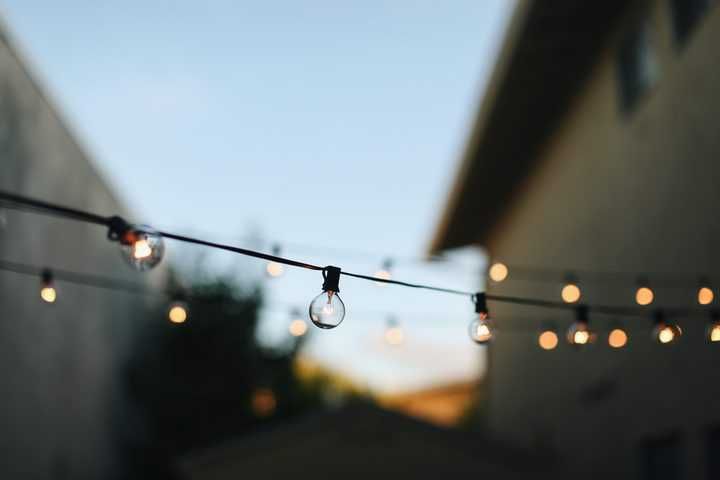
Four things drive the answer: how high you hang the lights, how bright the bulbs are, how densely they're spaced along the cable, and the size of the area you want to light.
Height Of Hung Lights
Hang height affects how bright the patio surface feels. The higher the lights, the less direct light reaches the patio, since brightness drops off with distance.
At the same time, you don't want to hang them so low that you or your guests have to duck under them. Around six feet is too low — taller people will feel boxed in.
Aim for around eight to ten feet from the ground. That keeps the bulbs above eye level but low enough that the light still reaches the patio surface, and you can do any maintenance with a stepladder rather than a full extension ladder.
Brightness Of Bulbs
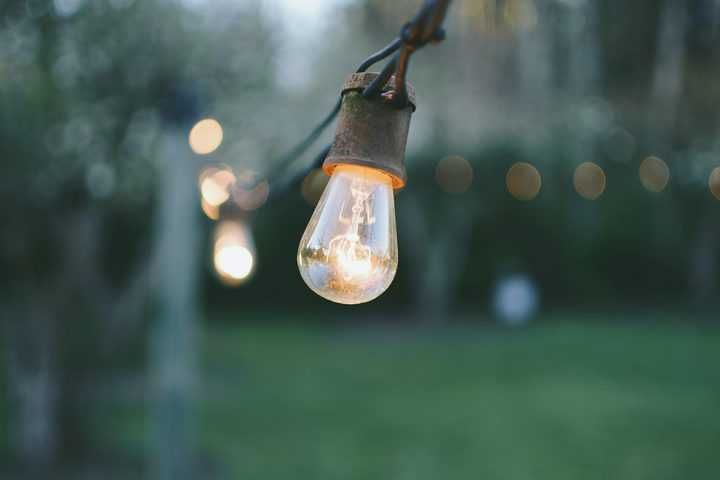
The next thing to consider is how bright the bulbs are and how bright you want the patio to feel.
Most of this comes down to personal preference. Some people want a patio that feels reasonably well-lit — not super-bright, but enough to maintain that late-evening, sun-just-set kind of vibe. Others prefer something dimmer, where there's enough ambient light that you aren't squinting but it still clearly feels like night.
Decorative string light bulbs commonly fall in the 50–100 lumen range, with some as low as 25 lumens per bulb for a very gentle glow and others reaching 150 lumens per bulb or more for stronger, brighter light.
If you're buying brighter bulbs, you'll probably want fewer lights overall — likely just around the perimeter, possibly only on three sides. With gentler bulbs, you might prefer more total length and a denser layout, often zig-zagged back and forth across the patio for a soft, even glow.
Density Of Bulbs
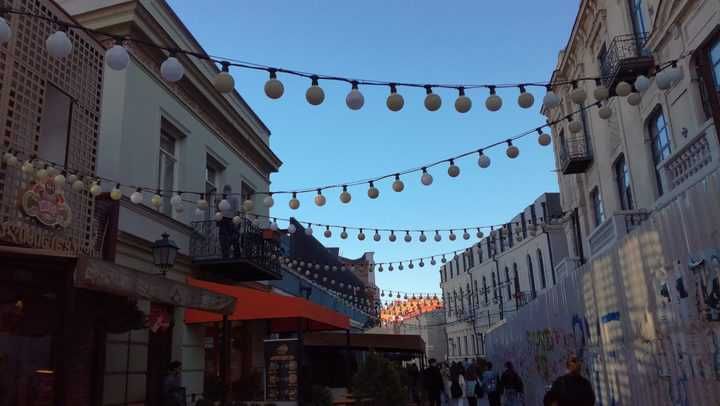
Bulb density matters as much as raw brightness. Two strings can advertise the same lumens per bulb yet feel completely different if one packs bulbs every six inches and the other every two feet. Use this two-step formula to compare them on equal footing:
Step 1: Bulbs on string ÷ String length (ft) = Bulbs per foot
Step 2: Bulbs per foot × Lumens per bulb = Lumens per foot
Lumens per foot is the cleanest apples-to-apples way to compare string lights from different brands.
The Size Of Lit Area
The size of the patio is the biggest factor in deciding how many lights to buy. A single 20-foot string won't go far on a large patio — you'll light up one side and leave the rest in the dark.
Factor in any other lighting you already have. If you've got wall lights or a nearby porch fixture, you'll need fewer string lights to reach a comfortable level of brightness.
How To Calculate The Length Of Patio Lights You Need
Perimeter Layout
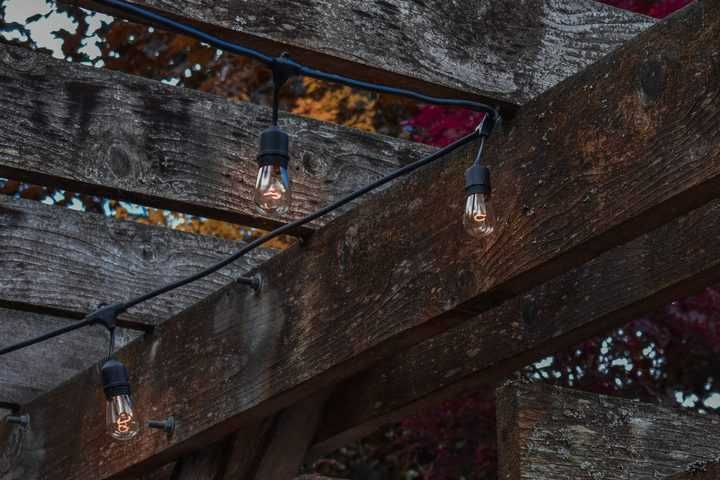
There are a few ways to hang patio lights, but the easiest is to run them around the perimeter. This gives you even lighting across the whole space and works perfectly with a pergola — just run the lights around the outer edge. Without a pergola, you'll need an anchor point in each corner: a tree, a gutter, or a dedicated string light pole.
Measure the length and width of your patio, add them together, and multiply by 2:
(Length + Width) × 2 = Perimeter (total cable length needed)Adding Slack For A Decorative Drape
The perimeter formula assumes the strings are pulled taut. If you want the cables to dip between anchor points, add 5–10% to the total length. A 5% allowance gives a subtle, gentle dip; 10% creates a more pronounced decorative drape. So for a 50-foot perimeter:
Subtle dip:        50 ft × 1.05 = 52.5 ft
Pronounced drape:  50 ft × 1.10 = 55 ft
Zig-Zag Layouts
If you want denser overhead coverage instead of perimeter-only lighting, zig-zag the strings back and forth between anchor points on opposite sides of the patio. Decide how many runs you want, multiply by the patio width, and add a small allowance for sag and the diagonal angle:
Number of runs × Patio width × 1.1 = Cable length neededFor a 15-foot-wide patio with five zig-zag runs, that works out to roughly 15 × 5 × 1.1 = 82.5 feet of string lights.
Plan Around Your Power Source
Before you commit to a layout, locate your nearest outdoor outlet. Most string lights end in a standard plug, and you'll want to keep extension cord runs short to avoid voltage drop and dimmer-than-expected bulbs. If the closest outlet is far from your starting anchor, factor in an outdoor-rated extension cord at the right gauge for the load.
Also check the maximum daisy-chain limit on the box. Most string lights cap out at 3–5 sets connected end to end before you risk overloading the line or visibly dimming the run. For larger patios, you may need to break the layout into separate plug-in sections.
Check The IP Rating
For outdoor patio use, look for an IP rating of IP65 or higher. That's the standard threshold for resistance to dust and water jets, which covers the rain conditions a covered or open patio will see. Lower ratings (IP44 and below) are only suitable for sheltered spots and won't last through a wet season.
Also read: Can Patio Lights Be Shortened?
Quick Decision Checklist
Before you click buy, run through this short list:
- Hang height: 8–10 feet from the ground.
- Lumen target: 50–100 per bulb for ambient mood, 150+ per bulb for stronger brightness.
- Density check: bulbs per foot × lumens per bulb = lumens per foot.
- Length: (length + width) × 2 for the perimeter, plus 5–10% if you want a decorative dip.
- Power: nearest outdoor outlet identified, daisy-chain limit checked.
- Weather: IP65 or higher for any uncovered installation.
If you want to dive into installation next, here's my take on the best way to hang patio lights.