
Can Patio String Lights Be Shortened?
Unscrewing a bulb to test your wiring sounds foolproof — but series-parallel hybrid strands will fool it every time, leaving you one cut away from a dead string.
 Eugen
EugenEugen Nikolajev
Creator of LED Lighting Info
Hi, I am Eugen. I was always one of those kids who had all sorts of weird lighting gadgets for every occasion.
Now, I want to share my knowledge and experience about lighting with you on LED Lighting Info.
Read my editorial standards
Key Takeaways
Yes — if your string lights are wired in parallel, cutting them short is fine and the rest will still work. Commercial-grade patio strings with large Edison-style replaceable sockets are usually parallel and almost always cuttable. Budget mini-light sets often use a series-parallel hybrid design and shouldn't be cut without confirming. Whatever you have, the cut end has to be sealed against water.
While string lights come in various standard sizes, they aren't custom-cut to your space, so you're almost always left with extra wire after the install. (If you're still planning the run, my guide to how many lengths of patio lights you need covers measuring before you buy.)
Can you just trim that extra wire off without breaking the rest of the strand?
Can You Cut Outdoor String Lights?
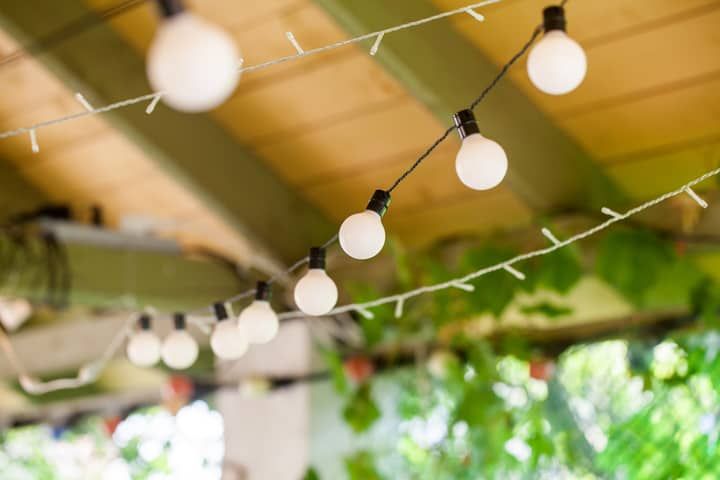
Strip lights and string lights look similar, but they aren't equally cuttable.
LED strip lights designed for indoor use are built from short series-connected segments — usually 3 LEDs each on a 12V strip, or longer groups on 24V — and those segments are wired in parallel along the length of the strip. The marked cut lines fall between segments, so cutting along one of those lines removes complete segments and leaves the remaining segments fully powered.
String lights don't usually have visible cut lines, so the question gets harder. Most of the time you can still cut them — but it depends on how the strand is wired.
Series vs Parallel Circuit
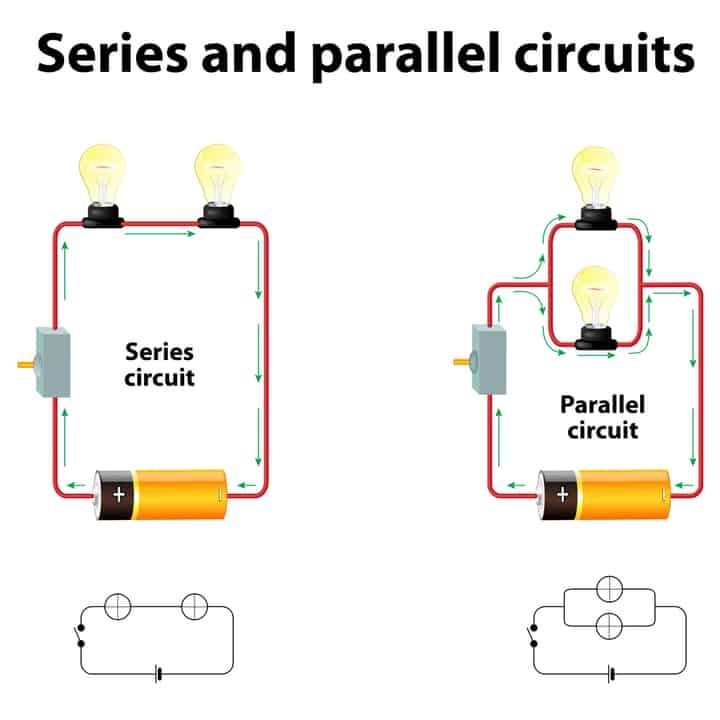
In a series circuit, the current runs through every component in a single loop. The same current flows through every bulb regardless of position — there's no "the bulbs at the end get less power" effect. The real downsides are that a single open component breaks the whole loop, and the supply voltage has to equal the sum of every bulb's forward voltage drop, which limits how long a pure-series string can practically be.
In a parallel circuit, multiple loops branch off the supply. If one bulb fails, only that branch is affected — every other branch still has a complete circuit and stays lit.
For decorative residential string lighting, parallel is the obvious choice because it tolerates single-bulb failures and spreads the load. Series wiring still has its place in engineering — particularly in current-regulated LED drivers, where uniform current matters more than fault tolerance — but for patio strings, parallel wins.
In practice, many indoor mini-style string lights use a series-parallel hybrid: several short series sub-strings linked in parallel. It's an inexpensive design, and on older or budget sets, pulling one bulb only darkens that sub-section rather than the whole strand. Modern incandescent mini lights also include a shunt wire at each bulb base, so the string keeps working when a filament burns out — and modern LED strings often stay lit when a single LED fails because LEDs typically fail short, completing the circuit on their own. The U.S. Department of Energy explicitly notes that holiday lights are wired both in series and in parallel.
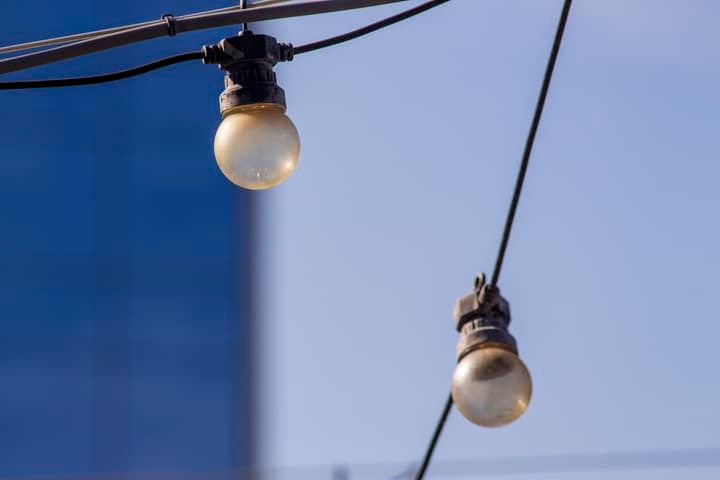
Where does that leave patio strings? Commercial-grade café/patio lights — the kind with large Edison-style replaceable sockets every couple of feet — are usually wired in parallel and can typically be cut between sockets. Budget outdoor mini-light strings often use the same series-parallel design as indoor sets, so always confirm before cutting.
Here's how the two pure designs compare at a glance:
| Property | Series | Parallel |
|---|---|---|
| One-bulb failure | Whole loop opens — unless the bulb has a shunt or fails short | Other branches stay lit |
| Cost to build | Cheaper — less wire | Slightly more expensive |
| Safe to cut to length? | No | Yes — between sockets |
| Where you'll see it | Older mini-light sets (often hybrid in practice); current-regulated LED drivers | Commercial Edison-socket patio strings |
How To Shorten Outdoor Patio String Lights
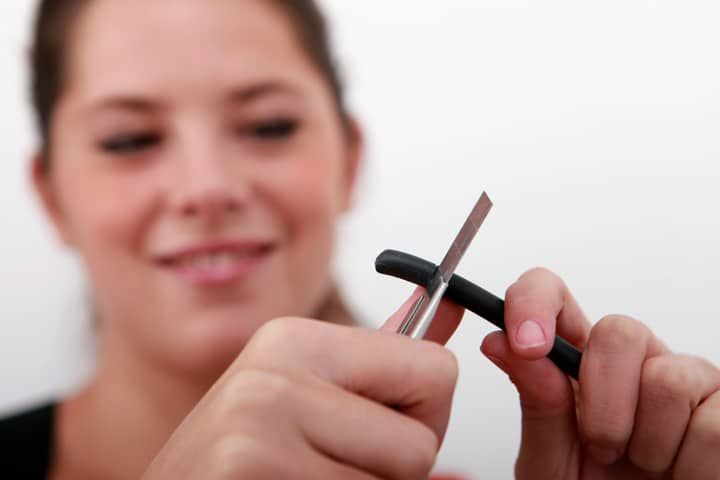
If your strand is parallel-wired, cutting is the cleanest fix. Here's how to do it:
- Confirm the strand is cuttable. Check the manual or packaging first — if it doesn't say, look for a "cuttable" marking on the wire. As a last check, unscrew one bulb with the lights on. If the rest stay lit, the string is likely parallel — but it isn't conclusive. Series-parallel hybrid sets only darken one sub-section when a bulb is pulled, and a few series strings include bypass components in the socket itself. If neither the docs nor the markings confirm it, don't cut.
- Check the power source. Most patio string lights run on 120V AC mains in North America (230V in the UK and EU). Some use a low-voltage DC transformer — common for solar and battery sets — which is mechanically the same to cut but considerably less risky electrically. The waterproofing step still matters either way.
- Unplug the lights. Don't cut anything live. In the U.S., outdoor receptacles serving dwellings are required to be GFCI-protected under NEC 210.8(F), and a GFCI will trip in milliseconds on a fault — but that's a backup, not a workaround. Unplug.
- Cut between sockets with the right tool. Use sharp wire cutters or electrical scissors — not a utility knife, which crushes conductors. Leave a few inches of slack on the side you're keeping so you've got room to work.
- Cap and waterproof each conductor separately. Use a waterproof wire connector on each lead (even though nothing else is joining), or self-sealing silicone tape backed with liquid electrical tape rated for outdoor use. The two conductors must not touch each other, and no copper can be exposed to weather.
Why does the seal matter? Water reaching exposed copper can short the strand, corrode the conductors, and create a shock hazard — and at worst, contribute to a fire if the circuit isn't properly protected. A GFCI outlet will usually trip in milliseconds before damage builds up, but you shouldn't rely on the breaker as your only line of defense. Skipping this step is the one mistake that can turn a simple DIY job into a hazard.
If You Can't (Or Shouldn't) Cut
If your strand isn't cuttable, or you can't tell, there are two clean workarounds:
- Option 1: Hide the extras in a sealed weatherproof box. Run the spare bulbs into a small outdoor-rated enclosure, layer the bulbs inside, and mount the box near one of your anchor points. LEDs run cool enough that heat buildup inside the box isn't a real concern, but the enclosure should still be rated for outdoor use so moisture can't reach the live sockets.
- Option 2: Take up the slack with the hang pattern. Instead of pulling the strand taut, let it dip slightly between anchor points. A long, gentle arc can absorb a couple of extra feet without looking sloppy — and it usually looks better than a tight straight line anyway.
Both work best when you're only a few feet over. If you bought 50 feet of lights for a 25-foot run, the right move is to return them and buy a properly-sized strand.
Key Takeaways
- Commercial Edison-socket patio strings are typically parallel-wired and safe to cut between sockets. Budget mini-light strands often aren't.
- The bulb-removal test is a useful first check, not proof — series-parallel hybrid wiring can fool it.
- Always unplug before cutting, and use sharp wire cutters — not a utility knife.
- Cap and waterproof each conductor separately with outdoor-rated connectors or tape.
- Plug into a GFCI-protected outdoor outlet — but treat the GFCI as the backup, not the primary safety measure.
- If in doubt, don't cut. Hide the excess in a sealed weatherproof box, or take up the slack with a gentle arc.