
Why Do Lighting Transformers Fail?
A transformer that takes down your whole landscape system often hasn't failed at all — a corroded terminal or stuck timer is just doing a convincing impression of one.
 Eugen
EugenEugen Nikolajev
Creator of LED Lighting Info
Hi, I am Eugen. I was always one of those kids who had all sorts of weird lighting gadgets for every occasion.
Now, I want to share my knowledge and experience about lighting with you on LED Lighting Info.
Read my editorial standards
Key Takeaways
The most common causes are overloading, thermal wear, water ingress, a stuck timer, and surge damage. Most are diagnosable with a multimeter and a ten-minute inspection of the enclosure — replacement is often the last resort, not the first.
Most landscape lighting faults take out a single bulb or one branch of the circuit. A failed transformer is different — it takes down the whole system at once, which makes it the first place to look when nothing on the circuit is working.
In this article, I'll walk through the common failure modes, show how to test a low-voltage transformer with a multimeter, and flag the symptoms that often get misattributed to transformer failure when the real problem is somewhere else on the circuit.
Common Low Voltage Transformer Problems
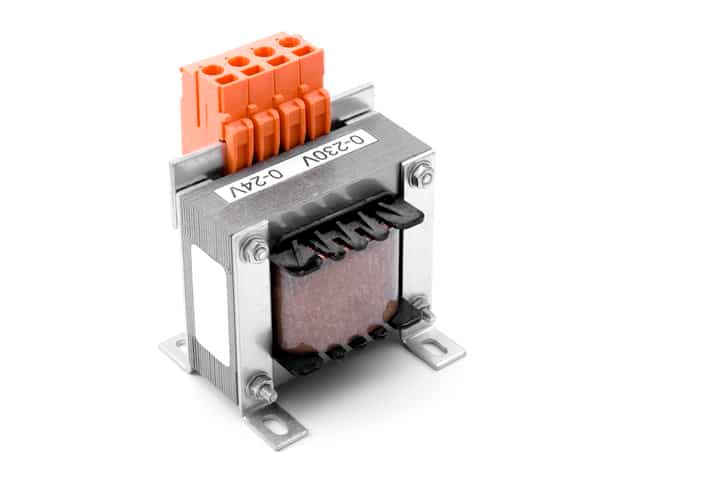
Four root causes account for the majority of landscape transformer failures. Work through them roughly in order of likelihood — the easy checks come first.
Overloading & Thermal Stress
Overloading is the single most common reason a low-voltage transformer fails. Every transformer is designed for a specific maximum power draw, and pushing past that limit cooks the windings from the inside out.
Common transformer sizes for landscape lighting are 120W, 200W, and 300W, with mini units below that and much larger ones for big installations.
The advertised wattage is the transformer's continuous rating, but industry best practice is to load it to no more than 80% of that rating. The 20% buffer accounts for inrush current when fixtures switch on, ongoing heat buildup, component aging, and headroom to add fixtures later without redoing the load math. A 300W transformer should carry about 240W of fixtures, not 300W.
Run a transformer chronically above that 80% threshold and the symptoms are predictable: flickering bulbs, prematurely blown bulbs, and overheating. In cheaper transformers there's also the potential for overheating to cause a fire.
First, check the bulbs. If they're halogen and the fixtures aren't sealed, swap them for LED — that one change typically drops the load by 80–90% and often resolves the overload entirely.
If the fixtures are sealed, or you're already running LEDs and still drawing too much, you have two options:
| Option | Cost | Trade-off |
|---|---|---|
| Remove or disable some fixtures | Free | Reduced coverage; you may have unused fixtures sitting dark in the yard |
| Replace the transformer with a larger one | Higher upfront cost | Keeps the full lighting design intact and gives you headroom to expand |
Replacement is usually the better long-term call: you keep the design you paid for, and you avoid running a borderline-overloaded unit that's already had its life shortened by stress.
Note that this is overloading — an overcurrent problem causing thermal stress on the windings. "High voltage stress" is a different and less common failure mode caused by surges on the supply side, covered later in this article.
Thermal Degradation
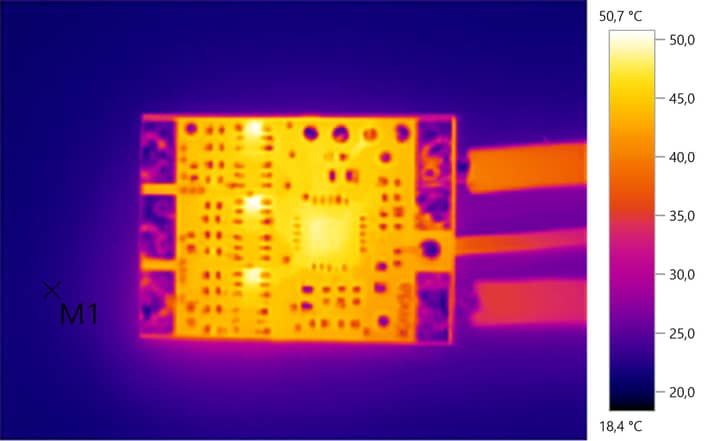
Heat is the enemy of every electrical component. Even a properly sized transformer wears out over time, and a unit that runs hot — because it's a budget model, because it's been chronically loaded near its limit, or because it's installed somewhere with poor ventilation — will fail well short of its rated lifespan.
Switch off the power, put on safety gloves, and touch the outside of the enclosure. A little warmth is normal under load. Hot to the touch is not. A transformer that runs hot has degraded internally, and the only fix is replacement.
Excessive Buzzing
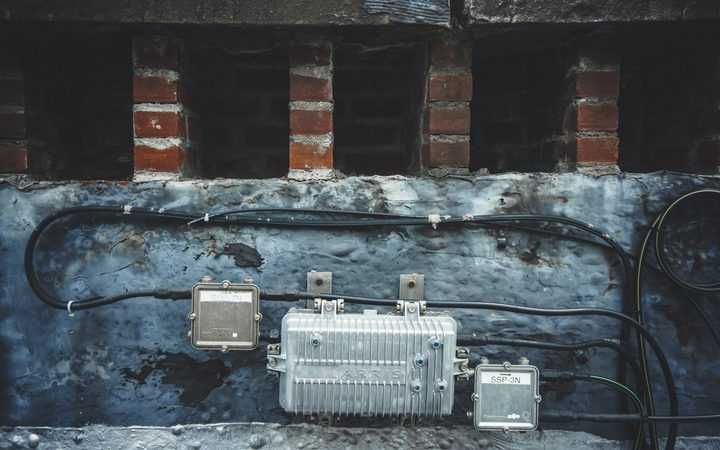
Magnetic transformers — the heavy toroidal or laminated-core type used for almost all landscape lighting — always emit a low buzz. It's caused by magnetostriction: the steel core laminations physically expand and contract as the alternating magnetic field reverses, producing a hum at twice the line frequency (120 Hz in North America, 100 Hz in 50 Hz countries). Most quality units include core potting or other dampening to mute the noise, but it can't be eliminated.
Electronic (switch-mode) transformers, more common in small under-cabinet or accent fixtures than in landscape installs, operate above 20 kHz and are typically silent.
If a magnetic transformer's buzz becomes noticeably louder than it was, that usually points to one of two things:
- A short on the load side — a damaged cable, a fixture with corroded contacts, or a pinched wire. Quality transformers have a secondary-side circuit breaker that trips on a short, so if a breaker keeps popping, look for the fault in the wiring, not in the transformer. Find and fix the short, reset the breaker, and the buzz returns to normal.
- An internal winding short — far less common, and the only fix is replacing the transformer.
Faulty Timer
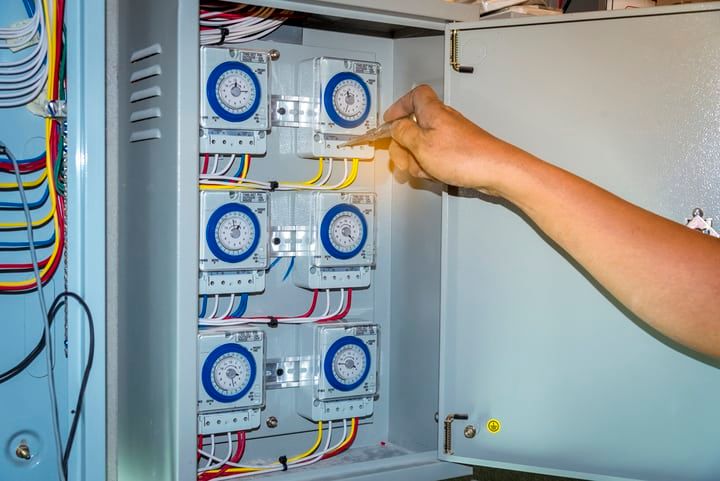
Sometimes the fault is as simple as a timer misbehaving. A digital or mechanical timer can fall out of sync, lose its program after a power blip, or just lock up.
For a digital timer, look for a reset button or switch and follow the unit's reset procedure. For a mechanical timer, move all the trip pegs to the off position and leave them there, power the transformer off and on again, then reset the pegs to your normal schedule.
If a reset clears the issue, the timer was the problem. If the lights still won't come on, you're probably looking at one of the more serious failures above.
Water Ingress & Corroded Connections
Outdoor transformers take a beating. Sprinklers, driveway runoff, ground flooding, and persistent rain all push moisture into enclosures that weren't sealed properly — or whose gaskets have aged out. Once water gets inside, it corrodes terminals, breaks down winding insulation, and shorts the circuitry.
Separately, the terminal screws where your fixture cables land are exposed to the weather every time the box is opened. Loose or corroded terminals are extremely common in older installs, and they mimic transformer failure perfectly: dim or intermittent lights, or a circuit that simply won't carry current.
Before condemning the transformer, switch off the power, open the enclosure on a dry day, and inspect for:
- Standing water or rust inside the housing
- Greenish corrosion on terminal screws or wire ends
- Loose connections — give each terminal screw a gentle tighten
- Damaged or brittle gaskets on the lid
Cleaning corroded terminals and tightening loose connections often restores a "failed" transformer to full function.
Power Surges & Lightning
In storm-prone regions, a nearby lightning strike or a grid switching event can drive a high-voltage transient down the supply line and flash over the primary winding. This is the genuine high-voltage-stress failure mode — distinct from overloading — and it usually kills a transformer instantly.
There's no fix after the fact. Prevention is a whole-house surge protector at the panel, or at minimum a plug-in surge protector on the outlet feeding the transformer.
How To Test a Low Voltage Transformer

To test a transformer you need a multimeter (Amazon).
⚠️ Safety: The input side of a landscape transformer is 120V mains AC. If you're not comfortable working around live mains, do not open or probe the input terminals — call a licensed electrician. The 12V output side is safe to work with; the 120V input side is not.
Set the multimeter to AC volts (often labeled VAC or V~) before testing. Both the 120V input and the 12V output are AC — DC mode will give you nonsense readings and may have you replacing a working transformer.
- Test the input terminals. With the transformer powered on, place the meter leads across the 120V input. Expect a reading between 114V and 126V — that's the normal range under ANSI C84.1 for U.S. residential service. A reading like 118V or 123V is fine. A reading well outside that band, or zero, points to a supply-side problem (breaker, wiring, utility), not the transformer.
- Test the output terminals. Note which tap your wires are connected to. A 12V tap should read around 12V (typically 11–13V depending on load); a 15V tap should read around 15V. Multi-tap transformers (12V/13V/14V/15V) are designed to give higher voltage at the upper taps to compensate for voltage drop on long wire runs — that's a feature, not a fault. If the input reads correctly but the output is far below the rated tap voltage, or zero, the transformer is faulty.
- Test for shorts and breaks. Switch off the power, disconnect the supply, and switch the multimeter to the resistance/ohms function. Probe across the input terminals and across the output terminals. The meter manual will tell you what a healthy reading looks like for that scale, but an open circuit (OL or infinite resistance) on either winding indicates an internal break and a dead transformer.
If readings are healthy but the lights still look wrong, check voltage drop
If the input and output both test within range but the lights are dim, flickering, or inconsistent along the run, the problem is almost certainly voltage drop along the cable, not the transformer.
Copper has resistance, and over a long run of low-voltage cable that resistance robs the bulbs of usable voltage. A fixture 100 feet from a 12V transformer can easily see 9–10V at the socket — enough to make LEDs look dim and halogen bulbs glow orange.
Test for voltage drop by walking the run with the multimeter and reading voltage at each fixture. If readings drop noticeably along the run, the answer isn't a new transformer — it's bumping up to a higher tap on a multi-tap unit, switching to a heavier-gauge cable, or rewiring the run as a hub or T-pattern instead of a long daisy chain.
Final Words
Most of the time, a transformer that "failed" didn't fail at all. The load is too high, water got in, a terminal corroded, the timer stuck, or voltage drop is making perfectly healthy fixtures look broken. Work through those checks first and replace the unit only when the testing actually points there.
When replacement really is the answer, my rule of thumb is to size the new unit so the system runs at no more than 70–80% of its continuous rating, buy from a reputable manufacturer, and protect it with a surge device on the supply side. A quality magnetic or toroidal transformer should give you 15–20+ years of service that way — and some premium brands like VOLT and Kichler back their commercial-grade units with a lifetime warranty. Budget units typically last 5–7 years, and you can usually feel the difference in build quality the moment you pick one up.