
What Size Landscape Lighting Transformer Do I Need?
Multiply your total fixture wattage by 1.25 — that single calculation is all it takes to land on the right transformer size, with headroom built in for future additions.
 Eugen
EugenEugen Nikolajev
Creator of LED Lighting Info
Hi, I am Eugen. I was always one of those kids who had all sorts of weird lighting gadgets for every occasion.
Now, I want to share my knowledge and experience about lighting with you on LED Lighting Info.
Read my editorial standards
Key Takeaways
Pick a transformer rated for 25% more than the total wattage of lights you intend to use — equivalent to loading the transformer to no more than 80% of its rated capacity. At the same time, avoid buying one that's dramatically oversized: with unregulated magnetic transformers, running far below rated capacity can push the secondary voltage above 12V and shorten bulb life.
In this article, I'm going to focus on the size of the transformer. That's not the literal dimensions, but the wattage that it's rated for.
One quick note before we start: most low-voltage landscape transformers output 12V AC (with 13/14/15V taps to compensate for voltage drop). Some newer LED-specific systems run on 12V DC instead, so check your fixtures' requirements before pairing them with a transformer.
To explain this in more detail, I'll take you through:
- How to calculate the transformer size you need
- How many lights you can add to a low voltage transformer
- Other considerations when choosing your transformer
What Size Transformer Do I Need For Landscape Lighting?

Low voltage lighting transformers have a rated wattage — the maximum total watts of bulbs that the unit is designed to power. The American Lighting Association recommends loading a transformer to no more than 80% of that rating, which is mathematically the same as multiplying your total fixture wattage by 1.25.
Running a transformer at its full rated capacity isn't technically an overload, but it leaves no margin for inrush current, generates more heat, and shortens the unit's lifespan. The 80% rule gives you headroom for surges and for adding fixtures later.
If you know which lights you want to use, work out the transformer size like this:
- Add up the total wattage of the bulbs you intend to use
- Multiply the total by 1.25
The result is the minimum recommended transformer rating. Round up to the nearest available size.
How Many Lights Can You Put On A Low Voltage Transformer?
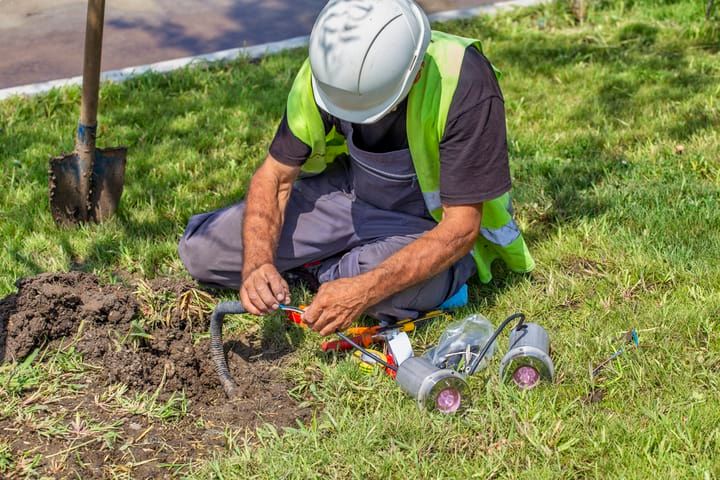
There's no fixed maximum — you can add as many fixtures as you like, provided the total wattage stays below 80% of the transformer's rated capacity. The table below shows typical bulb counts for common transformer sizes across a range of fixture wattages.
| Transformer rating | Max recommended load (80%) | 4W bulbs | 7W bulbs | 10W bulbs | 12W bulbs | 15W bulbs |
|---|---|---|---|---|---|---|
| 120W | 96W | 24 | 13 | 9 | 8 | 6 |
| 150W | 120W | 30 | 17 | 12 | 10 | 8 |
| 200W | 160W | 40 | 22 | 16 | 13 | 10 |
| 300W | 240W | 60 | 34 | 24 | 20 | 16 |
| 600W | 480W | 120 | 68 | 48 | 40 | 32 |
| 900W | 720W | 180 | 102 | 72 | 60 | 48 |
| 1200W | 960W | 240 | 137 | 96 | 80 | 64 |
Use this table as a guide — actual fixture wattages vary. Pathway lights are typically 4–5W, spotlights tend to land around 7–10W, and patio or floodlight bulbs can reach 15W or higher.
Because LED fixtures draw so little, even a modest transformer can run a sizeable system.
Splitting Lights Across Multiple Lines
Once you have more than a handful of fixtures or any long cable runs, consider splitting the lights across multiple output lines. The number of independent output lines varies by model — small residential transformers (around 150W) often have a single output, while larger units (300W and up) commonly offer two or more independently controlled zones. Don't confuse zones with multi-tap voltage outputs (12V/13V/14V/15V), which exist to compensate for voltage drop, not to split circuits.
Splitting reduces voltage drop. Voltage drop happens when wire resistance — combined with total current draw and run length — robs the far end of the circuit of voltage. The result is dimmer or flickering bulbs, and with LEDs you may also see a shift in color temperature.
Voltage drop exists on the 120V side too, but it's negligible there — a 1V loss is less than 1% of 120V. On the 12V side, that same 1V loss is over 8%, enough to dim fixtures visibly. So while the run from the power supply to the transformer doesn't matter much, the run from the transformer to the lights does.
Two practical ways to manage this:
- Split your fixtures across multiple shorter runs from the transformer instead of one long daisy-chained line.
- Use a hub or loop wiring method — running equal-length leads from a central point to each fixture, or running the cable in a loop back to the transformer — so every fixture sees roughly the same voltage.
Wire Gauge
Wire gauge matters as much as transformer size for keeping voltage where it needs to be. As a rule of thumb:
- 16 AWG is fine for short runs (under about 100 feet) carrying light loads.
- 12 AWG is the workhorse for runs over 100 feet or higher-wattage circuits.
- 10 AWG or 8 AWG is worth considering for very long runs or large lighting systems.
Try to keep individual cable runs under about 150 feet at 12 AWG to stay within a comfortable voltage-drop margin.
Other Considerations When Selecting A Transformer
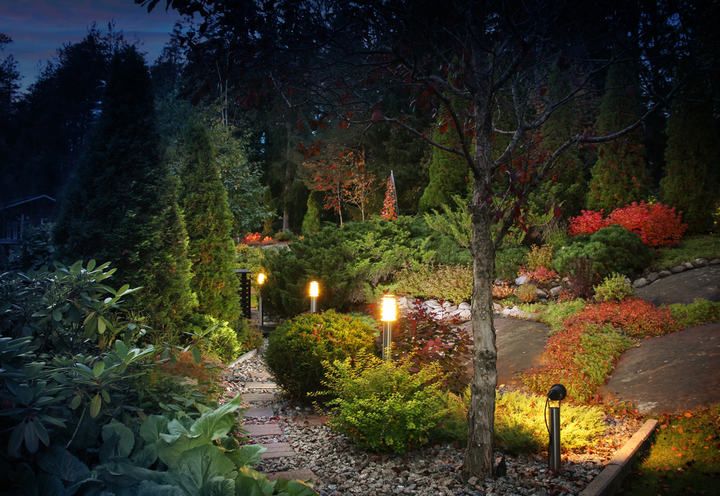
Beyond size, a few other factors are worth weighing before you buy.
Build Quality and Safety Certification
Buy your transformer from a reputable supplier. Cheap, poorly regulated units can let secondary voltage rise above 12V at light load — particularly older magnetic transformers — which shortens bulb life. Modern electronic and well-regulated transformers handle light loads better, but it's still wise not to oversize dramatically.
Look for transformers with a recognized safety listing. UL 1838 is the U.S. standard specifically for low-voltage landscape lighting systems, so a UL 1838 mark on the unit is a strong signal that it's been tested for outdoor use. Avoid units that don't display any recognized safety certification.
Some installers also struggle when they don't add enough lights to the transformer — with only a handful of bulbs absorbing all the output, those few fixtures can burn out faster on an unregulated unit.
Related: Why Do Lighting Transformers Fail?
Location of Transformer
Install your transformer as close to the lights as practical. The 120V run from your home's power supply to the transformer can be long without much consequence — voltage drop on that side is negligible. Once the voltage is stepped down to 12V, every foot of cable counts, so the transformer's distance from the fixtures matters far more than its distance from the outlet.
Most landscape transformers are designed for outdoor use, but always confirm the rating on yours. Outdoor transformers can usually be used indoors, but not the other way around — follow the manufacturer's instructions for your specific model.
Optional Features
Many transformers ship with built-in controls. Common options include:
- Mechanical or digital timers — let you set the times the lights switch on and off.
- A photocell (sometimes called a dusk-to-dawn sensor) — detects ambient light levels and turns the lights on at twilight, off at sunrise.
- A PIR (passive infrared) motion sensor — detects body heat and movement, useful for security-style lighting that only fires when someone approaches.
Photocells and PIR sensors do different jobs and are sometimes combined in the same unit. If you want lights to come on at dusk every night, that's a photocell. If you want them to flick on when something moves, that's a PIR.
In my experience, prioritize quality over features. A reliable, well-regulated transformer without a digital timer will outlast a feature-packed bargain unit every time.
Also read: Can Landscape Lighting Wire Be Buried?
Final Words
Sizing the transformer is straightforward once you know the lights you'll be using: total their wattage, multiply by 1.25, and round up to the next available rating. Check that the unit carries a UL 1838 listing, pair it with appropriate wire gauge for your run lengths, and leave yourself headroom for fixtures you might add later.
If your planned system is large or sits well above 600W, I'd recommend running the design past a licensed electrician — particularly for the 120V side and any permanent outdoor wiring.