
Do Low Voltage Pool Lights Have To Be GFCI Protected?
NEC 680.23(A)(8) only mandates GFCI protection for pool lights running above 15V AC — so most 12V LED fixtures are legally exempt. That exemption isn't a reason to skip it.
 Eugen
EugenEugen Nikolajev
Creator of LED Lighting Info
Hi, I am Eugen. I was always one of those kids who had all sorts of weird lighting gadgets for every occasion.
Now, I want to share my knowledge and experience about lighting with you on LED Lighting Info.
Read my editorial standards
Key Takeaways
Under NEC 680.23(A)(8) (2023 edition), GFCI protection is required for the branch circuit supplying underwater luminaires only when they operate above the "low-voltage contact limit" — 15V AC / 30V DC. Listed low-voltage pool lights, typically 12V, supplied through a listed isolation transformer per NEC 680.23(A)(2) are exempt from that requirement. Adding GFCI is still strongly recommended.
A GFCI is a safety device that monitors electrical current and cuts power when it detects a fault — and whether you need one for low-voltage pool lights is a common point of confusion.
The NEC is updated every three years (2017, 2020, 2023). Always verify requirements against the edition adopted in your local jurisdiction, and have a licensed electrician handle pool wiring whenever you're in doubt.
Is Low Voltage Lighting Safe Around The Pool?

Low-voltage lighting is safer than line-voltage lighting around water, but "safer" isn't "safe." The National Electrical Code — specifically NEC 411.6(B) in the 2023 edition (previously 411.5(B)) — generally prohibits low-voltage lighting systems within 10 feet horizontally of the nearest edge of water, including ponds, fountains, and swimming pools, unless permitted by Article 680.
Article 680 governs pool and spa lighting. It permits listed low-voltage luminaires that meet specific criteria — no grounding required, voltage at or below the low-voltage contact limit, supplied through a listed transformer per 680.23(A)(2) — to be installed within 10 feet of the pool, and in some cases under 5 feet from the inside walls. The fixture must be specifically listed for the application; "marketed for pool use" isn't a sufficient compliance test.
Why Low Voltage Still Deserves Respect
There are no documented fatalities directly from 12V DC pool lighting. But Electric Shock Drowning (ESD) is a real and documented hazard at low voltages, particularly with AC. As little as 2V AC per foot of voltage gradient in fresh water can deliver a fatal shock, and roughly 10 mA AC can cause skeletal-muscle paralysis — a swimmer who can't move can drown indirectly without ever being electrocuted in the strict sense. Low-voltage circuits can also become hazardous if a fault couples them to higher-voltage wiring upstream.
Treat any in-water electrical fault as potentially life-threatening. Keep general-purpose low-voltage garden lighting at least 10 feet from the pool, and only install fixtures listed for pool use closer than that.
Do Pool Lights Require GFCI?

It's a misconception that all swimming pool lights must be on a GFCI-protected circuit. NEC 680.23(A)(8) (2023 edition) requires GFCI protection on the branch circuit supplying underwater luminaires only when they operate above the low-voltage contact limit (15V AC / 30V DC). Most low-voltage LED pool lights run at 12V — well below that threshold — so the supply branch circuit is exempt when the fixture is listed and supplied through a listed isolation transformer per 680.23(A)(2).
That's the legal minimum. In my view, it's not the standard you should aim for. A GFCI adds an inexpensive extra layer of protection against fixture or transformer faults that could otherwise put current into the water, and it can also limit damage to your lights during a short. There's no real downside to exceeding the code here.
Don't Forget Equipotential Bonding
GFCI protection is separate from equipotential bonding, which NEC 680.26 requires around pool structures and metal components. Bonding ties all conductive parts to a common potential so a fault doesn't create dangerous voltage gradients in or around the water. Don't conflate the two — a pool can be GFCI-protected and still need bonding to be code-compliant.
Why Does The Pool Light Keep Tripping GFCI?
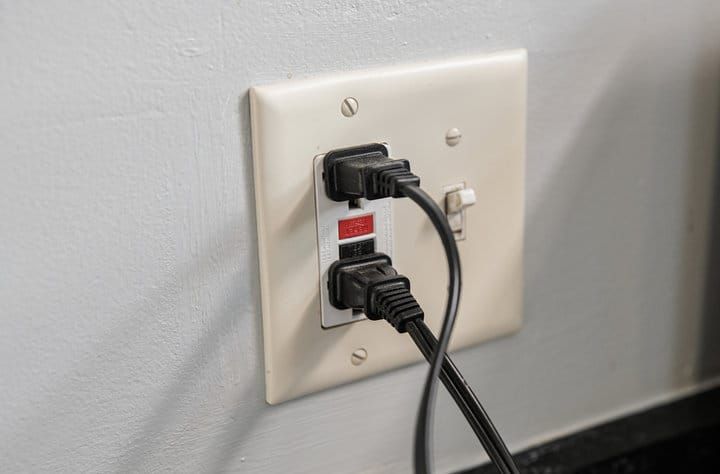
It helps to understand how a GFCI works. Current flows out through the live conductor and returns through the neutral. The GFCI compares the two and trips when the imbalance exceeds 4–6 mA — the UL Class A standard for personnel protection. That tiny missing current means power is leaking somewhere it shouldn't.
Around a pool, the leak path is almost always water — either inside the fixture itself or in the waterproof wire conduit. Conduit doesn't usually fail on its own, so the fixture is the prime suspect.
Step-by-Step Diagnosis
Switch off the power at the breaker before disconnecting any fixtures. Then work through the checks below in order:
- Disconnect all pool lights and reset the GFCI. If it holds, one of the lights is the source of the fault.
- Reconnect the lights one at a time, resetting the GFCI between each. The fixture that trips it is the faulty one.
- Inspect that fixture for water intrusion. Visible water inside the housing, or bubbles escaping when submerged, both indicate the seal has failed.
- If the fixture has a replaceable bulb, dry it out, replace the bulb, and — critically — replace the gasket that forms the watertight seal.
- If the fixture is a sealed, enclosed unit, replace the entire fixture. Sealed units aren't field-serviceable.
What If It's Not the Light?
If the GFCI trips with every light disconnected, the problem is upstream — usually the transformer or the GFCI itself.
- Unplug the transformer from the outlet and plug in a different appliance — a lamp or a phone charger works.
- If the GFCI trips with the unrelated load, the GFCI is faulty and needs to be replaced.
- If the GFCI holds, the transformer is faulty and needs replacing too. There are several reasons lighting transformers fail, but they generally aren't user-repairable.
Final Words
GFCI protection isn't legally required for listed 12V LED pool lights supplied through a compliant transformer, but I'd install one anyway. The cost is trivial relative to the protection it adds against ESD-class faults that the code's voltage threshold doesn't fully address.
Two things to confirm before you build out a pool lighting circuit: which NEC edition your local jurisdiction has adopted (the 2023 cycle introduced renumbering and tightened several pool-related rules), and whether your installation also satisfies the equipotential bonding requirements in 680.26. For anything beyond a like-for-like fixture swap, hire a licensed electrician — pool wiring is the wrong place to learn on the job.