
How Far Can I Run Landscape Lighting Wire?
Run 60W of lights over 50 feet on 14/2 and the math says your fixtures will dim. One formula tells you which gauge to use before you bury anything.
 Eugen
EugenEugen Nikolajev
Creator of LED Lighting Info
Hi, I am Eugen. I was always one of those kids who had all sorts of weird lighting gadgets for every occasion.
Now, I want to share my knowledge and experience about lighting with you on LED Lighting Info.
Read my editorial standards
Key Takeaways
How long you can run landscape lighting wire depends mainly on the wire gauge, although the number of lights also has an impact. 14/2 wire is fine for small runs, but for longer runs, you'll need 12/2 or 10/2 to avoid voltage drop.
Run your landscape lighting wire too thin or too long and your fixtures will glow dimly, flicker, or fail entirely. Replacing buried cable is costly and labor-intensive, so it pays to size the wire correctly the first time.
Note: The calculations and constants in this article assume a standard 12V AC low-voltage landscape lighting system, which is the most common type. If your system runs at 24V (increasingly common with larger LED installations), the wire constants and acceptable voltage-drop thresholds are different.
How Far Can Landscape Lighting Wiring Run?

Two main factors determine how far you can run your outdoor wiring: wire gauge and total fixture load.
Wire Gauge
Wire gauge is the most important variable. The gauge of a wire is a measurement of its conductor diameter, and it directly affects two things: the maximum wattage the cable can safely carry, and how much voltage drop you'll see across the run.
Voltage drop is the power lost across an electrical circuit. Every part of a circuit — including the wire itself — has resistance that reduces the voltage reaching your fixtures. Thicker wire has less resistance, so the drop over a given distance is smaller, and the cable can run further before that drop becomes a problem.
If you choose a wire gauge that isn't suitable for the distance, the lights at the end of the circuit won't get the voltage they need. They might glow dimly or flicker — and a miscalculation usually means re-laying the entire run to fix it.
Number Of Lights
The total wattage on a circuit also affects how far you can run the cable. A long run feeding only two or three small fixtures may have negligible drop, but add more lights and the same length of wire might not cope.
As long as you pick a gauge suited to your distance and stay under that gauge's maximum recommended wattage, you shouldn't have problems.
Which Gauge Wire Can Be Run Furthest?
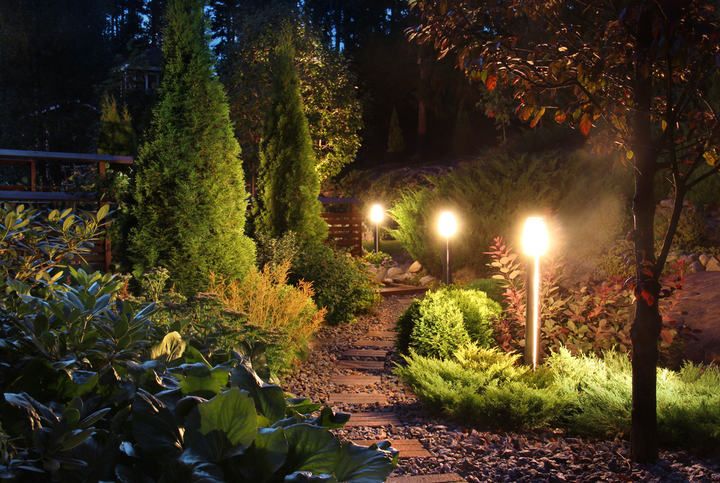
The AWG (American Wire Gauge) system covers wires from 4/0 (0000) ratings, measuring almost a half-inch in diameter (about 11.7mm), down to 26-gauge wire at just 0.0159 inches (0.4mm). For landscape lighting, you'll typically see cables between 8 and 18 AWG, stepping in even numbers — 8, 10, 12, 14, 16, and 18.
There's also a second number in the rating that tells you how many conductors the cable contains. For low-voltage landscape lighting it's almost always 2, so you'll see gauges written as 8/2, 10/2, and so on. Most cables are pure copper — beware of budget "copper-clad aluminum" (CCA) cables, which have higher resistance than the constants in this article assume.
Of the common gauges, 8/2 can run furthest but is overkill (and expensive) for most home projects. 18/2 runs the shortest distance because it's the thinnest. Most installations land on 14/2 or 12/2 for the best balance of cost, flexibility, and run length, with bigger projects stepping up to 10/2.
How Far Can You Run 14/2 Low Voltage Wire?
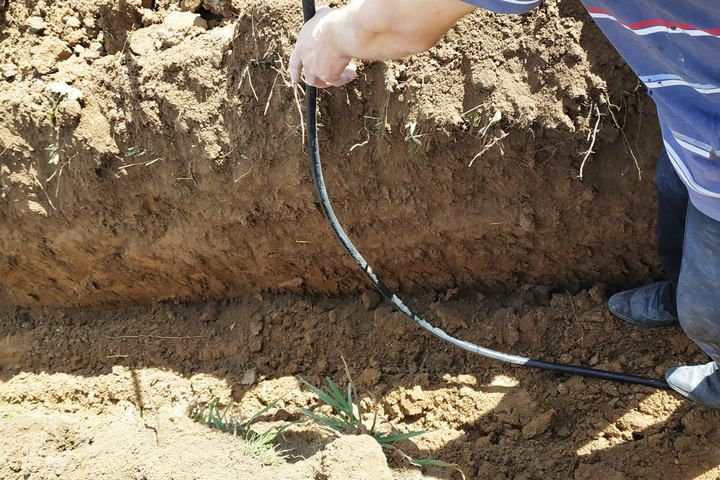
Let's compare 14/2 against the other gauges using a worked example: a 200W transformer.
You shouldn't connect 200W of lights to a 200W transformer. The American Lighting Association and most manufacturers recommend loading transformers to no more than 80% of their rated capacity. This protects the transformer from overheating, extends its lifespan, and provides headroom for the inrush current that fixtures draw at startup.
So with a 200W transformer, we plan around 160W of lights. Let's see how far each cable gauge can carry that load while keeping voltage drop within the 1.5V limit (about 12.5% of a 12V supply):
| Wire Gauge | Max Wattage | Max Run for 160W (≤1.5V drop) |
|---|---|---|
| 18/2 | 120W | N/A — exceeds wattage |
| 16/2 | 156W | N/A — exceeds wattage |
| 14/2 | 180W | ~16 feet |
| 12/2 | 240W | ~35 feet |
| 10/2 | 300W | ~56 feet |
| 8/2 | 480W | ~89 feet |
18/2 and 16/2 are immediately ruled out — 160W exceeds their maximum wattage. Note that 14/2's 180W rating is the absolute upper limit; for safety and heat headroom, many installers stay closer to 144W (80% of capacity) on 14/2.
How To Calculate Landscape Lighting Wiring Requirements
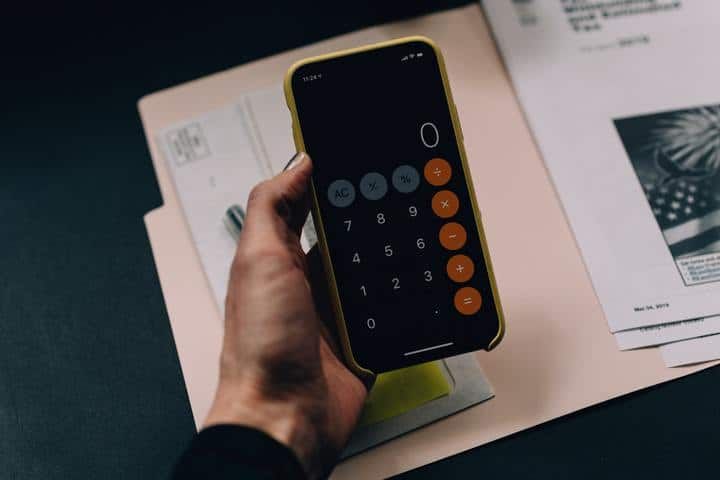
If your wattage isn't 160W, you can run the calculation yourself. Each copper gauge has a "wire constant" used in the voltage-drop formula:
| Wire Gauge | Copper Wire Constant |
|---|---|
| 18/2 | 1380 |
| 16/2 | 2200 |
| 14/2 | 3500 |
| 12/2 | 7500 |
| 10/2 | 11920 |
| 8/2 | 18960 |
Then run the calculation in four steps:
- Multiply your total fixture wattage by the cable distance in feet.
- Divide the result by the wire constant for the gauge you're considering. Start with 12/2 — if the result is too high, step up to 10/2 (thicker); if it's well below the limit, you may be able to drop down to 14/2 (thinner).
- Multiply that result by 2. This is your total voltage drop in volts.
- If the drop is 1.5V or lower, the gauge is acceptable. For best results aim for 1V or less.
A drop above ~1.5V (about 12.5% of a 12V supply) starts to cause noticeable issues. Halogen fixtures need at least 10.8V at the fixture and behave best in a tight 10–12V window; LEDs are more tolerant and typically run cleanly anywhere from 8V to 15V.
Worked Example
Say you have 60W of lights and a 50-foot run.
60 × 50 = 3000
Try 12/2: 3000 ÷ 7500 = 0.4. Multiplied by 2, that's a 0.8V drop — well within limits.
Try 14/2: 3000 ÷ 3500 ≈ 0.86. Multiplied by 2, that's about 1.71V — over the 1.5V limit, so the lights at the end of the run may dim or flicker. For 60W of lights over 50 feet, use 12/2 cable.
Daisy-Chain vs Home-Run Wiring
The formula above assumes a single home-run from the transformer to the fixture load — the simplest case. In practice, most DIYers daisy-chain fixtures along a single cable, and that changes how voltage drop accumulates: the fixture furthest from the transformer sees the largest drop, while the closest fixture sees almost none. The result is unevenly lit fixtures along the run.
For long runs, professionals often switch to a "hub" or "T" topology — splitting one feeder into branches of equal length so each fixture sees the same voltage. If you're daisy-chaining, keep individual runs short and keep similar wattages grouped together.
Burial Depth and Connectors
Low-voltage landscape wire (under 30V) typically only needs to be buried about 6 inches deep under NEC guidelines, although local codes vary and deeper burial protects against accidental damage from edging tools and shovels. Always check what your local jurisdiction requires.
Connectors matter too. Cheap pierce-point connectors and poorly waterproofed splices add resistance to the circuit and are one of the most common real-world causes of voltage drop and fixture failure. Use proper waterproof direct-burial connectors, minimize the number of splices on a single run, and consider crimped or soldered joints inside a gel-filled enclosure for permanent installations.
Also read: Why Do Landscape Lights Flicker?
Final Words
For most DIY landscape lighting projects, the gauge decision comes down to a few quick thresholds:
- Short runs (under ~30 ft) with modest loads: 14/2 is usually fine.
- Mid-sized runs (30–60 ft) or higher wattages: step up to 12/2.
- Long runs (60+ ft) or full transformer loads: 10/2 or 8/2.
Don't default to 8/2 — it's expensive, stiff, and harder to bury. Run the formula, give yourself a little headroom for future fixture additions, and you'll land on the right cable.
Call in a licensed electrician if your project involves runs longer than 300 feet, 120V line-voltage fixtures, conduit through hardscape, or any tie-in to your home's main electrical panel. Low-voltage DIY work is forgiving; line-voltage mistakes are not.