Do Solar Landscape Lights Work In The Shade?
Shade doesn't make your solar panel less efficient — it just starves it of light energy. Even a deep shadow lets some charge through, but how much depends on what's blocking the sun.
 Eugen
EugenEugen Nikolajev
Creator of LED Lighting Info
Hi, I am Eugen. I was always one of those kids who had all sorts of weird lighting gadgets for every occasion.
Now, I want to share my knowledge and experience about lighting with you on LED Lighting Info.
Read my editorial standards
Key Takeaways
Solar landscape lights will work in partial shade, they just won't run for as long after dark. As long as the panel sees some direct or diffuse daylight each day, the battery will gain some charge.
Deep, all-day shade is a different story, and artificial light from inside the house is not a real substitute for the sun.
You bought solar landscape lights expecting plug-and-play garden lighting, and now they're flickering out by 10 p.m. — or barely glowing at all. The usual culprit is shade: trees, fences, the side of the house, or just a stretch of overcast weather robbing the panel of the sunlight it needs.
Below, I'll cover how much sun your lights actually need, what shade does to charging in practical terms, and the workarounds worth knowing about before you give up on solar entirely.
How Many Hours Of Sun Do Solar Lights Need?
The simple answer: most small garden lights need around 6–8 hours of good sun for a full night's runtime. The exact figure depends on the panel size, the battery capacity, and the brightness setting of the light itself.
The easiest way to find the recommended charge time is to check the product manual or the packaging — most manufacturers list it directly. If you can't find it, you can estimate it from the spec sheet using a quick calculation.
The formula in plain English
First, work out how much energy the panel produces in a typical day:
- Panel wattage × hours of usable sun × a derating factor of around 0.7–0.75
The derating factor accounts for real-world losses — panel efficiency (small landscape panels typically convert only 12–18% of sunlight), charge controller losses, wiring, temperature, dust on the panel, and battery charging inefficiency. It is not the panel's efficiency by itself.
Then work out how much energy the battery holds:
- Battery voltage × battery amp-hours = battery capacity in watt-hours
Amp-hours (Ah) and milliamp-hours (mAh) are interchangeable — 1000 mAh equals 1 Ah. Divide the battery's watt-hours by the panel's average charging power to get an approximate full-charge time.
A worked example
Say a spotlight has a 5 W solar panel, and the spot it sits in gets 5 hours of usable sun per day:
- 5 W × 5 h × 0.75 = 18.75 watt-hours of energy per day
- Average charging power across those 5 hours: 18.75 ÷ 5 = 3.75 W
If the same light uses a 3.7 V, 2000 mAh lithium-ion cell — a common configuration for small spotlights — its capacity is 3.7 × 2 = 7.4 watt-hours. To fully charge that battery from empty at 3.75 W of average charging power needs about 7.4 ÷ 3.75 ≈ 2 hours of effective sun.
⚠️ Battery voltage varies widely. Most small landscape lights use 1.2 V (NiMH), 3.2 V (LiFePO4), or 3.7 V (Li-ion) cells, and the circuitry is matched to a specific chemistry — the voltages are not interchangeable. Check the spec label on your light before applying this calculation, because plugging in the wrong voltage will throw the result off completely.
In short: a bigger panel and a bigger battery means longer evenings of light. Most small garden lights need 6–8 hours of good sun for a full night's use, but you only need to top the battery up — not refill it from empty — every day.
Will Solar Lights Charge In The Shade?
Yes — solar lights will charge in shade or under cloud, just much more slowly. The panel's conversion efficiency does not actually drop in cloud or shade; what drops is the amount of light energy reaching the panel in the first place.
Here's what to expect in different conditions:
| Condition | Approx. Output vs. Full Sun | Practical Impact |
|---|---|---|
| Full direct sun | 100% | Optimal charge |
| Light cloud / haze | 50–70% | Slightly reduced runtime |
| Overcast sky | 10–25% | Significantly reduced — charging takes 4–10x longer |
| Dense shade (tree or building) | Under 10% | Likely insufficient for nightly use |
The numbers above are general guidance — actual output depends on the panel's quality, the angle of the sun, and how dense the shade is. A panel under thin tree cover with shifting dappled light will fare better than one stuck in the constant shadow of a building.
Workarounds for shaded gardens
If your light's intended position is shaded, you have more options than you might think:
- Pick lights with a separate, cabled panel. Many landscape spotlights come with a panel on a 3–5 metre cable, so the light body can sit in deep shade while the panel is mounted on a sunlit fence, post, or roofline. This is the single biggest fix for shaded gardens.
- Choose LiFePO4 over NiMH where possible. LiFePO4 batteries handle partial charge cycles better and last longer, which makes them more forgiving when the panel rarely gets a full top-up.
- Oversize the panel and battery. A higher-wattage panel paired with a larger battery gives you a bigger reservoir for the few hours of usable sun a shady spot does receive.
- Plan for the seasons. Sun hours change drastically between summer and winter — a spot that's marginal in June may be hopeless in December.
It's also worth setting expectations on brightness. Typical garden path lights output 10–100 lumens; a brighter accent or spotlight runs 100–300 lumens. Less charge usually means a shorter runtime rather than a dimmer light, but on the cheapest fixtures it can mean both.
Can Solar Lights Charge From Artificial Lights?
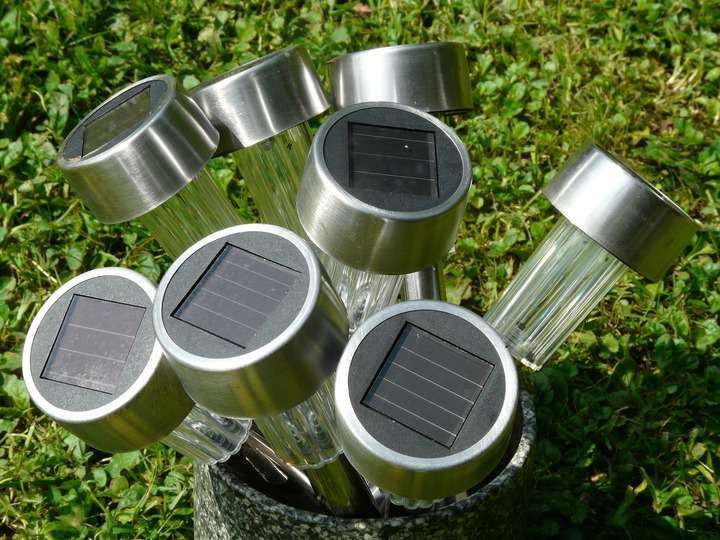
Technically, yes — a solar panel will respond to almost any visible light source, not just the sun. In practice, indoor lighting is so much weaker that it's not a viable charging method.
The sun delivers around 1,000 watts per square metre at noon — roughly 100,000 lux. Bright indoor LED lighting, by comparison, sits in the 300–1,000 lux range. That's typically less than 1% of the sun's charging power per unit area, and artificial light is often described as around 100 times less effective at charging a panel. Exact figures depend on the bulb output, the distance from the panel, and the panel's sensitivity.
Older non-directional bulbs make this worse — their already-low output spreads in every direction, so very little of it reaches the panel. Even directional LEDs aren't a great match, because solar panels are tuned for the broad spectrum of sunlight while LEDs emit a much narrower band of wavelengths.
You can read more on LEDs charging solar panels here, but the short version: don't rely on it.
A practical alternative: USB-charged landscape lights
Some landscape lights now ship with a USB port as a backup charging input. If your garden simply doesn't have enough sun, you can charge the light (or a power bank that powers it) from a mains socket indoors, then bring it back out for the evening.
If you go this route, choose a power bank rated for outdoor use (camping models are a good fit), keep the connection dry, and bring the bank inside to top up between uses. It's not as set-and-forget as true solar, but it's a workable compromise for a shaded plot.
Final Words
The decision usually comes down to three questions: how much direct sun the panel can see, how long you need the lights to run after dark, and how much you're willing to spend on a workaround.
My rule of thumb by garden type:
- Full sun: standard all-in-one solar lights are fine.
- Partial shade: look for higher-wattage panels and larger LiFePO4 batteries.
- Mostly shaded: choose lights with a separate, cabled panel you can mount in the sun, or go mains-powered.
If your garden is borderline, a single inexpensive light is a cheap test — try it for a couple of weeks before committing to a full set. And if winter is the real constraint, this guide on solar lights in winter is the next thing to read.