Can LED Lights Power Solar Panels?
Fifteen minutes of direct sunlight delivers as much energy to a solar watch as 8–10 hours under an LED bulb. Even heavy cloud cover usually beats an indoor light.
 Eugen
EugenEugen Nikolajev
Creator of LED Lighting Info
Hi, I am Eugen. I was always one of those kids who had all sorts of weird lighting gadgets for every occasion.
Now, I want to share my knowledge and experience about lighting with you on LED Lighting Info.
Read my editorial standards
Key Takeaways
Yes, LED lights can power a solar panel — but far less efficiently than sunlight. The bulb's color temperature, lumen output, and distance from the panel all determine how much usable energy reaches the cell, and in most situations even an overcast sky still beats an indoor LED.
Below, we'll look at how solar panels actually convert light into electricity, why color temperature matters, and the situations where LED charging is genuinely useful.
Do Solar Panels Need Sun or Just Light?
Solar power systems rely on the photovoltaic effect — the process by which certain materials generate electricity when light strikes them. The effect was first discovered in 1839 by 19-year-old French physicist Edmond Becquerel, working in his father's laboratory.
According to Ember's Global Electricity Review 2026, solar generation grew 30% year-on-year in 2025 and met three-quarters of the world's electricity demand growth — making it the fastest-growing energy source on the planet.
Modern panels are built from silicon, a semiconductor. Each cell has two layers of doped silicon: one P-type, with extra positive charge carriers (called holes), and one N-type, with extra electrons. The bulk material stays electrically neutral, but the boundary between the two layers — the P-N junction — forms an electric field that pushes charge in one direction once light is absorbed.
The full charging process happens in four steps:
- Light hits the solar cell.
- Photons knock electrons free from the silicon atoms.
- The electric field at the P-N junction drives those electrons into a current.
- The current is used immediately or stored in a battery.
Because solar cells are tuned to the sun's spectrum, any artificial light source that emits a similar mix of wavelengths can drive the same process — just at much lower intensity.
Does Color Temperature Affect Solar Panel Charging?
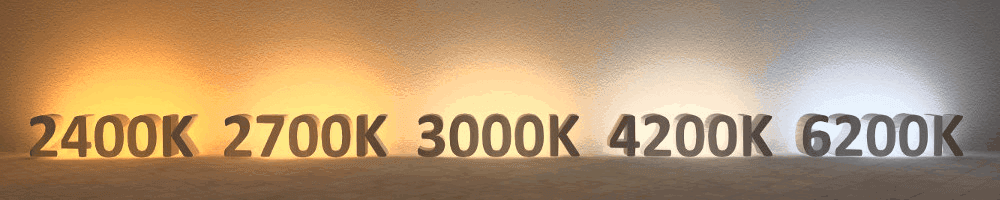
The sun radiates across the electromagnetic spectrum — ultraviolet, visible, and infrared — but most usable energy at ground level falls in the visible range, roughly 400–780 nanometers. Solar panels are optimized to absorb visible wavelengths: UV light is usually too short to be captured efficiently, while infrared photons don't carry enough energy to free electrons from silicon.
Unlike the sun, white-light LEDs emit almost exclusively visible light. Standard phosphor-converted LEDs produce negligible UV and very little infrared — that's actually why they're so much more efficient than incandescents, which waste most of their energy as heat. The visible output of an LED simply shifts toward red or blue depending on its color temperature, measured in degrees Kelvin (K).
Direct sunlight measures roughly 5500–6000K, varying with atmospheric conditions and time of day. LEDs in this range produce the closest spectral match to natural light, which is why they deliver the most usable energy to a solar cell — their peak output sits squarely in the visible band the panel is built to absorb.
| Color Temperature | Hue | Spectrum Profile | Solar Panel Efficiency |
|---|---|---|---|
| 2700–4000K | Warm white / yellow | Heavier in long (red) wavelengths | Low |
| 5000–6500K | Daylight / neutral | Strong visible-light output | Best match |
| 6500K and above | Cool white / blue | Shifted toward short (blue) wavelengths | Moderate |
Most consumer LEDs sit between 2700K (warm) and 6500K (daylight). Bulbs above 7000K exist but are mostly specialty products for aquariums or horticulture — and they don't actually emit meaningful UV, despite what older guides sometimes claim. For solar charging, look for bulbs labeled 5000K, 5500K, 6000K, or 6500K, often marketed as "daylight," "natural light," or "full-spectrum."
Can an LED Light Charge a Solar Watch?

Solar watch panels are tiny — usually just a few square centimeters — so it's tempting to assume an LED bulb can top them up in minutes. The reality is less encouraging.
Under the AM1.5 standard test conditions used industry-wide, the sun delivers about 1,000 watts of energy to every square meter of the Earth's surface. By contrast, an indoor LED bulb consumes only 5–15 watts of electricity total, and emits roughly 400 to 1,600 lumens depending on size and efficacy. Only a small fraction of that output actually reaches a small solar panel held nearby — typically just a few milliwatts per square centimeter.
In practice, around 15 minutes of direct sunlight delivers as much usable energy to a solar watch as 8–10 hours of LED exposure. And because LED intensity drops sharply with distance (the inverse-square law), positioning matters: keep the bulb within 2–4 inches (5–10 cm) of the panel for best results. Move the same bulb a foot away, and the energy reaching the cell falls by roughly 90%.
Even an overcast sky usually outperforms an indoor bulb. Cloud cover reduces solar panel output by anywhere from 20% to 90%, depending on cloud thickness — light overcast may only cut output by a quarter, while heavy storm clouds can reduce it to under 10% of peak. In nearly all cases, that's still more energy than a small LED a few inches away can deliver.
Also read: Do LED Lights Need A Special Photocell?
Other Devices You Can Charge With an LED
Solar watches aren't the only small device worth charging this way. Other practical use cases include:
- Solar-powered calculators — they only need a trickle of light, and a desk-lamp LED will keep them running indefinitely.
- Solar garden lights — useful for reviving units whose batteries have drained during a long gloomy stretch, by sitting them under a bright LED panel for several hours.
- Emergency backup panels — handy for testing whether a panel is still functional without waiting for a sunny day.
- Small portable power banks with built-in solar cells — slow, but viable in a pinch.
Larger panels — a rooftop array, or even a portable camping panel — are not realistic LED-charging targets. The electricity required to drive enough LEDs to meaningfully charge a 100W panel would dwarf any energy the panel could ever produce in return.
Is LED Lighting a Good Alternative for Charging Solar Panels Indoors?
If your solar device runs out at night and you need it working by morning, an LED is a sensible stopgap — but it shouldn't be a primary charging strategy.
Among indoor light sources, LEDs are the strongest performer. They're directional, so the light can be aimed straight at the panel, and they produce very little waste heat — meaning more of the input wattage becomes usable photons rather than infrared.
How Other Indoor Bulbs Compare
- CFLs (compact fluorescents) — emit in all directions, so most of their light spills past the panel. Their spectrum is also spiky rather than continuous, missing wavelengths a solar cell could otherwise use.
- Fluorescent tubes — share the same spectral gaps as CFLs, and the diffuse output of a long tube means low intensity at the panel surface.
- Halogen and incandescent bulbs — produce a broad, sun-like spectrum, but waste most of their energy as infrared heat. They can charge a panel, but inefficiently, and they pose a fire risk if positioned close enough to be useful.
There's also a sustainability catch. The electricity that powers an LED comes from the grid — and depending on your country, that mix can include fossil fuels, nuclear, and renewables. Globally, renewables overtook coal in 2025 for the first time, but in many regions a substantial share of grid power still comes from burning fossil fuels. Charging a solar panel indoors with that electricity carries a real carbon cost — and consumes many times more energy than the panel will ever produce in return.
What's Next: Solar Beyond Sunlight
Researchers are actively exploring ways to make solar panels useful in more conditions. Teams in China have demonstrated experimental graphene-coated solar cells that can generate small amounts of electricity from raindrops — though as of 2026, the technology remains a laboratory proof-of-concept with single-digit conversion efficiency, not a commercial product.
For now, the most reliable low-light solution remains pairing high-efficiency monocrystalline panels with battery storage, so that daytime sunlight can cover nighttime use.
Bottom Line: Use LED Charging Only as a Last Resort
LEDs can power a solar panel, and they do so more efficiently than other indoor bulbs. But they will never match even an overcast sky in raw output, and the grid electricity they consume undermines the environmental case for solar in the first place. Treat LED charging as a backup for small devices like watches, calculators, and garden lights — not as a substitute for sunlight.