
Do LED Headlights Work In Cold Weather?
LED headlights actually run more efficiently in the cold — but that same thermal efficiency is exactly why snow and slush can silently dim your beam on a winter road.
 Eugen
EugenEugen Nikolajev
Creator of LED Lighting Info
Hi, I am Eugen. I was always one of those kids who had all sorts of weird lighting gadgets for every occasion.
Now, I want to share my knowledge and experience about lighting with you on LED Lighting Info.
Read my editorial standards
Key Takeaways
LED headlights work in cold weather, in fact, they run more efficiently in cold temperatures than in heat. The trade-off is that LEDs produce very little heat at the lens, so snow and slush can stick to the outer headlight lens and obscure the beam.
Whether you're replacing an old halogen bulb or upgrading the lights on your car, LED headlights offer long life and excellent energy efficiency. But how do they hold up in cold weather, and do they even work?
In this article I'm going to cover:
- How efficient LED headlights are in cold weather
- The difference between OEM LED headlights and aftermarket retrofit bulbs
- The main problem LED headlights have in winter, and how to fix it
- Whether LEDs dazzle other drivers, and the best color temperature for snow and fog
Are LED Headlights As Efficient In Cold Weather As Normal?
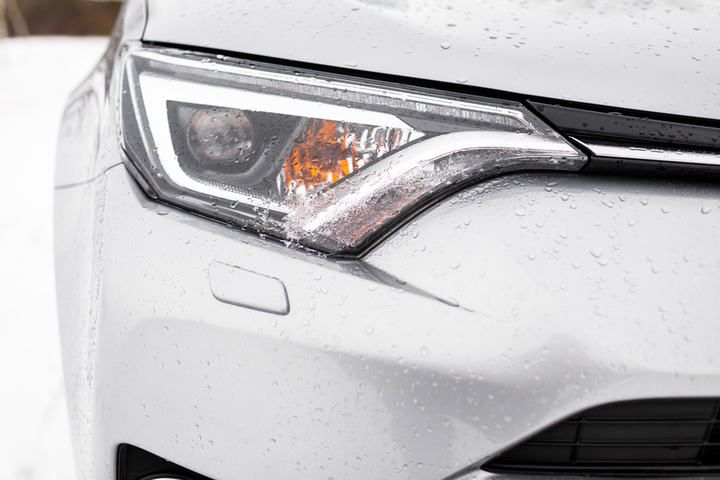
LED headlights aren't just 'as efficient' in colder weather — they actually run more efficiently than they do in warmer conditions. I cover the underlying physics in detail in my article on domestic LED lights in cold weather, but here's the summary.
LEDs are semiconductor devices: when current flows across the p-n junction, electrons recombine with holes and release energy as photons — a process called electroluminescence. Unlike halogen bulbs, they don't rely on heating a filament to produce light, so they aren't hampered by cold ambient temperatures.
LEDs are not heat-free, though. Even efficient commercial LEDs convert only about 50–60% of electrical input into light; the rest is dissipated as heat. The crucial difference is where that heat goes: it's pushed rearward through a heat sink (and often a small fan) at the back of the bulb assembly, rather than projected forward through the lens. That keeps the front of the headlight cool — which has implications later.
At higher junction temperatures, more electron-hole recombinations release their energy as heat (phonons) rather than light (photons), which lowers the LED's internal quantum efficiency. Cold conditions reduce these thermal losses, so the diode produces light more efficiently.
One bonus worth knowing: LEDs are instant-on regardless of temperature. Unlike fluorescent tubes, they don't need a warm-up period to reach full brightness — even at sub-zero temperatures, they hit full output the moment you flip the switch. So driving out into snow and ice, you can be confident your LEDs will produce a strong, immediate beam.
OEM LED Headlights vs Aftermarket Retrofit Bulbs
Before going further, an important distinction: factory-fitted LED headlights and aftermarket LED bulb retrofits are not the same product, and they don't behave the same way in winter.
OEM LED headlights are engineered as complete systems — the housing, reflector or projector, beam pattern, and thermal management are all designed around the LED light source. They typically perform excellently in all weather, including cold.
Aftermarket retrofit bulbs, by contrast, are designed to drop into housings originally built for halogen bulbs. The light source sits in a slightly different position relative to the reflector, which can produce a poor beam pattern, glare for oncoming drivers, and dark spots in your own line of sight. Many countries — and most U.S. states — consider these bulbs not road-legal in halogen housings, even though they're widely sold. If you're upgrading, check local rules first, and prefer DOT/SAE-compliant complete assemblies over a bulb-only swap.
What Is The Main Problem With LED Headlights In Winter?
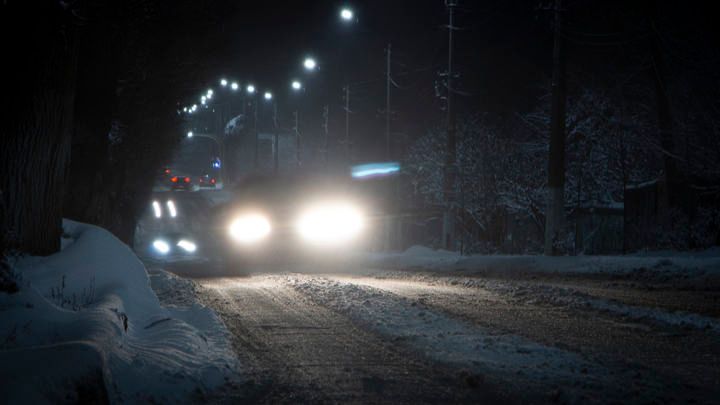
There's one real problem with LED headlights in winter, and it's again related to heat. Their efficiency in the cold is a virtue — but a little wasted warmth at the lens would actually be useful.
The reason is snow and slush. In heavy snowfall, or when the road kicks up icy spray, ice and slush can build up on the outer headlight lens and obscure the beam.
Halogen bulbs run hot enough that some of that heat conducts through the housing to the outer lens, helping melt snow and ice off it. Projector-style halogen housings are actually less effective at this than older reflector designs (the bulb sits recessed behind a cutoff shield, directing heat inward), but both produce far more lens-side heat than LEDs.
LED modules, by contrast, dissipate their heat rearward through a heat sink at the back of the bulb assembly — exactly the wrong direction for clearing snow off the front. Very little warmth reaches the outer lens, and snow and slush can sit there dimming the beam. That's a problem precisely when heavy snowfall means you need the strongest beam possible.
How To Keep Snow Off LED Headlights?
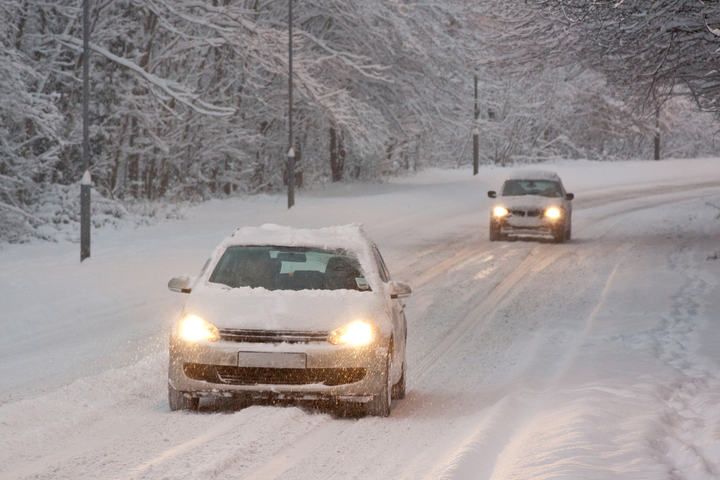
Pulling over to clear snow off your lights isn't always safe — single-lane roads with no shoulder leave nowhere clear to stop, and a stationary car becomes a hazard for drivers behind you. Stopping distances climb fast in winter, too: on packed snow at 35 mph, stopping distances are typically around 180 feet or more — roughly double the 60–100 feet needed on dry pavement. On true ice, that figure can balloon to 600 feet.
Better to prevent snow from sticking in the first place. Here are the main options, ranked roughly by effectiveness:
- Lens washers (best long-term solution). If your car has built-in headlight washers, you already have the strongest fix. Add a higher concentration of de-icer to the spray tank so it can cut through heavy snow quickly.
- Hydrophobic spray (around $10). A hydrophobic spray (Amazon) is widely available at hardware and auto stores. It bonds to the surface and repels water, so snow and slush slide off rather than gripping.
- Car wax (good seasonal maintenance). Apply a layer of car wax (Amazon) with a cloth before winter sets in. It makes the lens slicker and more water-repellent, which keeps snow from sticking.
- Cooking oil (emergency only). If you're caught out with no wax or spray and need to drive immediately, kitchen cooking oil works as a stopgap. It won't last long — re-apply at every rest stop on a long drive — but it'll keep ice from gripping the lens until you can pick up a proper product.
Don't forget the back of the car: if your taillights are LED too, treat them the same way. Visibility from behind matters just as much, especially for the drivers following you.
Can LED Headlights Blind Other Drivers In Snow?
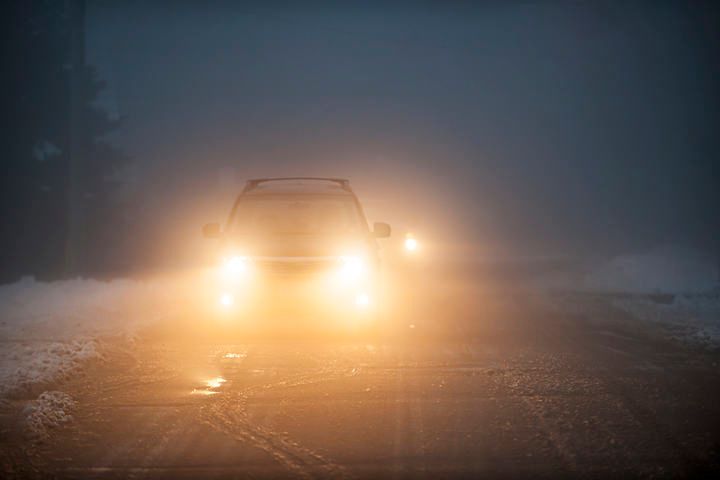
LED headlights have a very bright light output, and some drivers report finding modern LEDs uncomfortably bright, particularly when oncoming vehicles use high beams. Snow itself doesn't make this worse: properly aimed headlights won't reflect any more off snow than off wet pavement, and they won't bounce the beam back at you.
What white LED beams can do is illuminate falling snow and rain in front of you, which can pull your eye away from the road surface. That's a usability issue rather than a glare issue, and it points to a different fix: color temperature.
What Color LED Headlights Are Best For Winter Driving?
U.S. federal regulation FMVSS 108 requires road-legal headlamps to emit white light, with allowed color temperatures roughly between 3000 K and 6000 K. Most LED headlights sold for road use sit in the 4000–6000 K range — the cool, slightly blue-tinted white you see on modern cars. UK MOT rules and EU type approval impose similar white-only requirements.
Blue and purple LED headlights fall outside that window. They're illegal under FMVSS 108 (and equivalent rules abroad), and they perform comparatively poorly in snow and fog: shorter, cooler wavelengths scatter more off airborne snowflakes and water droplets, increasing backscatter glare — exactly what you don't want when visibility is already bad.
Yellow and amber light, at the warmer end of the spectrum, scatters less off precipitation.
That's why yellow fog lights cut through fog and heavy snow better than cool white. If you regularly drive in poor weather, a set of dedicated yellow LED fog lights paired with white main headlights is the best combination.
Final Words
If there's one thing I'd recommend doing before winter, it's this: spend ten minutes applying a coat of hydrophobic spray or car wax to your headlight and taillight lenses. It's the single most effective preventative measure for keeping your beam clear once the snow starts falling — and it costs less than a tank of fuel.