RGB & Color Mixing
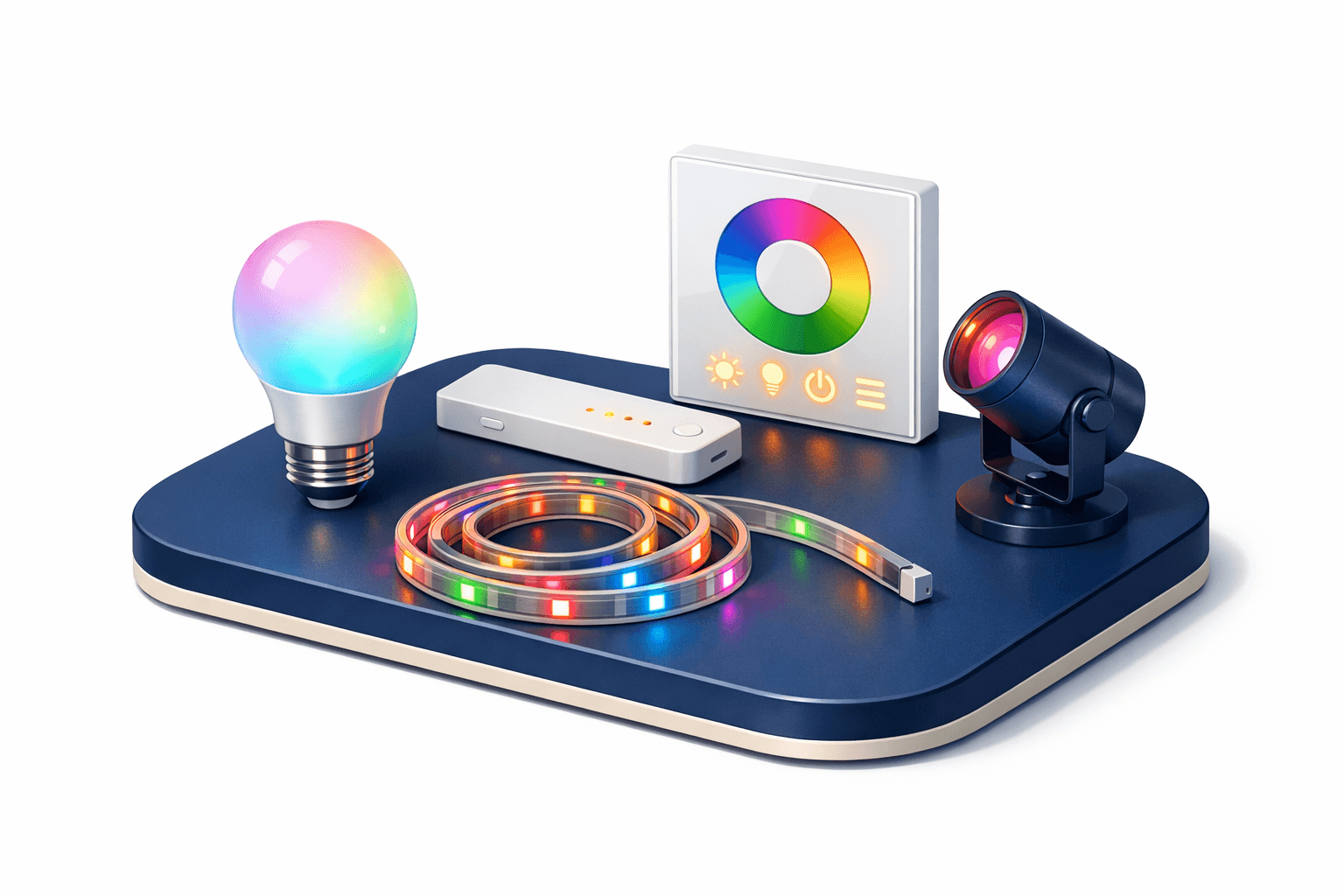
LED technology that combines red, green, and blue diodes to create millions of colors. Variants include RGBW (adds white), RGBWW (adds warm + cool white), and RGBIC (independently addressable segments).
RGB LEDs contain three separate diodes — red, green, and blue — inside a single package. By adjusting the intensity of each, the LED can produce virtually any color in the visible spectrum. Full red + full green = yellow. Full blue + full red = magenta. All three at full = an approximation of white (though not a great one).
That "approximate white" is the limitation of basic RGB. Because the white is created by mixing three colored LEDs rather than using a phosphor-coated white LED, it tends to look pale, pinkish, or slightly off. RGBW solves this by adding a dedicated white LED to the package — use RGB for colors, use the white LED for clean white light. RGBWW goes further with both a warm white and a cool white LED, giving you tunable white plus full RGB color.
RGBIC (sometimes called "addressable RGB" or "dreamcolor") is the latest evolution. Instead of the entire strip changing to one color, RGBIC divides the strip into independently controllable segments. Each segment can display a different color simultaneously, enabling rainbow effects, flowing gradients, and music-reactive patterns. Govee popularized this technology in consumer strips.
Specifications
| RGB | Red + Green + Blue — basic color mixing |
| RGBW | RGB + dedicated White LED — cleaner whites |
| RGBWW | RGB + Warm White + Cool White — best white quality |
| RGBIC | Independently controllable segments — rainbow effects |
Related Terms
- Addressable LEDs
LED strips where each LED (or small group) can be controlled independently for color and brightness — enabling rainbow effects, animations, and music sync.
- SMD (Surface Mount Device)
A type of LED chip soldered directly onto a circuit board. Common in strip lights — the number (2835, 5050) indicates the chip dimensions in tenths of millimeters.
- LED Density
The number of LED chips per meter on a strip light. Higher density produces smoother, more even light with fewer visible dots. Common values: 30, 60, 120, or 144 LEDs/m.
Mentioned in
How Do LED Lights Change Color?
An RGB LED can generate 16,777,216 colors — and it does it with just three diodes by varying how much current each one receives.
Everything You Need To Know About LED Strip Lights: Definitive Guide
RGB strips blend 16 million colors but can't produce a clean white — that approximate warm glow is exactly why RGBW strips exist.