
How Do LED Lights Change Color?
An RGB LED can generate 16,777,216 colors — and it does it with just three diodes by varying how much current each one receives.
 Eugen
EugenEugen Nikolajev
Creator of LED Lighting Info
Hi, I am Eugen. I was always one of those kids who had all sorts of weird lighting gadgets for every occasion.
Now, I want to share my knowledge and experience about lighting with you on LED Lighting Info.
Read my editorial standards
Key Takeaways
A color-changing LED contains three separate diodes within the same bulb casing. Each diode emits a specific color – red, green, or blue. When all three are switched on at full intensity, white light is produced. Adjusting the brightness of each diode allows a huge range of colors and shades to be created.
Gone are the days of using lighting gels to change the color of a light source. Today, one small diode is enough to supply an endless range of colors.
But what is it about LEDs, in comparison to traditional bulbs, that allows them to change color? How can something so technologically advanced be so small?
Colored LEDs are all around us. Beyond decorative applications, they're used for communication and indication — the status ring on an Amazon Echo, for example, is an array of RGB LEDs that flash different colors depending on what the device is doing.
In this article, I'll explain how colored LEDs work, whether you can change the color of your existing LEDs, and how color differs from color temperature.
The Difference Between Color and Color Temperature

'Color' refers to the hue of light a diode emits — this can be any color of the rainbow. Color temperature, by contrast, refers to the shade of white light emitted. White lights can produce warmer or cooler visual effects, and this is measured in degrees Kelvin.
The Kelvin scale was established by the Scottish-Irish physicist and mathematician Lord Kelvin (William Thomson), who studied color changes in heated metals. He observed that as the temperature of a black body increases, its glow shifts from red to yellow and eventually to blue.
Unlike air temperature, measured in Celsius or Fahrenheit, warm color temperatures correspond to low Kelvin values, while cool color temperatures correspond to high ones. In lighting, color temperatures are typically expressed on a scale running from about 1,000 K up to 10,000 K, with most LEDs falling between 2,000 K and 6,500 K.
Understanding the RGB Model
An RGB LED can generate up to 16 million colors. Here's how it manages that with just three diodes.
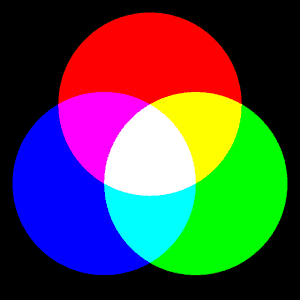
Colored LEDs are made up of three diodes: red, green, and blue (RGB). The RGB system is an additive color model — these three colors are used because the human eye perceives all colors as different combinations of red, green, and blue wavelengths.
Additive vs. Subtractive Color
You might remember from school that mixing blue and yellow paint made green, and that the primary colors were said to be red, yellow, and blue. That schoolroom system (RYB) is a traditional artist's approximation of subtractive color mixing — close enough for kids' poster paints, but not the model actually used in printing.
There are two color-mixing models in the visible world: subtractive and additive.
In the subtractive model, pigments or inks absorb certain wavelengths of light and reflect others — the color you see is the wavelength that isn't absorbed. The model used in commercial printing is CMYK (cyan, magenta, yellow, plus black), where mixing all three colored inks produces something close to black, and the absence of ink leaves white paper showing through.
The additive model is the opposite. The absence of light is black, and adding colored light together produces brighter, eventually white, output. This is the model LEDs use. In an LED, light is emitted when electrons recombine in a semiconductor junction; the wavelength — and therefore the color — depends on the bandgap of the specific semiconductor compound.
Red and amber LEDs use the aluminum gallium indium phosphide (AlGaInP) material system, while modern blue and green LEDs both use indium gallium nitride (InGaN) — the color is set by the indium content of the alloy. (Older, lower-brightness green LEDs used gallium phosphide, but that technology has largely been replaced.)
The RGB primaries are what matter here, because TVs, monitors, and electronic displays all use this color-mixing method. They illuminate red, green, or blue subpixels at varying intensities to produce over 16 million colors.
Current passing through all three diodes at equal intensity produces white light. Since LEDs are tiny and the diodes sit so close together, the eye blends the output and you see a single combined color rather than three separate dots.
Switching only two diodes on at a time produces a further three colors — magenta, yellow, and cyan — as shown in the table below.
| Red | Green | Blue | LED Color |
|---|---|---|---|
| ✓ | ✓ | ✓ | White |
| ✓ | ✘ | ✘ | Red |
| ✘ | ✓ | ✘ | Green |
| ✘ | ✘ | ✓ | Blue |
| ✓ | ✘ | ✓ | Magenta |
| ✓ | ✓ | ✘ | Yellow |
| ✘ | ✓ | ✓ | Cyan |
Mixing Intensities for Millions of Colors
Beyond these primary mixes, additional colors are created by varying the intensity of current through each diode. If the red and green diodes are both switched on but green is running at 50%, the result is a color between red and yellow — in this case, orange.
To quantify the intensity of each diode, the RGB model uses a numeric color code — the same one you'll have seen in graphic design or web development.
Each diode is given a value between 0 and 255. The code for orange, for example, is 255, 128, 0 — or in percentage form, 100%, 50%, 0%.
Since each of the three colors can be set to 256 values (including zero), 256 × 256 × 256 = 16,777,216 possible colors are available — all from mixing just three primaries.
To see how it works, you can play around with this color picker — adjust the RGB values and watch the color change.
How Brightness and Dimming Work
In a color-changing LED, a microcontroller decides whether each diode is on or off. To adjust brightness, LEDs use a technique called Pulse Width Modulation (PWM).
PWM works by rapidly switching the diode on and off:
- The diode switches on.
- The diode switches off.
- The cycle repeats hundreds or thousands of times per second.
- The eye perceives the average brightness, not the individual flashes.
When PWM frequency is high enough, the flickering blurs together for the eye into a single steady color. Cheaper drivers running at lower PWM frequencies, however, can produce flicker that's visible — particularly in peripheral vision or when you move your eyes — and may cause eye strain or headaches.
PWM frequencies vary widely by driver design, commonly between a few hundred Hz and several kHz. The IEEE 1789-2015 standard recommends that LEDs operate above roughly 1,250 Hz to minimize health risks. The average person stops consciously seeing flicker around 60–90 Hz, but modulation can still cause physiological effects at much higher frequencies, and you can detect it indirectly via the stroboscopic effect — the 'phantom array' you see when you wave a finger past a light.
RGB vs. RGBW LED Lights
A standard RGB LED uses three colored diodes. An RGBW LED adds a fourth — a dedicated white diode.
When you ask the fixture for white light, only the white diode lights up, producing a clean, neutral output. The colored diodes kick in when you want a hue.
An RGBW LED can produce well-saturated whites and softer, pastel-tinted shades that an RGB LED can only approximate. Because the white channel uses a phosphor-converted high-CRI white LED — CRI (Color Rendering Index) is a 0–100 scale measuring how accurately a light source renders colors compared with sunlight — RGBW output is suitable for task and mood lighting where you actually need to see objects clearly.
An RGBW fixture can also shift its color temperature: blending the white diode with the blue diode produces a cooler temperature for task lighting, while blending the white diode with the red diode produces the familiar warm-white you'd want in a living room.
Side by side, the trade-offs look like this:
| Feature | RGB | RGBW |
|---|---|---|
| Number of diodes | 3 | 4 |
| White light quality | Slightly blue-tinted mix | Clean, high-CRI white |
| Pastel and tinted colors | Limited | Strong |
| Task and mood lighting | Low suitability | High suitability |
| Cost and complexity | Lower | Higher |
If you don't need brightness or task-quality color rendering, a basic RGB LED is enough for ambience and decoration. For more demanding white-light quality, RGBW is the better pick.
Can an LED Change Its Color Temperature?
Adjusting an RGB LED's color is straightforward, but changing the color temperature of a fixed white LED is a different story.
A standard white LED is manufactured to produce a specific Kelvin value, and once it's built, that color temperature is fixed.
Warm light has a relaxing effect, while cooler, blueish light helps keep you alert. If you use the same room for both unwinding and concentrating, a single fixed color temperature is a real limitation.
Manufacturers responded with tunable white (CCT-adjustable) LEDs. These combine two sets of LED chips — one warm, one cool — and let you blend between them to land anywhere on the color-temperature spectrum. Some smart bulbs go further, combining RGB diodes with both warm and cool white diodes (sometimes labelled RGBWW or RGBCCT) for full hue plus tunable white in a single bulb.
The video below from SIRS-Electronics walks through how temperature-changing LEDs work in practice:
Customizing Color: Smart and Addressable LEDs
Despite the underlying technology being relatively simple, color-changing LEDs aren't always easy to customize.
There are two broad types of color LED: single-color and multi-color. A fixed-red LED, for example, has only the red diode inside the casing — including green and blue diodes would be wasteful since they'd never switch on.
That makes it physically impossible for a single-color LED to change color: it doesn't have the components.
Multi-color LEDs do contain all three primary diodes, but the colors and patterns they cycle through are usually preset by the manufacturer. The on-board microcontroller decides what each diode does, and unless you can talk to that controller, you can't change the behavior.
Smart LEDs and Wireless Control
In recent years, smart LEDs have become widely available, allowing you to control color and brightness on LED lights from a remote, smartphone app, or voice assistant. They communicate over a handful of protocols, each with its own trade-offs:
- Wi-Fi — connects directly to your home network. Easy to set up but draws more power and can clutter the network if you have a lot of bulbs.
- Bluetooth — short range, works without a hub, but doesn't reach across a whole house.
- Zigbee and Z-Wave — low-power mesh networks. Each bulb extends the range of the next. Requires a hub or compatible smart-home controller (Hue Bridge, SmartThings, etc.).
- Matter — a newer cross-vendor standard that lets devices from different brands talk to each other through a common API. If you want long-term flexibility, look for Matter-compatible bulbs.
Addressable LED Strips
Most basic RGB strips treat the entire strip as one unit — every LED on the strip displays the same color at the same time. Addressable strips work differently. Each LED (or small group of LEDs) has its own tiny controller chip — the most common is the WS2812B, often sold as 'NeoPixel' — and each can be set to any color independently of the others.
That's how you get chasing rainbows, color waves, and reactive effects on gaming setups, stage rigs, and architectural installations. A microcontroller (Arduino, ESP32, Raspberry Pi, or a dedicated controller) sends a stream of color values down the strip, and each LED reads its assigned slot.
Can You Convert a White LED Strip Into RGB?
If you've found a roll of white LED strip in storage and you're hoping to turn it into a color strip — unfortunately, no. A white LED simply doesn't contain the red, green, and blue diodes needed to mix colors, and there's no way to retrofit them after the fact.
If you want color, you'll need to buy an RGB or RGBW strip from the start.
A Note on Power and Heat
RGB and RGBW strips draw more current than basic single-color strips because they have more diodes per meter. Make sure the power supply is rated for the full length of the run — undersized supplies cause voltage drop, color shifts toward the far end of the strip, and premature failure. Equally, don't enclose LEDs in unventilated housings: heat shortens diode lifespan and can shift their color temperature over time.
Final Thoughts
The technology behind color-changing LEDs is straightforward in concept: three diodes, varying intensities, one microcontroller. The interesting part is what's been built on top of that foundation — high-CRI RGBW for accurate task lighting, tunable-white systems for adjustable color temperature, addressable strips for per-pixel control, and smart bulbs that talk to phones, voice assistants, and increasingly to each other through Matter.
This color effect is unique to LEDs — halogen and incandescent bulbs can't replicate it. As lighting design continues to lean on programmable, color-aware fixtures, expect RGB and tunable-white systems to keep showing up everywhere from architectural lighting to everyday household bulbs.