
Why Are Light Bulbs Round?
LED chips are flat semiconductors with no reason to be round — they inherited the A-shape bulb purely to fit sockets built for Edison's glowing filament over a century ago.
 Eugen
EugenEugen Nikolajev
Creator of LED Lighting Info
Hi, I am Eugen. I was always one of those kids who had all sorts of weird lighting gadgets for every occasion.
Now, I want to share my knowledge and experience about lighting with you on LED Lighting Info.
Read my editorial standards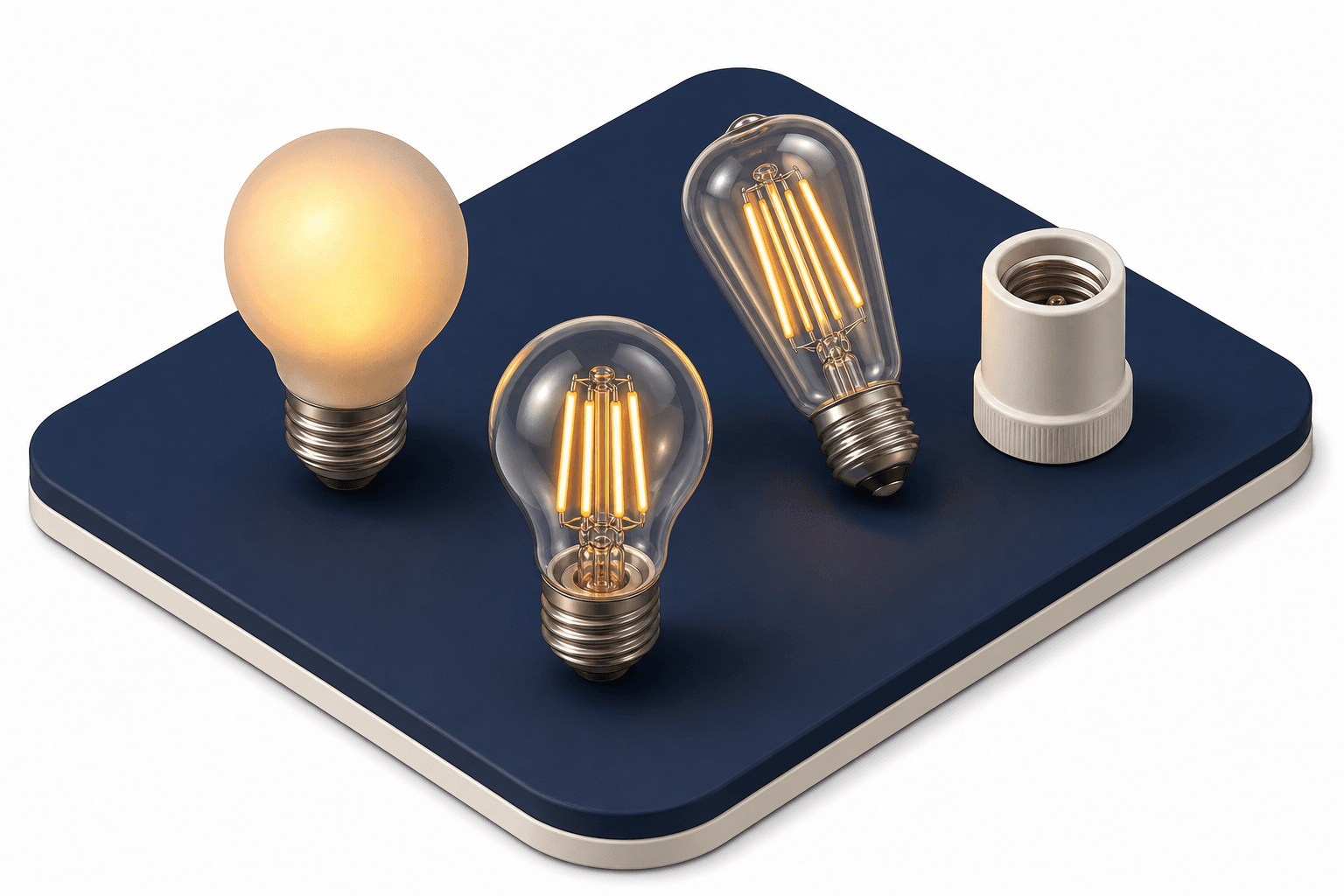
Key Takeaways
Round bulbs were the easiest and most natural shape to manufacture, and the geometry brought real technical advantages: a favorable volume-to-surface-area ratio, no structural weak points under vacuum, and roughly equidistant filament placement for even light distribution.
When LED bulbs first arrived, they were designed to fit the screw sockets and round fixtures we already had — much like a backward-compatible game console.
That decision is the main reason most LED bulbs still look like the incandescent A-shape Edison popularized over a century ago, even though the LED chips inside have nothing in common with a glowing filament.
Does Light Bulb Shape Affect Light Illumination?
In a traditional bulb, the light source needs to sit roughly equidistant from the glass on all sides to produce uniform, omnidirectional light. A round bulb makes it easier for the central tungsten filament to meet that criterion — though filament placement and any internal reflector matter at least as much.
Several non-spherical shapes (globe G25, candelabra CA10, the classic A-series pear) achieve very similar omnidirectional output when the source inside is positioned well.
A square bulb, by contrast, would struggle to throw light evenly in every direction. Bulbs that aren't pear, spherical, or globe shaped — the candle bulbs in chandeliers, the tubes of a fluorescent fixture, the cuboid designer LEDs — are shaped that way for aesthetic or structural reasons rather than for light distribution.
What's So Special About a Spherical Shape?

If you had to design a glass enclosure to house a burning hot metal filament, you would probably end up reinventing the famous A-type bulb. The shape is so fool-proof that it has barely changed since Edison produced the first commercially practical model in 1879. Four things are doing the work.
Glass blowing naturally produces round shapes
Hot glass shaped by blowing air into it expands into a round form — the same physics as inflating a balloon. Early bulbs were hand-blown and rolled on metal surfaces to even out flaws. Today bulb manufacturing is fully automated, but the same physics still governs mold and machine design.
Round molds are cheap and forgiving
The frames that hold the mold are round so that hot glass can be expanded equally and quickly into the cavity. There are no corners to leave unfilled or overfilled, no edges where the glass thins out or bunches up. The result is uniform wall thickness, which means uniform light dispersion — produced cost-effectively at scale.
It survives the manufacturing vacuum
Modern incandescent and halogen bulbs aren't operated under hard vacuum — they are filled with inert gases like argon (sometimes with nitrogen or krypton) at near-atmospheric pressure to slow filament evaporation. But during manufacture, every bulb is briefly evacuated before the gas is introduced, and that evacuation step puts the glass envelope under significant external pressure.
A sphere has no bending stress and no structurally weak points, so it handles that pressure without caving in — the same principle that lets a dome roof stay intact. A square or triangular envelope would simply collapse.
It uses the least glass for the most volume
A sphere encloses the most volume with the least surface area of any 3D shape. In bulb terms, the least glass needs to be used to produce a given internal volume — and that volume matters for two reasons:
- Heat clearance. A tungsten filament gets white-hot in operation. The fragile glass envelope needs to stay well clear of it to avoid heat damage and excessive heat loss. A roomy spherical interior gives the filament that breathing room without wasting glass.
- Fill gas. Halogen and standard incandescent bulbs need enough internal volume to hold a useful charge of inert gas at the right pressure for the filament to operate efficiently.
A Quick Reference to Common Bulb Shapes
Bulb packaging uses an ANSI/IEC code that combines a letter for the shape and a number for the diameter (in eighths of an inch in North America, or millimeters in Europe). The codes you'll meet most often:
| Shape Code | Common Name | Typical Use | Round? |
|---|---|---|---|
| A19 | Standard A-shape (pear) | General household lamps and fixtures | Yes — pear-shaped |
| G25 / G30 | Globe | Bathroom vanity bars, pendant fixtures | Yes — spherical |
| BR30 / BR40 | Bulged reflector | Recessed cans, downlights | Partly — domed front |
| PAR38 | Parabolic aluminized reflector | Outdoor floods, track and spotlights | No — flat-faced reflector |
| CA10 / B11 | Candelabra (candle) | Chandeliers, sconces, decorative fixtures | No — flame-shaped |
| T8 / T5 | Tubular | Linear fluorescent and LED tubes | No — straight tube |
| Spiral CFL | Compact fluorescent (twist) | Retrofit replacements for A-shape bulbs | No — wound tube |
Can Light Bulbs Have Different Shapes?
Plenty of bulbs aren't round at all. Some shapes exist for a functional reason — a PAR floodlight needs its parabolic reflector face, a tube needs to be a tube to fit a linear fixture — and others exist purely for aesthetics, like the cuboid and faceted designer LED bulbs that have appeared in the last few years.
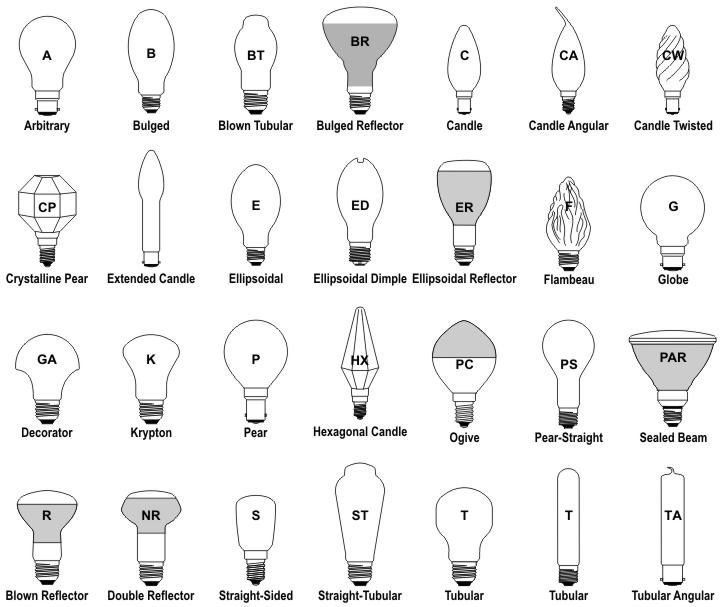
CFL and fluorescent lamps are mostly tubes. In purpose-built fixtures they stay long and straight, but when they need to replace a screw-in bulb the tube is wound into the familiar spiral so the whole assembly fits roughly into the footprint of an A-shape lamp.
LED vs Incandescent Bulbs: Does the Shape Matter?

An LED is a flat semiconductor chip, not a glowing wire. It emits light directionally — typically into a hemisphere of about 180° in front of the chip — rather than radiating in every direction the way a filament does. That changes everything about what shape the bulb "wants" to be. Look up at a flush ceiling light and you'll see the most natural LED form factor: a flat panel with diodes spread evenly across it.
Why so many LED bulbs are still round
Why so many LED bulbs are still round
Because the existing world of fixtures, sockets, and shades is built around the A-shape. Making LED replacements spherical lets them drop straight into lamps and fittings already in use — pure backward compatibility, the same logic that keeps new game consoles playing older titles.
The LED diodes themselves don't need any of this. They run on low-voltage DC supplied by an internal driver that rectifies the mains AC down to a few volts; they don't need screw-type bases; and least of all, they don't need the round bulb shape. The retrofit bulb on the shelf still plugs into the same socket, but the technology inside is fundamentally different.
Making a directional chip behave like an omnidirectional bulb
A single LED chip pointing forward can't replicate the all-around glow of an A19 incandescent. To get omnidirectional output from a round LED bulb, manufacturers use one of three tricks: arrange multiple chips on a 3D core so they point in different directions; cover the chips with a frosted diffuser that scatters light in every direction; or build vertical "filament" strips of tiny LEDs to mimic the look and light pattern of a real filament.
Heat sinks shape the bulb too
LEDs run cool at the surface but the chip itself needs heat carried away to last. That's why many older LED retrofits had finned aluminum heat sinks where the neck of the bulb would normally taper, and why some cheaper modern bulbs use a chunky white plastic base hiding a thermal core. The shape of an LED bulb isn't only about how the light gets out — it's also about how the heat does.
Final Words
Three things explain why the default light bulb is round: glass blowing and round molds make manufacturing cheap and uniform; a sphere is the strongest shape for the brief vacuum step in production; and the geometry keeps a hot filament safely distant from the glass while using the least material to enclose the most space.
LEDs inherit the shape vocabulary of older bulbs not because they need any of these properties but because the world's fixtures were already built around them. As lighting design moves further away from the screw-in retrofit, expect to see more LED form factors — flat panels, strips, and shapes the incandescent era never imagined — that have no reason to be round at all.