How Do I Know What Base My Light Bulb Is?
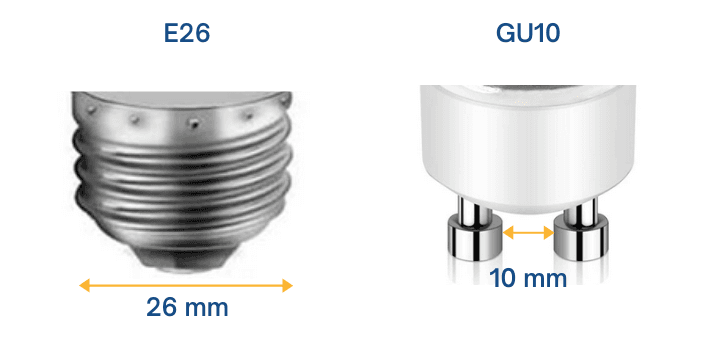
E26 isn't just a label — it describes the bulb: E for Edison, 26 for the shell diameter in millimeters. The same logic unlocks every other base code too.
 Eugen
EugenEugen Nikolajev
Creator of LED Lighting Info
Hi, I am Eugen. I was always one of those kids who had all sorts of weird lighting gadgets for every occasion.
Now, I want to share my knowledge and experience about lighting with you on LED Lighting Info.
Read my editorial standards
Key Takeaways
To identify a bulb base, follow two steps:
- Identify the base category — screw, pin, or bayonet.
- Measure in millimeters: shell diameter for screw and bayonet bases, or the distance between the pins for pin bases.
How many hourly electricians does it take to change a light bulb? Two: one to hold up the bulb, and one to spin the ladder around.
Getting the correct bulb for your fixture is straightforward. All you need is a ruler and the base identification guide below.
💡Don't have a ruler handy? Take a photo of your bulb with my Bulb Identifier — it identifies the base type, voltage, and compatible LED replacements automatically.
Light Bulb Bases Explained
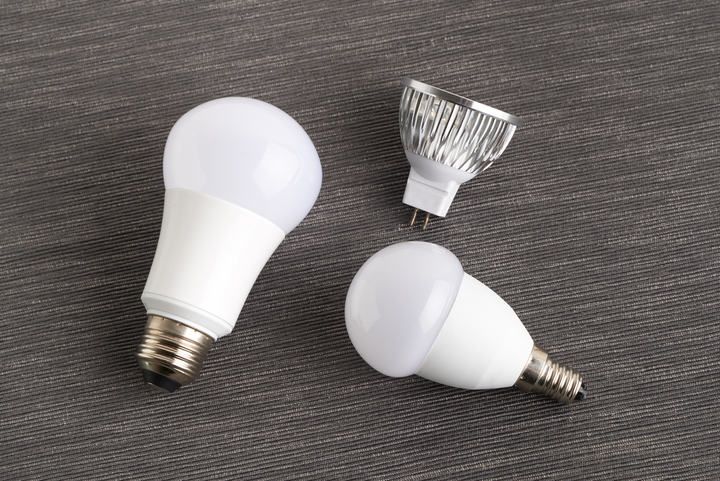
The most common type of bulb is called the Edison base, a homage to the creator of the original light bulb, Thomas Edison. All Edison base codes start with "E" (for Edison), and the number indicates the shell diameter in millimeters — so an E26 measures 26 mm across. Although Edison himself worked in imperial units, the IEC later standardized screw bases using millimeter designations, which is how the E-codes came to be.
E26 / E27 — Standard Edison Screw
The E26 is the standard screw base in North America, found in most ceiling lights, lamps, ceiling fans, and general household fixtures. Paired with reflector bulbs, it also shows up in spotlights and floodlights.
The E27 is its European counterpart — one millimeter larger across the shell, and generally interchangeable with the E26 in fixtures rated for the same voltage. Between them, these two bases cover the vast majority of household bulbs sold worldwide.
E12 — Candelabra
The E12 candelabra base is the North American standard for decorative chandeliers, table lamps, wall sconces, festive string lights, and restaurant fixtures. Its European equivalent is the E14 (SES, or Small Edison Screw) — not the E11, which is a separate mini-candelabra size used worldwide for specialty halogens and display fixtures.
Output ranges from low to medium brightness depending on the bulb's lumen rating, making candelabra bulbs well-suited for ambient and decorative lighting.
GU10 — Twist-Lock Spotlight
The GU10 is a mains-voltage twist-lock base — 120 V in North America and 230 V in Europe and similar markets — that connects directly to mains without a transformer. It's the go-to base for downlights, recessed can lights, kitchen track lights, retail displays, and garden spotlights.
The pins of a GU10 are cylindrical with bulbous tips, spaced 10 mm apart, and lock into keyhole-shaped slots via a twist-and-lock mechanism that holds the bulb securely.
G9 — Looped-Pin
Don't confuse the GU10 with the G9. The G9 uses a looped-pin base — two wire loops spaced 9 mm apart that slide into matching slots in the socket. G9 bulbs often get stuck because of the friction fit between those loops and the socket contacts.
G13 — Bi-Pin Fluorescent Tube
The G13 is the medium bi-pin base found on T8 and T12 linear fluorescent tubes — the long, skinny bulbs typical of older kitchens, garages, and office ceilings. The number indicates the 13 mm pin spacing, and the G is historically derived from Glass, the material used in the original tubes.
Note that G13 is a linear fluorescent base, not a compact fluorescent (CFL) base. CFLs use plug-in bases such as G23, GX23, G24, 2G11, or an integrated E26/E27 screw base.
BA15 / B22 — Bayonet
Bayonet bases use two small pins on opposite sides of the shell that slide into L-shaped slots in the socket — push in and twist a quarter turn to lock. They come in single-contact (BA15s, B22s) and double-contact (BA15d, B22d) versions. The contact count determines how many separate electrical connections the base provides; double-contact is used where two leads are needed, as with dual-filament automotive bulbs.
The B22 (22 mm shell) is the standard household bayonet across the UK, Ireland, Australia, and parts of Asia, typically handling the same 40–100 W bulbs as a screw base in those regions. The BA15 (15 mm shell) is rarely used in household fixtures — you'll mostly find it in automotive, marine, and specialty decorative lighting.
Bulb Base Sizes Chart
Edison Screw Bases
Edison screw bases come in four main size families, with slight regional variations between North America and Europe. E26 and E27 dominate general household lighting; candelabra and mogul sizes cover decorative and high-wattage fixtures respectively; and the E11 mini-candelabra is a specialty size used worldwide for small halogens.
| Edison Bulb Sizes | North America | Europe |
|---|---|---|
| Candelabra | E12 – 12 mm | E14 – 14 mm (SES) |
| Mini-candelabra (specialty) | E11 – 11 mm | E11 – 11 mm |
| Intermediate | E17 – 17 mm | — |
| Standard (most common) | E26 – 26 mm | E27 – 27 mm |
| Mogul | E39 – 39 mm | E40 – 40 mm |
Twist-and-Lock Bases
Twist-and-lock bases fall into two families: bayonet (push and turn) and GU-style spotlight. Bayonet fittings are uncommon in US households — the B22 dominates as the standard domestic bayonet in the UK, Europe, and Australia, while BA15 is mostly confined to automotive and specialty applications. The GU10 spotlight, by contrast, is the standard mains-voltage twist-lock base worldwide.
| Twist-and-Lock Bulb | Code – Shell diameter / Pin spacing | Typical use |
|---|---|---|
| Bayonet (single contact) | BA15s – 15 mm shell | Automotive, marine, specialty decorative |
| Bayonet (double contact) | B22d – 22 mm shell | Household lighting in UK, Europe, Australia |
| Spotlight | GU10 – 10 mm pin spacing | Mains-voltage spotlights worldwide |
Pin Bases
Pin bases cover a wider range of specialty fixtures. Common examples include the G5 for T5 linear fluorescent tubes (and their LED replacements), the G5.3 for MR16 low-voltage spotlights, and the G13 for the T8/T12 tubes found in older office and garage ceilings. In each code, the number indicates pin spacing in millimeters.
Many of these pin sizes are now available in LED form, though some — like G5 and G13 — may require fixture-level changes to bypass the original ballast.
| Pin base | Pin spacing | Typical use |
|---|---|---|
| G4 | 4 mm | Low-voltage capsule bulbs in desk lamps and some chandeliers |
| G5 | 5 mm | T5 linear fluorescent tubes and T5 LED replacements |
| G5.3 | 5.3 mm | MR16 low-voltage spotlights |
| G9 | 9 mm | Looped-pin base used in decorative and under-cabinet fixtures |
| G12 | 12 mm | Replacement base for metal halide lamps |
| G13 | 13 mm | T8 and T12 linear fluorescent tubes |
Why Do Fittings Have Different Bases?
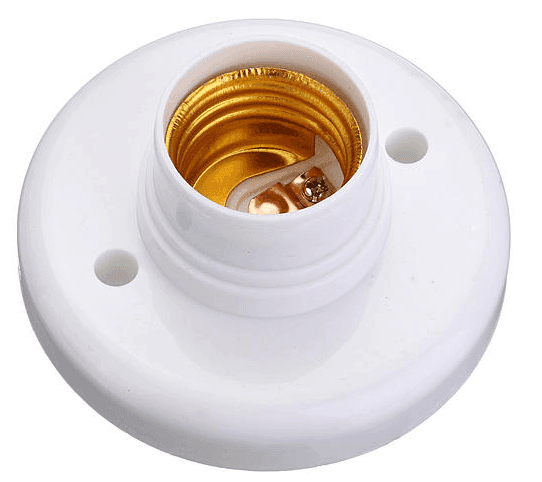
Different bases serve different purposes. Screw bases have been the workhorse for decades because the threaded connection is stable and resists vibration — the bulb won't loosen in fixtures near doors or running appliances.
Pin-type bases allow a more compact socket, so smaller bulbs fit neatly into slimline fixtures — a must for modern decorative and architectural lighting. Twist-and-lock mechanisms like the GU10 are also faster to change than Edison screws, especially in recessed or tight spots.
In all cases the base has two jobs: provide the electrical contact between the bulb and the circuit, and secure the bulb in the socket.
Base Adapters and Safety
Some base types can be swapped using adapters. Common examples include E12-to-E26 adapters (letting you screw a candelabra bulb into a standard socket) and GU10-to-E26 adapters that convert a pin-base spotlight to a screw fitting.
Handle any adapter with care. In a correctly wired Edison socket, the threaded shell is connected to neutral as a deliberate safety feature, so touching it while changing the bulb should not be dangerous. But wiring errors, reversed polarity, or switched-neutral installations can leave that shell live — and adapters (especially Edison-to-bayonet converters) can scramble the polarity the fixture was designed for, creating a real shock hazard. Polarity matters for some bulb types, and even the metallic part of the base in an Edison bulb is only safe to touch when the circuit is wired correctly. The standard rule: always turn off power at the switch or breaker before handling any bulb or socket.
Every socket and adapter also carries a maximum wattage rating, usually printed on the socket housing or inside the fixture canopy. Never exceed that rating, even when using an adapter — a higher-wattage bulb can overheat the wiring and start a fire.
Swapping to LED and Reading Fixture Labels
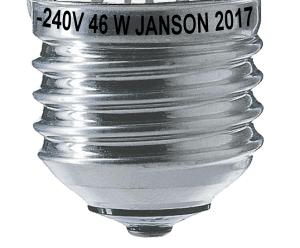
Most common bases — E26, E27, E12, E14, GU10, G9, and B22 — have direct LED retrofits that screw or twist into an existing socket with no fixture changes. Pin-base fluorescent tubes (G5, G13) are trickier: many T5 and T8 LED replacements require rewiring the fixture to bypass the original ballast, so always check the LED tube's compatibility notes before buying.
If the bulb is missing and you're working from an empty socket, look inside the fixture canopy or on the socket housing for a printed label. It usually states the base type (e.g., "E26") and the maximum wattage the fixture is rated for — the fastest way to identify what bulb you need.
Do Bulb Bases Affect Voltage and Performance?
Some bases only accept mains-voltage bulbs — 120 V in North America, 230 V in Europe and similar markets. These include the Edison E-bases, the GU10 twist-lock, and the B22 bayonet.
Other bases are low-voltage only, typically 12 V (or multiples like 24 V), and require a transformer or driver in the fixture. These show up on small pin-type bulbs used in aquariums, landscape lighting, and decorative under-cabinet fixtures — the G4 and GU5.3 are the best-known examples.
You cannot swap across these voltage classes: a 12 V bulb installed in a 120 V socket will fail instantly, and a mains bulb installed in a low-voltage fitting simply won't light up. Beyond that, the base itself has no effect on brightness, color temperature, or wattage — those are determined by the bulb's internals.
Final Thoughts
Edison screw bulbs aren't going anywhere. Incandescents and CFLs are being phased out, but the screw base itself is staying — it's simply being fitted with LEDs instead.
Quick recap for identifying your base:
- Threaded metal shell → screw base; measure the shell diameter (E26, E12, etc.).
- Two pins or wire loops sticking out → pin base; measure the spacing between them (G9, G13, GU10).
- Two side pins with a push-and-twist lock → bayonet (BA15, B22); measure the shell diameter.
- No bulb to check? Look for the type and max wattage printed inside the fixture.
And to close on the obligatory bulb joke: how many psychiatrists does it take to change a bulb? One — but the bulb must want to change.
FAQ
Can I replace my old bulb with an LED in the same fitting?
For most household bases — E26, E27, E12, E14, GU10, G9, and B22 — yes. Direct LED retrofits are widely available and drop in without any fixture changes. Pin-base fluorescent tubes like G5 and G13 are the main exception: many T5 and T8 LED tubes require rewiring the fixture to bypass the original ballast, so always check the compatibility notes on the replacement tube.
How do I identify the base if I don't have the bulb?
Look inside the fixture canopy or on the socket housing for a printed label. It almost always lists the base type (e.g., "E26") and the maximum wattage the fixture can handle. If there's no label, compare the empty socket against the chart in this guide — screw threads, pin count, and socket opening diameter will narrow it down quickly.
Can I use a higher-wattage bulb if I have an adapter?
No. An adapter doesn't change the wattage rating of the socket or the fixture wiring. Using a bulb that exceeds the rated maximum can overheat the fixture and become a fire hazard. Stick to the maximum wattage printed on the socket, regardless of whether an adapter is in the middle.
Is E11 the European equivalent of E12?
No — this is a common mix-up. The European equivalent of the E12 candelabra is the E14 (SES, or Small Edison Screw). The E11 is a separate mini-candelabra size used worldwide for specialty halogens (JD/JDR types) and certain display and ceiling-fan fixtures, and is not interchangeable with either E12 or E14.