Short Neck vs Long Neck: BR30 And PAR30 Bulbs Compared
A 10W LED PAR30 can match a 75W halogen — but pick the wrong neck length and that beam gets clipped before it ever reaches the room.
 Eugen
EugenEugen Nikolajev
Creator of LED Lighting Info
Hi, I am Eugen. I was always one of those kids who had all sorts of weird lighting gadgets for every occasion.
Now, I want to share my knowledge and experience about lighting with you on LED Lighting Info.
Read my editorial standards
Key Takeaways
Short-neck PAR30s sit deeper in recessed fittings and produce a more controlled beam, long-neck PAR30s extend further out and spread their beam wider, and BR30s use a bulged reflector to throw a soft, wide flood instead of a focused beam.
PAR30 bulbs are versatile directional lights, but they come in two flavors that confuse a lot of buyers: short neck and long neck. Picking the wrong one can mean a bulb that protrudes from a recessed can, sits too far back to throw light properly, or simply won't fit.
On top of that, PAR30s are often confused with BR30s, which share the same diameter but produce a completely different kind of light.
What are PAR30 bulbs?
PAR stands for parabolic aluminized reflector. "Parabolic" refers to the symmetrical U-shaped reflector inside the bulb, and "aluminized" means that reflector is coated with aluminum to bounce light forward. The result is a self-contained directional light made up of a lamp, parabolic reflector, and lens — designed to throw a controlled beam rather than radiate light in all directions.
PAR bulbs come in a range of sizes. The most common for residential and commercial use are PAR16, PAR20, PAR30, and PAR38. Larger sizes like PAR36, PAR56, and PAR64 also exist, but PAR36 is mostly used in low-voltage landscape and specialty fixtures, and PAR56/PAR64 are stage and theatrical lighting.
The number after "PAR" indicates the bulb's diameter in eighths of an inch. Divide the PAR number by 8 to get the diameter in inches. So a PAR30 measures 30/8 = 3.75 inches across, and a PAR38 measures 38/8 = 4.75 inches.
PAR LEDs are far more energy-efficient than the incandescent and halogen PAR bulbs they replace, producing roughly 80–100 lumens per watt versus about 14 lm/W for incandescent and 16–25 lm/W for halogen. In practice that means a 10–13W LED PAR30 can match the brightness of a 75W halogen PAR30 — same directional output, a fraction of the energy and heat. Most LED PAR30s also last 15,000–25,000 hours, compared to 2,000–3,000 hours for halogen.
PAR30 bulbs are sold in a range of beam angles, from tight spotlights to wide floods:
| Name | Beam Angle |
|---|---|
| Narrow Spotlight | 5° – 15° |
| Spotlight | 16° – 22° |
| Narrow Floodlight | 23° – 32° |
| Floodlight | 33° – 45° |
| Wide Floodlight | Over 45° |
Short Neck vs Long Neck PAR30: Dimensions
All PAR30 bulbs share the same 3.75-inch diameter — the "30" in the name fixes that. Where short-neck and long-neck PAR30s diverge is in length: long necks add roughly an inch to the body of the bulb, which is enough to change how the bulb sits in a recessed can and how its beam spreads.
Looking at the top-selling short-neck and long-neck PAR30s on the market, length ranges break down as follows:
| Type of Bulb | Diameter | Length Range | Average Length |
|---|---|---|---|
| Short Neck PAR30 | 3.75 in | 3.40 – 4.72 in | 3.98 in |
| Long Neck PAR30 | 3.75 in | 4.20 – 5.00 in | 4.74 in |
Both versions use the standard E26 medium screw base used by most household bulbs in North America, so the socket itself is never the issue — only the depth of the fixture.
PAR30 Short Neck Bulbs
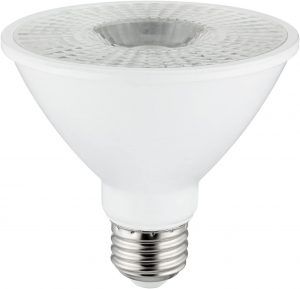
Short-neck PAR30s sit further back in recessed canister fittings than their long-neck siblings, which makes them the right choice for shallow ceilings and other tight spaces where there isn't much clearance behind the trim. They're also commonly used in track fixtures and smaller recessed cans.
Because a short-neck sits deeper in a recessed can, the edges of the fixture clip the outer edges of its beam — so the effective beam reaching the room is narrower and more concentrated than the bulb's spec sheet might suggest. Same wattage as a long neck, just a more controlled spill of light.
Long Neck PAR30 Bulbs
Long-neck PAR30s extend further out of the fixture, sitting flush with the trim or protruding past it. Because the bulb's emitter clears the edges of the can, the full beam angle reaches the room without being clipped. That's why long necks are the default for outdoor lighting, spotlights, projectors, landscape lighting, larger canister fittings, and lampposts.
What Is a Bulged Reflector (BR) Bulb?
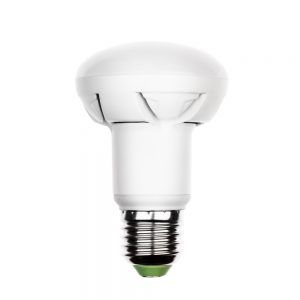
An R bulb is a Reflector bulb; a BR bulb is a Bulged Reflector bulb. The BR was designed as an improvement on the older R, and it's largely replaced it on store shelves — most flood bulbs you'll find at a hardware store today are BRs.
The reflector is the painted, mirrored surface lining the inside of the bulb. Its job is to catch light radiated toward the back of the bulb and bounce it forward through the lens. The "bulged" shape of a BR adds extra reflective area near the neck, recovering more of that backward-traveling light than a plain R bulb does — so a BR pushes more of its lumens out the front for the same wattage.
That extra reflector also widens the beam: a typical BR30 throws light at around 110°–120°, while an R30 sits closer to 60°–80° because its smoother, less-flared reflector produces a tighter beam. So BR bulbs spread light wider than R bulbs, even though both are flood-style.
BR30 vs PAR30: What Is The Difference?
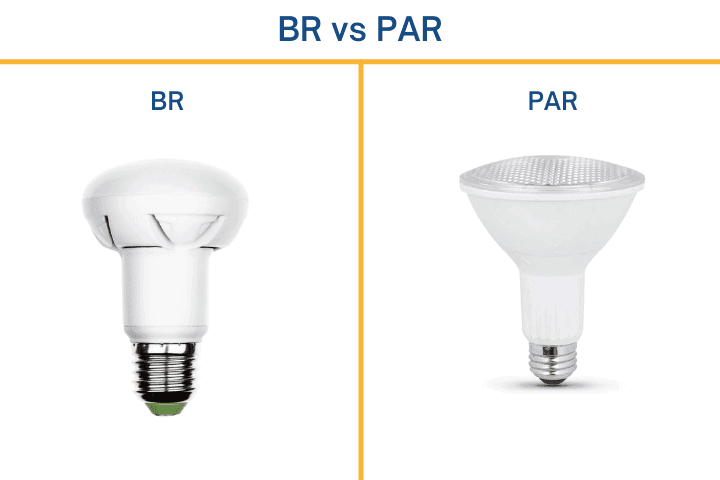
BR30 and PAR30 share the same 3.75-inch diameter and the same E26 base, so in most fixtures they're physically interchangeable. The exception is long-neck PAR30s — they extend further than a BR30 and may protrude from or fail to seat properly in shallow recessed cans designed around BR30 dimensions. Always check trim depth before swapping a BR30 for a long-neck PAR30.
The real difference between the two is the kind of light they produce:
| Feature | PAR30 | BR30 |
|---|---|---|
| Diameter | 3.75 in | 3.75 in |
| Base | E26 | E26 |
| Beam angle | 10°–60°+ (spot to wide flood) | ~110°–120° (wide flood) |
| Light type | Concentrated, directional | Soft, diffused flood |
| Lens / coating | Clear lens | Frosted or patterned coating |
| Wattage (LED) | ~9–13W (replaces 75W halogen) | ~9–11W (replaces 65W incandescent) |
| Dimmable | Most LED models | Most LED models |
| Best for | Spotlighting, accent, outdoor | Ambient, general room lighting |
PAR30s use a clear lens and tighter beam to produce concentrated, directional light — the kind you'd point at an object. BR30s use a frosted or patterned coating to produce a soft, diffused wash that fills a room. The trade-off is control: a PAR30 lets you aim the light, while a BR30 spreads it evenly but gives you no real say in where it lands.
Most modern LED versions of both bulb types are dimmable, so dimmability isn't really a deciding factor between them — just check the product spec to confirm.
When to Use BR vs PAR Bulbs
BR bulbs spread light wide and shadow-free, which makes them well suited for evenly lighting larger indoor spaces — kitchens, family rooms, hallways, and open-plan areas. A BR30 in a recessed can on the ceiling produces ambient light that fills a bedroom or living room uniformly, and a BR40 in a larger fixture will do the same job for a stairway or oversized hallway. They also work well in track lights aimed at artwork or display walls when you want a soft wall-wash rather than a sharp beam.
PAR bulbs are the right pick when you need a brighter, more focused beam to draw the eye to something specific. Their concentrated output makes them the standard for indoor and outdoor security lighting, theater and gallery accent lighting, restaurant and bar spotlights, and uplighting for sculptures or trees.
For outdoor PAR applications — including retail signs, signboards, and landscape uplights — make sure to choose a model that's specifically rated for the location. "Damp-rated" bulbs handle moisture in covered outdoor spaces (porches, soffits), while "wet-rated" bulbs can be exposed to direct rain or snow. Standard indoor PAR30s aren't built for that exposure and will fail prematurely if used outside.
Frequently Asked Questions
FAQ
Can I use a long-neck PAR30 in place of a BR30?
Often yes, but check the fixture first. Both share a 3.75-inch diameter and E26 base, but a long-neck PAR30 extends about an inch further than a BR30 and may protrude from or fail to seat in shallow recessed cans designed around BR30 dimensions. A short-neck PAR30 is a much safer swap.
What wattage LED PAR30 replaces a 75W halogen PAR30?
A 9–13W LED PAR30 typically matches the brightness of a 75W halogen PAR30. Look for an LED rated around 700–950 lumens to get equivalent output, and confirm the beam angle matches what you're replacing.
Are PAR30 and BR30 dimmable?
Most current LED versions of both bulb types are dimmable, but not all of them. Check the product spec sheet before buying — non-dimmable LEDs on a dimmer circuit will flicker or buzz.
What's the difference between a short-neck and long-neck PAR30 in beam shape?
Both bulbs ship with the same rated beam angle, but the short neck sits deeper in a recessed can, so the fixture's edges clip the outer edges of the beam. The result is a narrower, more controlled spill of light from a short neck and a wider effective beam from a long neck.
Do PAR30 and BR30 use the same socket?
Yes. Both use the standard E26 medium screw base in North American residential applications, so the socket itself is never the limiting factor — fit depends on the depth and trim of the fixture.
Final Words
There are plenty of decisions to make when choosing new lighting — lumen output, color temperature, CRI, and bulb type — but neck length and shape come down to a simple rule of thumb.
Use a short-neck PAR30 in shallow recessed cans and tight ceilings where the bulb needs to sit flush or set back. Use a long-neck PAR30 outdoors, in deeper fixtures, and anywhere you need the full unrestricted beam — landscape uplights, lampposts, exterior spotlights. And if you're after soft ambient light to fill a room rather than a focused beam, skip the PAR30 entirely and reach for a BR30.