Can A Lux Meter Measure LED Light?
Standard lux meters work on LED light — but with a calibration error that can be off by a factor of 10 or more for saturated colored LEDs. That spectral mismatch is exactly why an LED-specific meter exists.
 Eugen
EugenEugen Nikolajev
Creator of LED Lighting Info
Hi, I am Eugen. I was always one of those kids who had all sorts of weird lighting gadgets for every occasion.
Now, I want to share my knowledge and experience about lighting with you on LED Lighting Info.
Read my editorial standards
Key Takeaways
A standard lux meter will measure LED light, but the reading can carry a noticeable error because most meters are calibrated against an incandescent reference. For typical white LEDs the error is usually a few percent up to around 20%; for narrowband colored LEDs (red, blue, purple) it can exceed a factor of 10. An LED-specific lux meter applies tighter spectral correction and gives much more reliable readings.
Lux meters (also called light meters or illuminance meters — they're the same device) are handy for checking the amount of light landing on a surface. Common uses include plant grow setups, gallery lighting, and general home ambiance checks.
But does a regular lux meter work with LED lighting, or do you need a special one for LED lights?
In this guide, I'll cover:
- What a lux meter actually measures
- Why standard meters struggle with LEDs (the spectral mismatch problem)
- How to choose between a standard meter, an LED meter, and a PAR meter
- How to use one to check the brightness of LED light sources
What Does A Lux Meter Measure?
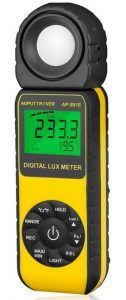
A lux meter measures illuminance — the amount of light landing on a surface, measured in lux (lumens per square meter). Most meters also display foot-candles (lumens per square foot) for those who prefer imperial units.
One important distinction: a lux meter doesn't measure a bulb's total lumen output. Lumens (luminous flux) are the total light a source produces, measured in a lab with an integrating sphere. Lux is the light landing on a specific surface — that's what the meter actually reads.
The device itself is a handheld unit with a sensor either built-in or attached via a cable. Place the sensor on the surface where you want to check brightness, and it'll detect the light intensity at that point.
Place the sensor where you want to measure — don't hold it. Holding it produces unstable readings as your hand moves, no matter how still you think you are.
A lux meter is great for checking the lux level of a particular area — say, whether your new lighting installation is bright enough for a kitchen worktop, or whether you need extra fixtures or brighter bulbs to keep the space safe to work in. They're also used in professional settings, like checking that street lights meet safety standards.
If you're a keen gardener, you'll want a PAR meter instead. PAR meters measure photosynthetic photon flux density (PPFD) — the count of photons in the 400–700 nm range that plants actually use for photosynthesis, expressed in μmol/m²/s. They're more expensive, but a lux meter (which is weighted to human vision) is the wrong tool for evaluating grow lights.
LED Light Meter Vs Regular Light Meter: What Is The Difference?
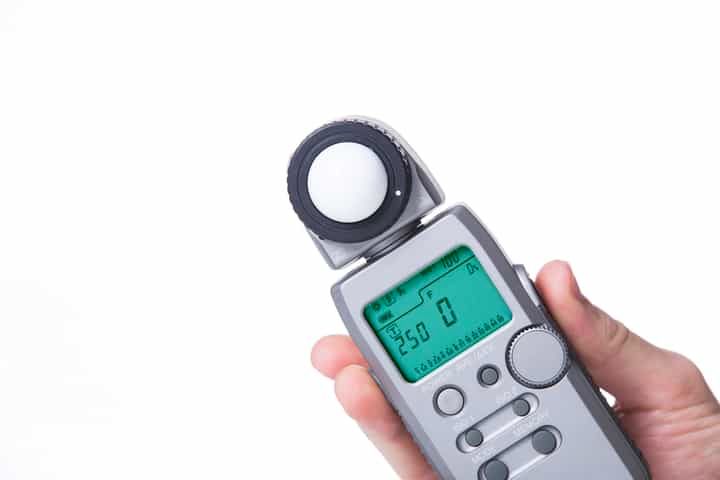
Standard lux meters use a silicon photodiode with a filter that approximates the human eye's photopic sensitivity curve. They respond to all visible wavelengths, but they're calibrated against an incandescent reference source — so accuracy depends on how closely the source you're measuring matches that calibration. The difference between the meter's response and the source's actual spectrum is called spectral mismatch error, and it's the reason LED readings can drift from the true value.
Here's how the two types of meter compare in practice:
| Feature | Standard Lux Meter | LED Lux Meter |
|---|---|---|
| Calibration reference | Incandescent (CIE Illuminant A) | Tighter V(λ) match or LED-specific correction factors |
| White LED accuracy | A few % up to ~20% error | Within a few percent |
| Colored LED accuracy | Can be off by 10× or more | Better, but a spectroradiometer is best for precision work |
| Works with older sources (incandescent, fluorescent, HPS) | Yes | Yes |
| Price | Lower | Higher |
| Best for | Quick room or area checks under traditional lighting | LED installations and mixed-source environments |
Most white LEDs are made by pairing a blue LED chip (around 450 nm) with a yellow phosphor — so their spectrum has a sharp blue peak that incandescent bulbs lack, plus a broader phosphor emission across the 500–700 nm range. That spectral fingerprint is what causes the measurement error: a meter calibrated for incandescent under- or over-reports brightness depending on how the LED's spectrum interacts with its filter.
Saturated red, blue, and purple LEDs are even more problematic. Those colors fall on the edges of the human eye's sensitivity curve, where small filter imperfections translate into very large percentage errors. The reading can be off by a factor of 10 or more, making a standard meter unreliable for any precision work with colored LEDs.
An LED-specific lux meter typically has tighter spectral correction or built-in correction factors for common LED types, giving much more accurate readings. The good news: an LED light meter can also measure older sources like fluorescent, incandescent, and high pressure sodium (still common in horticulture and some street lighting). For the most demanding work — especially with monochromatic colored LEDs — a spectroradiometer, which measures the full light spectrum, is the gold standard.
How To Measure LED Light Intensity With A Lux Meter
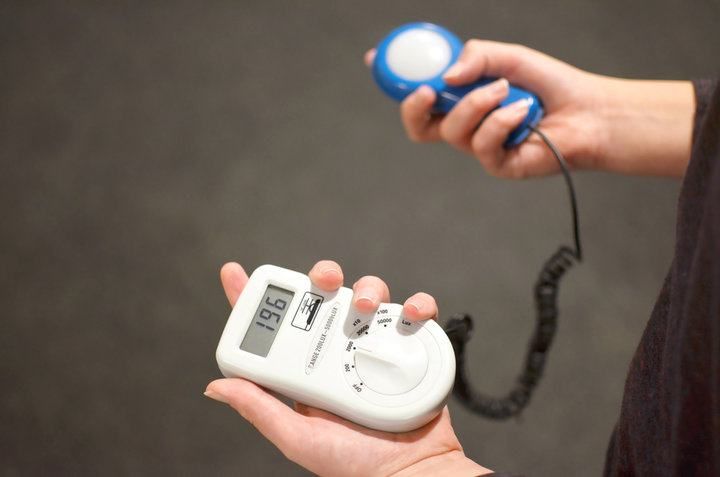
Every lux meter is a little different, but the basic procedure is the same:
- Power on the meter and wait a moment for the sensor to stabilize.
- Place the sensor flat on the surface you want to measure — don't hold it in your hand.
- Wait for the display to settle, then record the reading.
Useful Features To Look For
- Data Hold — freezes the current reading on the screen so you can move the meter without losing the number.
- Min/Max memory — stores the lowest and highest readings during a session, useful for comparing light levels across a space without taking manual notes.
- Hard carrying case — worth it if you're carrying the meter on jobs.
- Rotatable sensor head — lets you check light from multiple directions without repositioning the whole unit.
- Foot-candle mode — most meters toggle between lux and foot-candles (1 fc ≈ 10.76 lx).
Recommended Lux Levels For Common Spaces
A reading on its own isn't useful without a benchmark. Here are typical target lux levels for everyday spaces and tasks:
| Space / Task | Recommended Lux |
|---|---|
| Hallways and stairs | 100–200 |
| Living room (general ambient) | 150–300 |
| Bedroom (general) | 100–200 |
| Kitchen worktops and food prep | 300–500 |
| Office / study desk | 300–500 |
| Detailed tasks (sewing, drafting, electronics) | 750–1000 |
| Art display | 150–300 |
| Bathroom mirror / grooming | 300–500 |
If your reading falls well below the target for the task, you need brighter bulbs, more fixtures, or task lighting closer to the work surface.
What About Phone Apps?
Phone apps that claim to measure light aren't a substitute for a real lux meter. Phone camera sensors aren't calibrated for the human eye's photopic response, vary widely between models, and are constantly adjusted by the camera's auto-exposure logic. Readings can be off by 50% or more and aren't comparable between devices — fine for rough comparisons, not for anything precise.
Final Words
The headline takeaway: standard lux meters do work on LED light, but the readings carry a calibration error that grows with how unusual the LED's spectrum is — modest for white LEDs, severe for saturated colored ones. If you're regularly measuring LED installations, an LED-specific lux meter is the right investment. They cost a bit more than a basic meter, but they handle older light sources just as well, so you're not giving anything up.
And if you're growing plants, skip the lux meter entirely and use a PAR meter — see my guide on using LED strips for growing plants for more on that.
FAQ
What's the difference between lux and lumens?
Lumens measure a bulb's total light output (luminous flux), measured in a lab with an integrating sphere. Lux measures the light landing on a specific surface (illuminance) — 1 lux equals 1 lumen per square meter. A lux meter measures lux, not a bulb's lumen rating.
Can my phone replace a lux meter?
Not for accurate work. Phone camera sensors aren't calibrated for human eye sensitivity, vary widely between models, and are constantly adjusted by auto-exposure. App readings can be off by 50% or more — useful for rough comparisons but not for setting up task lighting or grow rooms.
How accurate is a standard lux meter on white LEDs?
For phosphor-converted white LEDs (the common type), a quality V(λ)-corrected meter is usually within a few percent up to about 20% of the true value. The exact error depends on the LED's spectrum and the precision of the meter's filter.
Why are colored LEDs so much harder to measure?
Saturated red, blue, and purple LEDs emit in a narrow band of wavelengths, often near the edges of the human eye's sensitivity curve. Small filter imperfections at those wavelengths get amplified into very large percentage errors — sometimes 10× or more. For precision work with colored LEDs, use a spectroradiometer.
Do I need a PAR meter for houseplants?
If you're using regular room lighting, no — the light isn't strong enough for serious horticulture either way. But if you're running grow lights for vegetables, herbs, or flowering plants, a PAR meter measures the photons in the 400–700 nm range that plants actually use for photosynthesis, which a lux meter cannot.
Is a light meter the same as a lux meter?
Yes — light meter, lux meter, and illuminance meter are different names for the same device. When shopping, just confirm it's suitable for LED light sources if that's what you'll be measuring.