Can You Use LED Strips To Grow Plants?
Lumens measure brightness for human eyes, not plant growth — the spec-sheet number you're probably checking is the wrong one. PPFD, which counts photons in the 400–700 nm PAR range, is what plants actually respond to.
 Eugen
EugenEugen Nikolajev
Creator of LED Lighting Info
Hi, I am Eugen. I was always one of those kids who had all sorts of weird lighting gadgets for every occasion.
Now, I want to share my knowledge and experience about lighting with you on LED Lighting Info.
Read my editorial standards
Key Takeaways
LED strip lights can grow plants, but only the right ones. High-density 5050 strips or dedicated full-spectrum grow strips can carry leafy greens, herbs, and many flowering houseplants through their full life cycle. Generic decor strips at low density usually fall short on both intensity and spectrum. What matters is photon output in the wavelengths plants actually use (PPFD) and the spectral mix — not the lumen rating on the box.
Indoor plants don't get the sunlight their outdoor counterparts do, so anyone growing plants under a roof has to recreate it. Can LED strip lights actually do that job?
Do LED Strip Lights Provide Enough Light for Plants?
Plant lighting isn't measured in lumens. Lumens describe brightness as the human eye perceives it — heavily weighted toward the green-yellow wavelengths around 555 nm — but plants do most of their photosynthesis at the red and blue ends of the spectrum. The horticultural metric is PPFD (photosynthetic photon flux density), measured in µmol/m²/s, which counts the photons in the 400–700 nm PAR range that plants can actually use. Industry references explicitly warn that lumens, lux, or foot candles shouldn't be used to evaluate horticultural lighting.
Different plants need different intensities at the canopy:
| Plant type | PPFD target (µmol/m²/s) | Notes |
|---|---|---|
| Low-light foliage (pothos, snake plant) | 100–200 | Most undemanding houseplants |
| Herbs and leafy greens (basil, lettuce) | 200–400 | Sweet spot for entry-level grow strips |
| Flowering and high-light plants | 400–600 | Peppers, strawberries, mature flowers |
| Fruiting crops (tomatoes, cucumbers) | 600–1,000+ | Demand high-output arrays |
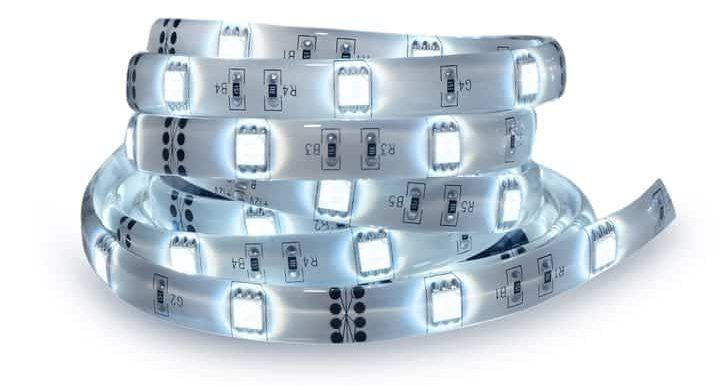
Strip output also varies far more than the often-quoted 450 lm/ft figure suggests. Low-density 3528 strips put out closer to 100 lm/ft, mid-density 5050 strips run roughly 300–330 lm/ft, and high-density 2835 strips can reach 400–800+ lm/ft at 120 LEDs/m. Always check the lm/ft (or lm/m) figure on the spec sheet rather than relying on a generic average — and remember that lumens still aren't the right yardstick for plant growth.
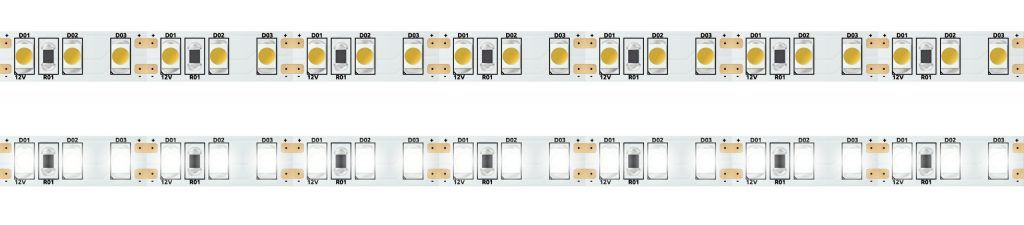
The 5050 LED package is 5.0 mm × 5.0 mm and houses three LED dies in a single chip — used either for RGB color mixing or to triple white-light output. That's why 5050-based strips dominate practical grow-light builds: they pack significantly more photons per inch than smaller 3528 packages.
One small caveat about heat. LED strips run far cooler than HPS or incandescent grow lights and don't bake leaves with infrared the way older fixtures do, but they aren't heat-free. Roughly half of the input wattage on a grow LED is dissipated as heat at the fixture, and high-output panels placed too close can still bleach leaves through radiant heat and excess intensity. Maintain a sensible distance, especially with strong full-spectrum strips.
What Color Spectrum Do Plants Need?
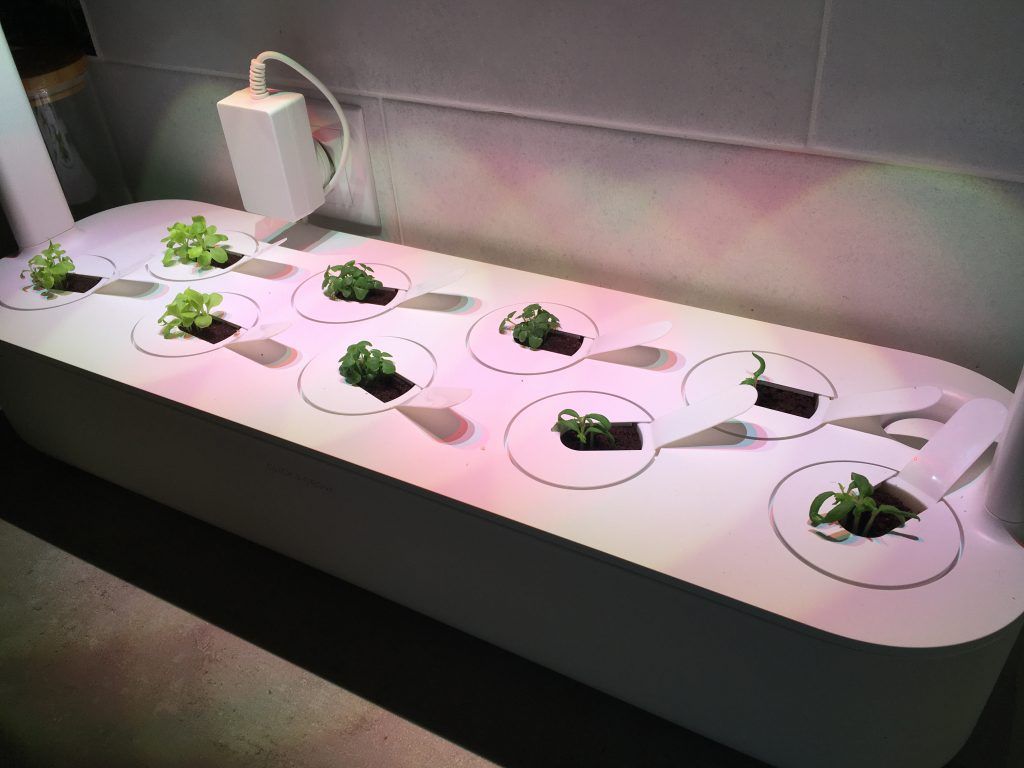
Plants respond primarily to specific wavelengths. Chlorophyll a and b absorb most strongly around 450 nm (blue), which drives vegetative growth, and 660 nm (red), which drives flowering and fruiting. Far-red around 730 nm and small amounts of UV play supporting roles in purpose-built horticultural fixtures.
Lumens overweight the green and yellow wavelengths human eyes are most sensitive to. Plants do use green light — it actually penetrates deeper into the canopy and into leaf interiors than red or blue — but the older claim that plants "don't need yellow light" is too strong. The accurate version is that red and blue drive photosynthesis far more efficiently, so a generic white strip wastes a lot of its output on wavelengths plants use less.
Kelvin ratings on white LED strips are a rough proxy for spectral mix: cooler 5000K–6500K daylight whites contain more blue and suit vegetative stages, while warmer 2700K–3000K whites push more red for flowering. But because all phosphor-converted white LEDs also emit a lot of green and yellow that plants use less efficiently, a purpose-built full-spectrum strip with engineered blue and red peaks will outperform a generic white strip at any color temperature.
A note on terminology: a single-color (or single-CCT) strip emits one fixed color temperature — its brightness can dim, but the CCT does not change. A strip whose color temperature can be adjusted across, say, 2200K–6500K is a tunable white strip, which mixes warm-white and cool-white LEDs and lets you bias toward blue for veg and red for bloom. Tunable white is more flexible than fixed CCT, but no white strip — fixed or tunable — is a complete substitute for a strip with dedicated blue and red peaks.
If you only have a single RGB strip on hand, set it to purple. Purple is red plus blue mixed together, which mimics the wavelengths plants prioritize and skips the green-yellow output a white setting would add. It works as an emergency option, but be aware that consumer RGB diodes are tuned for visual color appeal — typically around 625 nm red and 470 nm blue — not for the photosynthetically optimal 660 nm and 450 nm peaks. They'll keep a plant alive but won't match a dedicated grow strip's efficiency.
| Strip type | Best for | Pros | Cons |
|---|---|---|---|
| Dedicated full-spectrum grow strip | All stages, serious growers | Engineered 450 nm + 660 nm peaks; highest efficiency for plants | Higher upfront cost; visually pink-purple |
| High-density 5050 white (5000K–6500K) | Vegetative stage, herbs, greens | Cheap, easy to source; bright enough for low-medium PPFD | Wastes output on green/yellow; weaker for flowering |
| Tunable white (2200K–6500K) | Veg + flowering with one fixture | Convenient warm/cool blend in a single strip | Still phosphor white; less red/blue intensity than dedicated grow strips |
| RGB strip set to purple | Hobby seedlings, supplemental light | Affordable; manual control | Diode peaks off-target; lower PPFD than purpose-built strips |
| Multiple single-color (red + blue) strips | DIY full-stage builds | Full manual control over ratio | Complex wiring; harder to dial in correctly |
Setting Up LED Strips for Plants
How far should LED strips be from the plants?
The right distance depends on the strip's intensity and the growth stage. As a starting point:
| Growth stage | Distance above canopy | Why |
|---|---|---|
| Seedlings / cuttings | 10–14 in (25–35 cm) | Need bright light to push initial growth without bleaching tender leaves |
| Vegetative | 12–18 in (30–45 cm) | Higher PPFD encourages dense, leafy growth |
| Flowering / fruiting | 18–36 in (45–90 cm) | Plants are larger and more sensitive to overexposure; stretch the canopy further from the strip |
Mount the strips so you can raise them as plants grow. If leaves curl downward, look bleached, or develop pale patches directly under the strip, raise it. If stems stretch tall and spindly reaching toward the light, the strip is too far away.
How long should the lights run each day?
Photoperiod matters as much as intensity. Standard targets:
- Seedlings and clones: 16–18 hours on, 6–8 hours off
- Vegetative growth: 14–16 hours on
- Flowering / fruiting (for photoperiod-sensitive plants): 12 hours on, 12 hours off
- Low-light houseplants on a desk: 8–12 hours is plenty
Plants need a true dark period — running strips 24/7 stresses most species and can suppress flowering. A plug-in timer or a strip with a built-in timer (3/9/12-hour cycles are common) is the easiest way to keep this consistent.
Strip density and layout
For a small grow tray (roughly 2 ft × 4 ft), two to four parallel runs of high-density 5050 strip mounted to an aluminum channel above the canopy is a workable starting point for herbs and leafy greens. Run the strips along the long axis of the tray, spaced about 4–6 inches apart, to spread light evenly. Multiple closely-spaced strips outperform a single intense run because the light overlaps and reduces shadowing between leaves.
If you can borrow or rent a PAR meter, aim for a PPFD reading at canopy that matches the targets in the first table. Without a meter, more strips at the same height usually beat fewer strips closer in.
Heat, airflow, and humidity
High-density 5050 strips drawing serious wattage need somewhere for that heat to go. Mount them on aluminum channels or heatsink-backed extrusions, not bare double-sided tape, and leave airflow above the strip. A 10°C rise in junction temperature above the rated threshold can cut LED lifespan by up to half.
Indoor gardens and grow tents are humid environments with regular watering, so use strips rated IP65 or higher. Bare uncoated strips will corrode quickly under condensation and water splashes, and water reaching the contacts is also a fire and shock risk.
What About Demanding Plants Like Tomatoes?
Tomatoes are very light-hungry — they need roughly 600–1,000 µmol/m²/s PPFD at canopy for 14–18 hours a day during vegetative growth and 12–14 hours during fruiting. A single low-density strip won't fruit them. But high-output full-spectrum LED strips, especially when arrayed in multiple rows close above the plants, absolutely can. Commercial vertical farms grow tomatoes under LED at scale; the real limit is intensity and spectrum, not the LED format.
For most home growers, fruiting tomatoes under strip lights means committing to a dense array of dedicated grow strips and accepting that the electricity bill and setup time look more like a serious hobby than a casual experiment. Leafy greens and herbs are dramatically easier.
FAQ
Can regular RGB LED strips grow plants?
They can keep undemanding plants alive and help with seedlings if you set them to purple (red plus blue together). But consumer RGB diodes peak around 625 nm red and 470 nm blue rather than the photosynthetically ideal 660 nm and 450 nm, so they're far less efficient than dedicated grow strips. Treat RGB as a hobbyist or supplemental option, not a replacement for purpose-built horticultural lighting.
How many hours per day should LED grow strips be on?
16–18 hours for seedlings, 14–16 hours during vegetative growth, and 12 hours for flowering or fruiting in photoperiod-sensitive plants. Low-light houseplants are happy with 8–12 hours. Plants need a true dark period — never run strips 24/7.
Will LED strips burn my plants?
LED strips don't emit infrared the way HPS bulbs do, so they won't bake leaves, but high-output strips placed too close can still bleach leaves through radiant heat from the fixture and excess light intensity. Keep seedlings 10–14 in below the strip and raise the strip as plants mature. Bleached patches directly under the strip mean it's too close.
What IP rating do I need for a grow tent?
IP65 or higher. Grow tents are humid and frequently watered, and uncoated strips will corrode quickly while water reaching the contacts is a shock and fire risk. IP65-rated strips are sealed against water jets, which is enough for typical indoor garden conditions.
Can I really grow vegetables under LED strips?
Leafy greens, herbs, and many peppers and strawberries do well under high-density 5050 full-spectrum strips arranged a few inches apart over a small tray. Fruiting crops like tomatoes and cucumbers need a much denser array of strips because they demand 600–1,000+ µmol/m²/s PPFD — possible, but more setup than most casual growers want.
Bottom Line
If you're growing leafy greens or herbs, two or three runs of high-density 5050 full-spectrum strip mounted on aluminum channel 12–18 inches above the canopy, on a 14-hour timer, is a cost-effective starting point. For flowering houseplants, switch to a dedicated grow strip with engineered red and blue peaks and drop the photoperiod to 12 hours when buds form. For tomatoes and other fruiting crops, plan on a dense array and check the spec sheet for PPFD coverage rather than lumens.
Sunlight still beats any strip on raw spectral breadth and free UV, but a properly specced LED strip setup is more than enough for most indoor edibles and decorative plants — and it's vastly more controllable than a sunny windowsill.
Check out my definitive guide to strip LED lights if you want to know more about them before you buy, or my piece on whether plants like LED lighting for the broader picture.