
How Important Is CRI In Lighting?
An LED can score a 95 CRI and still render deep reds so poorly it drains warmth from skin tones — because that weakness never shows up in the headline number.
 Eugen
EugenEugen Nikolajev
Creator of LED Lighting Info
Hi, I am Eugen. I was always one of those kids who had all sorts of weird lighting gadgets for every occasion.
Now, I want to share my knowledge and experience about lighting with you on LED Lighting Info.
Read my editorial standards
Key Takeaways
The color rendering index (CRI) of a light source can have a crucial and polarising effect on your home or workspace. CRI refers to how accurately a light displays color. At one end of the spectrum, high CRI bulbs will be extremely flattering and make colors 'pop', but low CRI bulbs will deliver dull, washed-out colors.
Have you ever left the house feeling ok about your appearance, only to look in the bathroom mirror when you get to work and realize you look awful?
Your skin tone looks uneven, wrinkles look exaggerated, and the bags under your eyes appear darker than ever?
As well as color temperature and lumen output, it's vital to take note of the CRI of a bulb before you commit to purchasing.
Read on for a simple guide on what CRI is, why it is essential, and which type of lights have the best CRI.
What Is Color Rendering Index (CRI)?
CRI, color rendering index, was first established by the CIE (International Commission on Illumination) to evaluate how effectively light sources display color.
It is measured on a scale that tops out at 100, with most usable light sources falling between 0 and 100 (some very poor sources, such as low-pressure sodium, can score negative). It's vital to distinguish CRI from color temperature (CCT), which refers to how warm or cool a white light source appears — for example, a 2700K bulb gives off a warm yellow-white glow, while a 5000K bulb produces a cool, daylight-like white. CRI tells you how accurately colors are rendered; CCT tells you the hue of the white light itself.
The general CRI (Ra) is calculated as the average of 8 standard test color samples (R1–R8), drawn from a larger set of 15 samples (R1–R15) defined in the full CIE method. The samples are illuminated by a test light source and compared to a reference illuminant of the same correlated color temperature. CRI is calculated from the difference in chromaticities between the test light and the reference light.
The smaller the average difference in chromaticities, the higher the CRI. A CRI of 100 means that the test light performed exactly the same as the reference illuminant.
The standard CRI metric is also called Ra, where the 'a' denotes that it is an average — specifically, the arithmetic mean of the first 8 test color samples (R1–R8). Just to give you an example, take a look at the image below. This is roughly how colors appear under a low-CRI source compared to daylight.
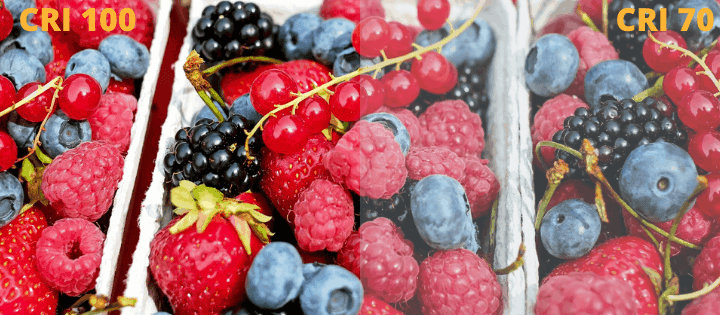
Look a bit dull, doesn't it? Exact CRI cannot accurately be assessed by visual inspection — it requires a precise calculation, which is why you have to rely on the value printed on the spec sheet rather than your own eye.
Why Is CRI Important When Selecting LED Lighting?
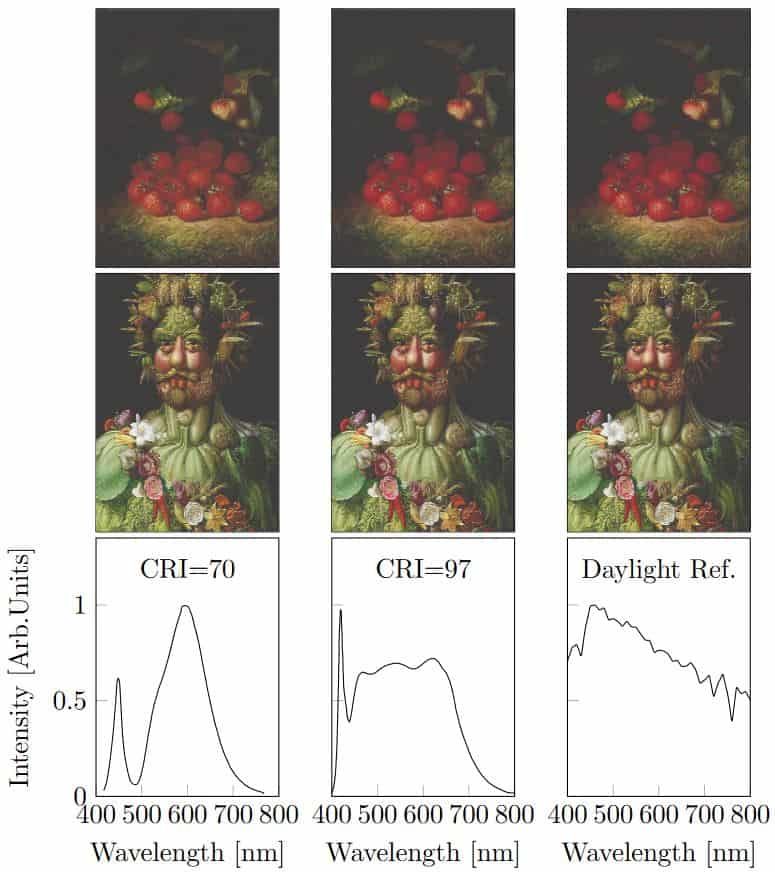
LEDs with high CRI ratings render colors accurately, which helps textures, fine details, and colors stand out. This has a flattering effect on people, making hair look lustrous and skin look rich and healthy.
High CRI LEDs are valuable in both the home and workplace. In grocery stores, for example, fruit and vegetables look juicier and more appetizing when displayed under high CRI lights.
In hospitals, accurate color rendering is critical — it allows clinicians to distinguish tissue color, detect bruising, and make accurate diagnoses.
Conversely, LEDs with low CRI ratings make things appear drab and dull. Colors are not portrayed accurately, which causes people to look unappealing and their skin to look lifeless.
What Is a Good CRI Number?
As a general rule of thumb, you should aim for a minimum CRI of 80, and the closer to 100, the better. A score of 100 indicates that a light displays colors exactly how they would appear under the reference illuminant (natural daylight, for high color temperatures).
The table below shows how CRI ranges map to typical applications:
| CRI Range | Rating | Best For |
|---|---|---|
| 90–100 | Excellent | Hospitals, museums, retail, print studios |
| 80–89 | Good | Residential, offices, ambient lighting |
| 70–79 | Fair | Warehouses, utility spaces |
| Below 70 | Poor | Specialty or mood applications only |
Low CRI bulbs aren't entirely useless. They can be beneficial when a gloomy effect is desirable, such as on movie sets or at horror attractions.
In some situations, minimum CRIs are mandated by law. In California, Title 24 requires light sources used to meet residential energy-code compliance to be certified under Joint Appendix 8 (JA8), which mandates a minimum CRI of 90 and a minimum R9 value of 50, among other requirements. JA8-certified high-efficacy sources are required for most permanently installed residential lighting under the code, so in practice most new home lighting in California has to meet that bar.
How to Check CRI Before You Buy
CRI is usually printed on the bulb's packaging or in the product spec sheet, often labeled as 'CRI', 'Ra', or 'Color Rendering Index'. Reputable manufacturers list it alongside lumens and color temperature. If a bulb's packaging doesn't mention CRI at all, that's often a sign it's below 80 — assume the worst and look elsewhere. For premium applications, look for products that also publish their R9 score and, increasingly, IES TM-30 Rf/Rg values (more on that below).
Incandescent vs LED vs Fluorescent: Which Has Better CRI?
In the past, CRI was seen as relatively unimportant when choosing a light source, because traditional incandescent bulbs were the default and they happen to score near a perfect 100. Incandescent and halogen bulbs are essentially blackbody radiators, and because CRI compares a test source against a reference illuminant (a Planckian blackbody at color temperatures below 5000K), incandescents score at or very near 100 by definition.
As incandescent bulbs were gradually phased out in most countries due to their poor energy efficiency, the importance of CRI became more apparent.
Fluorescent bulbs are attractive because they are far more energy-efficient than incandescents and give off considerably less heat — though they aren't heat-free. Their CRI varies widely with the phosphor mix, ranging from roughly 50 to 90 depending on the lamp.
LED CRI has improved dramatically as the technology has matured. Most general-purpose LEDs on the market today are rated at CRI 80, which is the industry baseline. Higher-quality LEDs rated CRI 90 or above are increasingly available and are recommended for retail, hospitality, and residential settings where color accuracy matters.
| Type of Bulb | Typical CRI |
|---|---|
| Incandescent / Halogen | ~100 |
| Fluorescent | 50 to 90 (depends on phosphor) |
| LED | Typically 80, with 90+ available in higher-quality products |
Related: Should I Switch From CFL To LED?
The Limitations of CRI
CRI is the most widely used color rendering metric, but it has well-known weaknesses.
Only 8 unsaturated samples
Standard Ra is averaged from just the first 8 CIE test color samples, all of which are unsaturated pastels. Because of this, Ra is widely criticized as unrepresentative of how light renders saturated, real-world colors. Some sources reference an extended index (sometimes called Re) that incorporates all 15 CIE samples, but the more prominent successor metric is IES TM-30, discussed below.
The R9 (deep red) problem
R9 is the saturated deep red test color (roughly 620–700 nm of visible red — not infrared, as it's sometimes incorrectly described). Most LEDs, especially blue-pump phosphor LEDs, struggle to render this part of the spectrum. An LED with an overall CRI of 95 could have an R9 value of 30, but because Ra averages only R1–R8, that weakness is hidden in the headline number.
R9 matters disproportionately for skin tones, food, fabrics, and medical settings, which is why high-end residential, retail, and hospital fixtures often specify a minimum R9 (typically 50 or higher) alongside the headline CRI.
CRI can shift when dimmed
CRI is measured at full output, but some LED drivers cause noticeable color shifts at lower dimming levels. If color quality matters in your space and you intend to dim heavily, look for products that specifically advertise stable color rendering across the dimming range (often marketed as 'warm dim' or 'dim-to-warm').
Beyond CRI: IES TM-30
In 2015, the Illuminating Engineering Society introduced TM-30, a more comprehensive alternative to CRI that uses 99 color evaluation samples and reports two separate metrics: Rf (a fidelity score analogous to CRI Ra) and Rg (a gamut/saturation score indicating whether a light source over- or under-saturates colors). The standard has since been updated, most recently as ANSI/IES TM-30-20.
The U.S. Department of Energy and many lighting specifiers now reference TM-30 alongside CRI. It hasn't replaced CRI on consumer bulb packaging yet, but it's becoming standard in professional specifications, particularly for retail, hospitality, and architectural projects. Expect to see Rf/Rg values appear on more premium product spec sheets over the next few years.
Final Words
Color rendering is an essential consideration when lighting your home or property, and the CRI calculation is used universally by the lighting industry. My rule of thumb: aim for CRI 90+ wherever people, food, or finishes are on display, settle for CRI 80 in utility spaces, and check for an R9 value if skin tones or saturated reds matter.
And if you're shopping for premium lighting, start looking for TM-30 Rf and Rg values on the spec sheet — they give a far more complete picture of color quality than CRI alone.