
Should I Switch From CFL To LED Light?
A 13W CFL and a 9W LED both replace a 60W incandescent, but that 4-watt gap saves less than $1.20 a year — which is why patience beats a wholesale swap.
 Eugen
EugenEugen Nikolajev
Creator of LED Lighting Info
Hi, I am Eugen. I was always one of those kids who had all sorts of weird lighting gadgets for every occasion.
Now, I want to share my knowledge and experience about lighting with you on LED Lighting Info.
Read my editorial standards
Key Takeaways
If your CFL bulbs are working, it’s usually not worth replacing them with LEDs immediately, LEDs are more efficient, but the savings aren’t huge. Only replace them now if your CFLs aren’t suited to the fitting or are damaging fabrics. Otherwise, wait until they’re burned out.
You might have switched to CFLs years ago, back when they were the energy-efficient upgrade everyone recommended. Now LEDs have leapfrogged them. So is it worth replacing your working CFLs with LEDs right now, or should you wait until they burn out?
In this article I’ll cover:
- Why immediate replacement usually isn’t worth it
- The actual cost and lifespan differences between like-for-like CFL and LED bulbs
- What to check before buying LED replacements (base, dimmer, voltage, color temperature)
Is It Worth Replacing CFLs With LEDs?
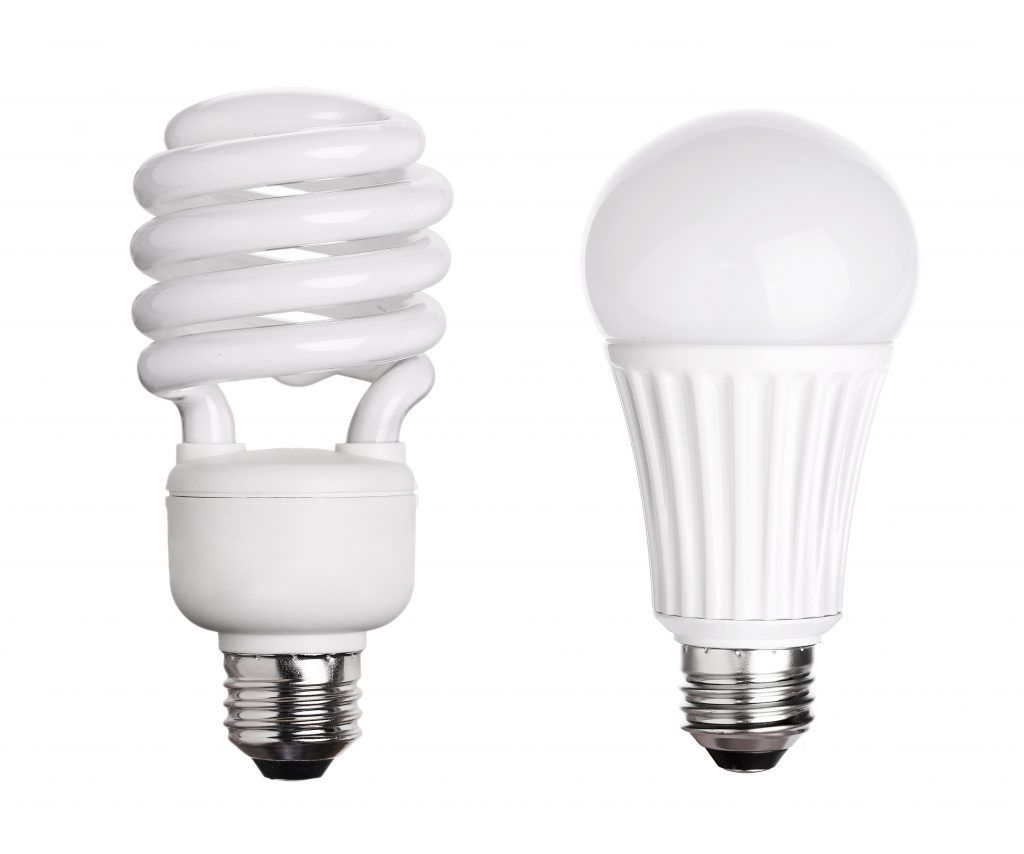
First, a quick reminder of how CFLs and LEDs stack up against each other and against incandescent bulbs.
CFLs were the original next-big-thing in light bulb tech. The spiral design was invented by GE engineer Edward Hammer in 1976, and the first commercial screw-in CFL — the Philips SL — reached consumers in 1980. They use a phosphor coating and mercury vapor, electrically charged to produce fluorescent light.
Compared to filament-heating incandescents, CFLs were a major leap in efficiency, and they lasted about 10,000 hours instead of just 1,000.
LEDs took it further. They use semi-conducting diodes that generate light when electricity passes through them. There are no harmful gases, very little heat, and a much longer lifespan — most ENERGY STAR residential LEDs are rated for 15,000–25,000 hours, with premium bulbs reaching 50,000.
LEDs have other advantages over CFLs too. They generally run at a lower wattage for the same light output, they don’t emit the ultraviolet and infrared that can fade fabrics over time, and they perform much better when directed by a fixture.
Worth noting: replacement CFLs are getting harder to find. The EU has largely completed its phase-out of household CFLs, and U.S. ENERGY STAR has shifted its focus to LEDs. When a CFL burns out, you may find LEDs are now the only option on the shelf — which simplifies the decision.
How Big Is The Difference In Energy Consumption?

If LEDs are much more efficient than CFLs, surely it makes sense to swap them all out today? In light-quality terms there are no real downsides to LEDs versus CFLs, so the only reason to delay is financial.
For an ‘average’ 800-lumen output, you’ll need an incandescent bulb of 60 Watts, a CFL of 13 Watts, or an LED of 7–10 Watts (figures vary slightly between products, so check the label before buying). For a brighter 1,100-lumen bulb, the equivalents are roughly 75 W incandescent, 18 W CFL, and 10–15 W LED.
Also read: What Is The LED Watts Equivalent?
| Bulb Type | Wattage for 800 lm | Wattage for 1,100 lm | Efficiency (lm/W) | Typical Lifespan |
|---|---|---|---|---|
| Incandescent | 60 W | 75 W | ~13 lm/W | ~1,000 hours |
| CFL | 13 W | 18 W | ~60 lm/W | ~10,000 hours |
| LED | 7–10 W | 10–15 W | ~90–100 lm/W | 15,000–25,000 hours (up to 50,000 for premium) |
The industry-standard efficiency metric is lumens per watt (lm/W), where higher is better. LEDs deliver roughly seven times more light per watt than incandescents, and 1.5–2× more than CFLs.
To turn that into dollars: U.S. residential electricity rates currently average about 17 cents per kilowatt-hour, though state rates range from roughly 12¢ to 30¢ — check your utility bill for your exact figure. At five hours of daily use, that works out to:
- A 60 W incandescent bulb: about $18.60 per year
- A 13 W CFL bulb: about $4.00 per year
- A 9 W LED bulb: about $2.80 per year
There’s lifespan to factor in as well. A typical residential LED lasts roughly two to three times as long as a CFL (up to five times for premium models). LEDs cost a few dollars more upfront but make up the difference quickly across all the bulbs in a typical home.
There’s also a directional efficiency gain. LEDs work especially well in directed fittings — recessed cans, spotlights, downlights — while CFLs lose more light to leakage. You can sometimes use a lower-equivalent LED bulb and still get the same lux on the surface that matters.
LEDs are clearly better. It’s worth making the change when your CFLs burn out, and possibly sooner — but you won’t save hundreds of dollars by replacing working CFLs, so being patient is reasonable.
Related content: What Is The Difference Between Lumen And Lux?
Beyond Cost — Other Reasons LEDs Win
A few things LEDs do better that aren’t captured in the energy bill:
- Instant brightness. CFLs are notorious for taking 30–60 seconds to reach full output, especially in cold rooms or garages. LEDs hit full brightness the moment you flip the switch.
- Better color rendering. CFL bulbs typically have a lower color rendering index (CRI) than LEDs and incandescents, which can make colors in your home look washed out. Most decent LEDs hit CRI 80+, and high-end ones reach 90+.
- No UV/IR fade damage. CFLs emit small amounts of UV and infrared light that can fade fabrics, art, and book bindings over years of exposure. LEDs don’t.
Main Watchouts When Switching to LEDs
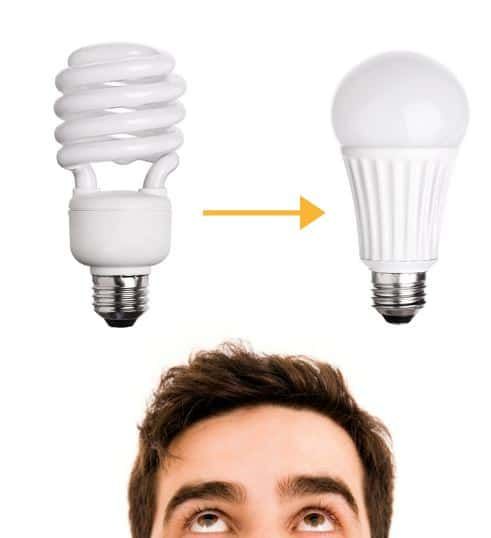
If you do decide to make the switch from CFL to LED, here’s a checklist to run through before you buy:
- Check the base. Most household CFLs use the same E26 medium screw base as LEDs and incandescents — those are an easy swap. Some CFLs, particularly plug-in types in recessed fixtures, use 2- or 4-pin bases like GU24, G23, or G24. If your fixture has a pin base, you’ll need either a matching pin-base LED or to swap the fixture itself.
- Match the color temperature. ‘Soft white’ CFLs are usually around 2700K (warm yellow); ‘daylight’ runs 5000K (cool blue-white). Pick the same Kelvin number as your existing CFL or you’ll notice a jarring change in the room. The color temperature is printed on the package.
- Check dimmer compatibility. If the fixture is on a dimmer, the LED replacement needs to be labeled ‘dimmable’ AND compatible with the dimmer type. Older leading-edge (TRIAC) dimmers often cause flicker with LEDs; trailing-edge or LED-rated dimmers work better. Check the bulb packaging for a list of compatible dimmer brands.
- Watch for low-voltage fittings. Most screw-in bulbs run on standard line voltage (120V in North America, 230V elsewhere), but some specialist fixtures — particularly recessed downlights and landscape lights — use a 12V transformer. A 12V LED needs an LED-compatible driver; an old magnetic transformer designed for halogens can flicker or buzz with LEDs.
- Dispose of CFLs safely. CFLs contain a small amount of mercury and shouldn’t go in regular trash. In the U.S., Home Depot, Lowe’s, and IKEA all run free CFL take-back programs. The EPA’s recycling locator and Earth911.com can find drop-off points near you.
Final Words
You don’t need to rip out every working CFL today, but the case for switching is stronger than just the energy savings. My quick decision checklist:
- Replace now if the CFL is in a directed fitting (recessed can, spotlight) where it leaks light, or sits near UV-sensitive fabrics, art, or book bindings.
- Replace now if the CFL takes ages to warm up in a cold room or garage where you want instant light.
- Replace at burnout otherwise — the per-bulb annual savings are real but small, so wait until the CFL goes.
- Whenever you replace, match the base type, dimmer compatibility, voltage, and color temperature before clicking buy.
Long-term, LEDs are the future. I’d suggest replacing each CFL with an LED as soon as it burns out — just make sure the one you pick will actually work in the fitting it’s going into.
FAQ
Are CFLs being phased out?
Yes — the EU has largely completed its phase-out of household CFLs, and U.S. ENERGY STAR has shifted its focus to LEDs. Replacement CFLs are increasingly hard to find on store shelves, which is one practical reason to plan for an LED swap.
Do I have to replace my CFLs right away to save money?
No. The annual energy-cost difference between a CFL and an LED is only a couple of dollars per bulb, so replacing working CFLs gives a slow payback. Replacing them as they burn out is usually the right financial call.
Can I put an LED bulb in a fixture with a dimmer switch?
Only if the LED is labeled ‘dimmable’ AND the dimmer is compatible. Older TRIAC (leading-edge) dimmers often cause flicker with LEDs; trailing-edge or LED-rated dimmers work better. Check the bulb packaging for compatibility notes.
How do I dispose of CFL bulbs safely?
Don’t throw them in regular trash — they contain mercury vapor. In the U.S., Home Depot, Lowe’s, and IKEA accept used CFLs for free, and the EPA recycling locator and Earth911.com can point you to nearby drop-off sites.
What color temperature should I pick to match my old CFLs?
Look for the Kelvin (K) number on the package. ‘Soft white’ CFLs are usually 2700K, ‘bright white’ around 3500K, and ‘daylight’ around 5000K. Match the number on your existing CFL packaging to avoid a jarring color shift in the room.