
Can You Touch LED Bulbs With Your Hands?
Touching an LED bulb with bare hands is fine — it's halogen bulbs where skin oils trigger devitrification, crystallizing the quartz envelope until it cracks under heat.
 Eugen
EugenEugen Nikolajev
Creator of LED Lighting Info
Hi, I am Eugen. I was always one of those kids who had all sorts of weird lighting gadgets for every occasion.
Now, I want to share my knowledge and experience about lighting with you on LED Lighting Info.
Read my editorial standards
Key Takeaways
LEDs are safe to touch with your bare hands, even when switched on. They produce light through electroluminescence rather than a glowing-hot filament, so the lens stays cool to the touch and skin oils on the casing don't compromise the bulb.
Unlike halogen or incandescent bulbs, LEDs are generally safe to handle with bare hands — but there are a few caveats worth knowing before you start swapping bulbs.
Below I'll cover why LEDs are safe to handle, which bulb types you should never touch with bare skin, and what to do if you've already grabbed the wrong bulb.
Touching LED Bulbs With Your Hands
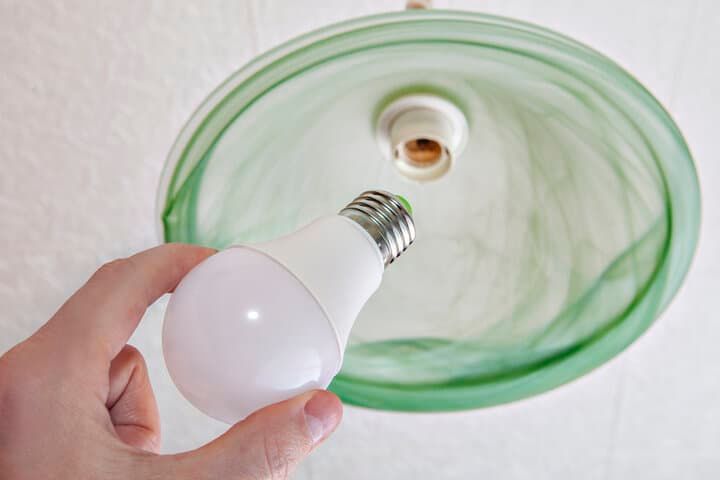
An LED bulb is safe to handle by either the lens or the metal base. The lens stays close to room temperature, and the base only gets gently warm during operation. Skin oils on the surface don't damage the bulb the way they damage halogens, so there's no need for gloves or post-handling cleaning.
Even so, treat the bulb with care. The lens is often thin glass or plastic, and the LED chips and driver inside don't appreciate being dropped. Hold it firmly and don't fidget with it any more than the install requires.
How LEDs Produce Light
An LED is built from two semiconductor layers — an n-type layer rich in negatively charged electrons, and a p-type layer rich in positively charged "holes" (vacancies in the lattice that behave like positive charge carriers). When current flows across the junction, electrons recombine with holes and release the energy difference as a photon. This process is called electroluminescence, and it generates light directly without first heating a filament.
Because there's no glowing filament, the lens never reaches the temperatures that make incandescents and halogens dangerous to touch. See do LED lights produce heat for the full breakdown of where the heat actually goes.
Are LED Bulbs Hot To Touch?
The lens or plastic dome of an LED bulb stays close to room temperature — gently warm at most. The base, which houses the heat sink and driver electronics, runs warmer but is still safe to touch briefly.
Most of the heat in an LED bulb is generated at the LED chip itself: roughly 70% of the input electrical energy becomes heat at the semiconductor junction, with the rest emitted as light. That heat is conducted away from the chip through an aluminum heat sink — usually the finned body behind the lens — and dissipated into the surrounding air. The driver electronics in the base contribute a smaller share. The cooler the junction, the longer the LED lasts, which is why thermal management matters for bulb lifespan.
Can You Touch Incandescent Bulbs?

Standard incandescent bulbs get hot enough to burn skin while they're on — outer envelope temperatures of 150–250°C (300–480°F) are typical — so wait until the bulb is cool before handling it. The fingerprint-causes-explosion risk is mostly a halogen problem (covered in the next section), because standard incandescents use soda-lime ("soft") glass envelopes that tolerate skin oils. With ordinary incandescents, the main reason to avoid touching the glass is heat, plus the small risk of dropping a hot bulb.
If an incandescent does fail, the classic modes are filament burnout (a loud pop, harmless) or thermal shock — for example, a water droplet hitting hot glass. Wait for the bulb to cool, then handle it by the metal base.
Can You Touch Halogen Bulbs?
No — halogen bulbs should never be handled with bare skin. They use a quartz or aluminosilicate envelope that runs at 250–600°C and relies on staying contamination-free to work properly.
Halogen lamps add a small amount of halogen gas (iodine or bromine) to the inert fill, which lets evaporated tungsten redeposit on the filament rather than blackening the envelope. For that regenerative cycle to work, the envelope must run very hot — which is why it's made of quartz instead of ordinary soft glass.
Touch the quartz with bare skin and you leave behind sodium and oils. The next time the bulb runs hot, those contaminants trigger devitrification: the amorphous quartz crystallizes into cristobalite around the contaminated spot, becoming opaque and mechanically weak. Here is the failure sequence:
- Skin oils and salts transfer onto the quartz envelope.
- The contaminated spot heats unevenly and crystallizes (devitrification).
- The crystallized region loses its glassy strength and becomes a structural weak point.
- Thermal stress causes the spot to blister or crack.
- Air enters the envelope, oxidizing the filament — the bulb fails, sometimes violently.
Always wear clean nitrile, latex, or vinyl gloves when fitting a halogen bulb, or hold it through a clean lint-free cloth. If you don't have either to hand, use a folded paper towel.
Can You Touch HID and Xenon Bulbs?
HID and xenon arc lamps — common in car headlights and high-output projectors — share the same fingerprint problem as halogens. They run on a high-temperature quartz envelope under significant internal pressure, so a contaminated spot can crack and the bulb can fail explosively. Always handle with gloves.
Can You Touch CFL and Neon Bulbs?
CFLs run cooler than incandescents but still reach surface temperatures of around 70–100°C (170–210°F) — hot enough to burn skin during prolonged contact. Their tubes also contain a small amount of mercury (typically about 4 mg per bulb, capped at 5 mg under EPA/Energy Star). When cool, a CFL is fine to handle by its plastic base. If one breaks, do not vacuum the area: ventilate the room for at least 15 minutes, sweep the debris into a sealed container, and follow EPA cleanup guidelines.
Neon tubes themselves run cool to the touch, but the transformers driving them step mains voltage up to several thousand volts. A live or broken tube is a serious shock hazard. Always switch off and disconnect power before handling a neon fixture, and replace cracked tubes rather than attempting to use them.
Quick Reference: Which Bulbs Can You Touch?
Use this as a fast at-a-glance summary. "When on" assumes the bulb has been running long enough to reach normal operating temperature; "when off" assumes the bulb has cooled to room temperature.
| Bulb Type | Safe When Off | Safe When On | Gloves Needed | Primary Risk |
|---|---|---|---|---|
| LED | Yes | Yes | No | Dropping the bulb |
| Incandescent | Yes (when cool) | No — very hot | Recommended | Burns; thermal shock |
| Halogen | No — bare skin only | No | Yes | Devitrification of quartz; envelope failure |
| HID / Xenon | No — bare skin only | No | Yes | Devitrification; high internal pressure |
| CFL | Yes (when cool) | Caution — hot surface | No | Surface burns; mercury if broken |
| Neon | Yes (de-energized) | No — high-voltage wiring | No | Shock from transformer/electrodes |
What To Do If You Accidentally Touched a Halogen Bulb
If you grabbed a halogen, HID, or xenon bulb with bare fingers, don't power it on yet. The contaminants only cause damage once the envelope reaches operating temperature, so a quick clean before first use will usually save the bulb.
- Make sure the bulb is at room temperature and disconnected from power.
- Dampen a clean lint-free cloth with isopropyl alcohol (90% or higher). Methylated spirit also works in a pinch.
- Wipe the entire envelope, paying particular attention to the area you touched.
- Let the bulb air-dry completely before installing and powering it on.
Standard incandescent and LED bulbs don't need this treatment — a quick wipe with a dry cloth is enough if you want to remove smudges.
FAQ
Can I touch an LED bulb while it is switched on?
Yes. The lens of an LED bulb stays close to room temperature, and the casing dissipates the small amount of heat it does generate gradually. You can safely adjust or unscrew an LED bulb while it's on, though it's still good practice to switch off the fixture first to avoid shorting anything.
How long should I wait before touching an LED bulb after turning it off?
There's no real waiting period for the lens. The metal base may stay warm for a minute or two after extended use, but it won't be hot enough to burn you. For comparison, halogens need 10–15 minutes to cool down to a safe handling temperature.
What should I do if I accidentally touched a halogen bulb with bare hands?
Wipe the entire envelope with a lint-free cloth dampened with isopropyl alcohol (90% or higher), or methylated spirit if that's what's available. Let the bulb air-dry completely before powering it on. This removes the skin oils that would otherwise cause devitrification on the next heat cycle.
Are GU10 and MR16 LED bulbs safe to touch the same way?
Yes. The form factor doesn't change anything — GU10, MR16, A19, candle, and every other LED bulb shape relies on the same electroluminescence process and stays cool enough to handle by the lens or base. Only legacy halogen GU10 and MR16 bulbs need the gloves treatment.
Does touching a light bulb shorten its life?
For halogens, HIDs, and xenons, yes — fingerprint contamination triggers devitrification and dramatically shortens lifespan. For standard incandescents, CFLs, and LEDs, casual handling has essentially no effect on lifespan.
Can you touch halogen bulbs with latex gloves?
Yes. Latex, nitrile, or vinyl gloves all block skin oils and salts effectively. Just make sure the gloves themselves are clean — a glove that's been used for other tasks may have picked up oils or chemicals that could transfer to the envelope.
Final Words
Switching to LEDs eliminates the fingerprint-handling ritual that halogen and HID bulbs demand. Pick up an LED however is convenient, screw it in, and forget about it.
Just remember the lens is still glass or thin plastic, so don't drop it. And while it's extremely rare, an LED bulb can fail violently from internal driver faults rather than external contamination — but that has nothing to do with how you handled it.