Do LED Bulbs Work in Projector Headlights?
Two H7 LED kits with identical lumen ratings can produce wildly different beam patterns — because chip geometry, not raw brightness, determines whether your projector housing actually focuses the light.
 Eugen
EugenEugen Nikolajev
Creator of LED Lighting Info
Hi, I am Eugen. I was always one of those kids who had all sorts of weird lighting gadgets for every occasion.
Now, I want to share my knowledge and experience about lighting with you on LED Lighting Info.
Read my editorial standards
Key Takeaways
Aftermarket LED retrofit bulbs generally work well only in projector housings, and even then only if the bulb is designed to mimic a halogen filament's light source geometry.
Installing them in reflector housings designed for halogen causes glare and is non-compliant with federal standards. OEM LED headlights — the factory-installed assemblies on new vehicles — are a different matter and are fully legal.
LED headlights are rapidly displacing halogen and HID as the dominant automotive lighting technology — reached roughly 46% market share in new vehicles in 2023 and continues to grow. But the question of whether you can drop a set of aftermarket LED bulbs into your existing projector headlights is less straightforward than the marketing suggests.
This article covers why projector housings work better with LEDs, how LED retrofits compare to halogen and HID, what brightness and color temperature limits are reasonable, and the legal and practical issues — CANBUS errors, heat, beam pattern — that trip up most retrofitters.
Before You Buy: The Legality Question
In the US, Federal Motor Vehicle Safety Standard 108 (FMVSS 108) does not approve LEDs as a light source in a replaceable-bulb headlamp. That makes aftermarket LED retrofit bulbs — the kind you screw into a housing originally engineered for halogens — technically non-compliant at the federal level, regardless of how bright or well-built they are.
What is legal:
- OEM LED headlamps on vehicles that shipped with them from the factory.
- Complete certified LED headlight assemblies sold as sealed or integral-beam units.
- Adaptive driving beam (ADB) LED systems, which NHTSA finalized a rule permitting in February 2022.
Enforcement of the retrofit-bulb rule is mostly handled at the state level and varies widely. Some states are stricter about maximum brightness and color temperature; many won't flag you unless your lights are visibly dazzling oncoming drivers. Check your state's vehicle code before installing, and consult the eCFR text of FMVSS 108 if you want the authoritative source.
What Are Projector Headlights?
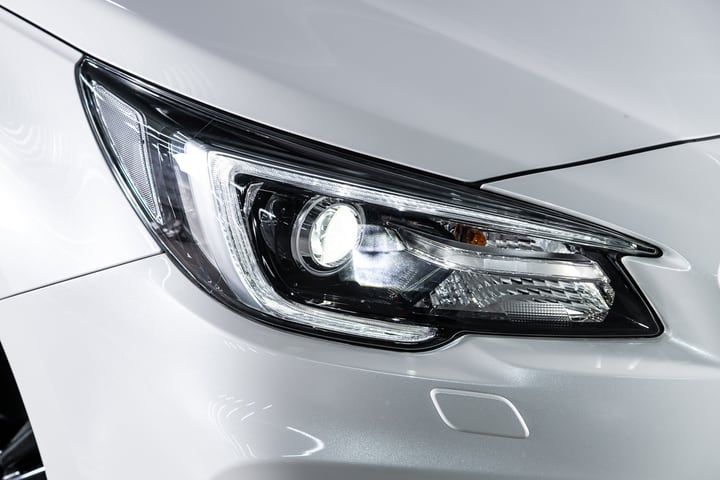
Projector headlights are a headlight housing design first introduced to vehicles in the 1980s. A projector consists of a bulb set inside a metal bowl with mirrored reflectors, a shutter (or cutoff shield), and a rounded lens at the front.
The shutter cuts off stray light so the beam is directed onto the road and not into the eyes of oncoming drivers. The lens focuses and intensifies the beam, driving light further down the road.
Projector vs Reflector Headlights
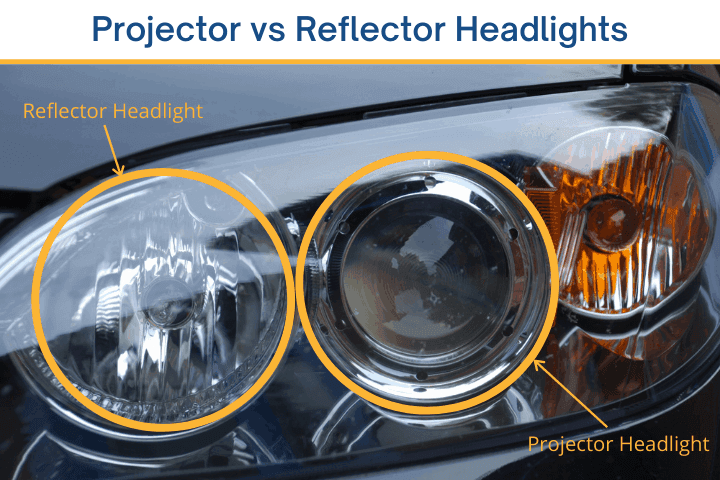
The core difference is the lens and shutter — reflector housings don't have them. Reflector beams are wider and less intense, which means they can have darker patches and are more likely to blind oncoming drivers if the light source is too bright. Projector housings produce a tighter, more consistent beam pattern aimed downward at the road.
This is why you can't drop LED bulbs into a reflector headlight designed for halogens without a purpose-built reflector bowl — the beam geometry is wrong and they will dazzle other drivers.
How Do I Know If I Have Projector Headlights?
Look at the headlight. If you can see a rounded, fish-eye-shaped glass lens covering the bulb, it's a projector. If you can see the bulb sticking out into an open dome-shaped reflector, it's a reflector housing.
Are LEDs Bright Enough for Projector Headlights?
Projector headlights have historically used halogen or HID bulbs, so how do LEDs compare?
Premium aftermarket LED bulbs claim up to 3–4× the raw lumen output of standard halogens, though actual on-road brightness depends far more on beam pattern and housing compatibility than on raw lumens. In projector housings, good-quality LED retrofits typically match or exceed HID brightness.
Why Beam Pattern Matters More Than Lumens
Halogen filaments emit light from a small, linear filament positioned at the housing's optical focal point. LED chips emit light from flat surfaces with a different geometry. If the LED's emitting surfaces aren't placed in a way that mimics the filament's position, the projector (or reflector) focuses the beam incorrectly: hotspots, dark foreground patches, and glare scattered above the cutoff line.
This is the core reason many cheap LED retrofits produce an intense foreground beam but poor distance projection — the light isn't being focused properly. Well-engineered retrofits use LED chip layouts and spacing designed to match halogen filament geometry for specific bulb types (H7, H11, 9005, 9006, etc.). Cheap bulbs don't, which is why two H7 LED kits at identical lumen ratings can produce wildly different real-world beam patterns.
LED vs HID: Which Is Better for Projector Headlights?
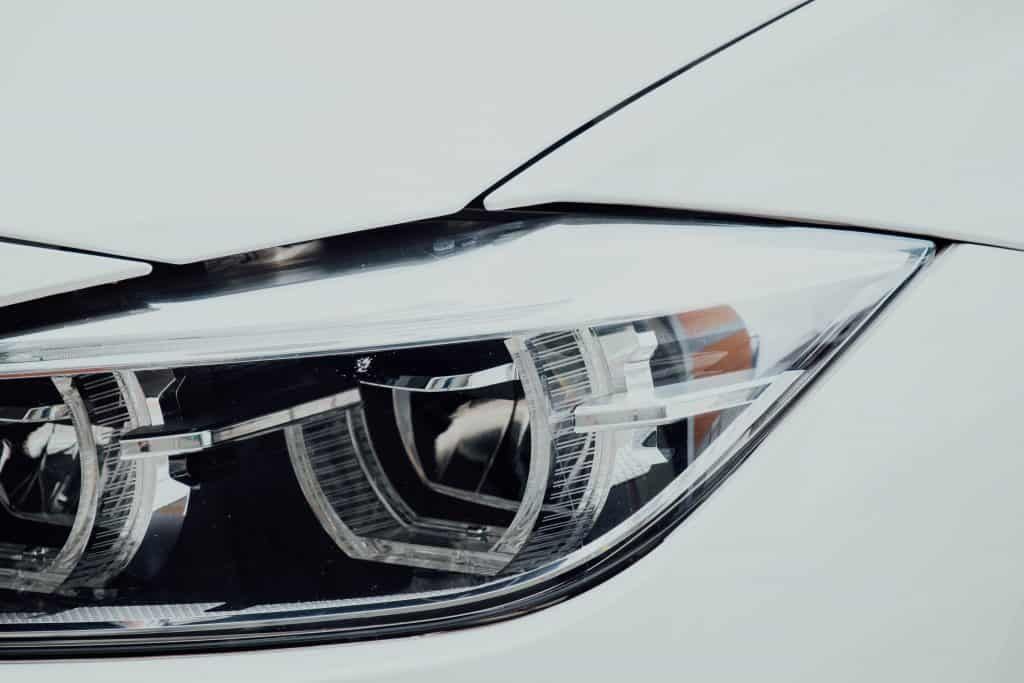
Automotive headlights have passed through four major technology generations: tungsten incandescent (early 1900s), halogen (introduced in the 1960s), HID/xenon (popularized in the 1990s), and LED (reaching production cars in the late 2000s). Laser headlights are a fourth generation just beginning to arrive on high-end cars.
HID/Xenon
HID (high-intensity discharge) bulbs, often called xenons, consist of two tungsten electrodes inside a capsule filled with xenon gas and metal salts. When current flows through the electrodes, the metal salts evaporate and form a light-emitting plasma that produces roughly three times the brightness of traditional halogens at only about 35 watts.
HIDs take around 2 to 5 seconds to reach full brightness — not instantaneous, but much faster than earlier generations.
LED
LEDs produce light using a semiconductor. LED low-beam headlights first appeared on a production car in 2007 with the Lexus LS 600h (2008 model year). The 2008 Audi R8 followed as the first vehicle with a fully all-LED headlight system. In 2013, Audi introduced Matrix LED technology on the A8 facelift, using 25 individually controllable high-beam LEDs per headlight that dim in 64 stages to avoid blinding oncoming drivers.
Modern LEDs draw 15–18 watts — more efficient than HIDs — and go from dark to full brightness instantly. LED lifespan typically outlasts the vehicle itself.
| Feature | HID / Xenon | LED |
|---|---|---|
| Power draw | ~35 W | 15–18 W |
| Brightness vs. halogen | ~3× | Up to 3–4× (marketing ceiling) |
| Startup time | 2–5 seconds to full brightness | Instant |
| Lifespan | Moderate (1,500–3,000 hours typical) | Very long (often 30,000+ hours) |
| Warm-up behavior | Gradually intensifies | Immediate |
For projector housings specifically, LEDs generally win on efficiency, longevity, and immediate start-up. The main practical catch: LED bulbs require a heat sink — typically a finned metal assembly or a small fan at the rear of the bulb, extending roughly an inch into the engine bay. This limits the physical space in which the bulb can fit, and on some vehicles the heat sink simply won't clear the dust cover or the housing wall.
What About Laser Headlights?
In 2014, both BMW (on the i8) and Audi (on the R8 LMX) launched laser headlights, which claim roughly twice the range of the brightest LED high beams (about 600 m vs 300 m). Laser headlights remain rare and are offered only on a small number of high-end vehicles — they aren't yet a retrofit option for most drivers, and replaceable laser bulbs aren't a real consumer product.
What Brightness Is Best for Projector Headlights?
The goal of a headlight is to light the road without blinding other drivers. Brightness is measured in lumens. Standard H7 halogens typically produce around 1,500 lumens — the exact figure varies by bulb type (H1, H4, H7, H11, 9005, 9006). HID bulbs output roughly 3,000 lumens. LED bulbs typically emit 2,000–4,000 lumens, with some aftermarket claims running well above that.
Color Temperature (Kelvin)
Color temperature, measured in Kelvin (K), describes the tint of the light. Lower values are warmer (yellower); higher values are cooler (bluer/whiter). Halogens sit around 3,200 K (warm white), HIDs around 4,500 K, and most LED headlights around 5,500–6,000 K (daylight white).
Roughly 6,000 K is a common practical threshold — above that, bulbs shift into a blue-violet range that scatters more in rain and fog, reduces actual visibility, and is more likely to dazzle oncoming drivers. Many states' vehicle codes restrict blue-tinted headlights specifically, and most reputable aftermarket brands cap their products around 6,000 K for that reason.
A study by RAC found that 65% of motorists have been dazzled by LED lights — even when dipped. Headlights should illuminate the road well ahead on low beam and substantially further on high beam (FMVSS 108 sets photometric minimums for both), but going brighter is not free: poorly aimed or too-intense beams trade your visibility for other drivers' loss of it.
| Halogen | HID | LED | |
|---|---|---|---|
| Lumen Output | ~1,500 | ~3,000 | 2,000 – 4,000 |
| Color Temperature | 3,200K | 4,500K | 5,500 – 6,000K |
What Types of LED Lights Work Best with Projector Headlights?
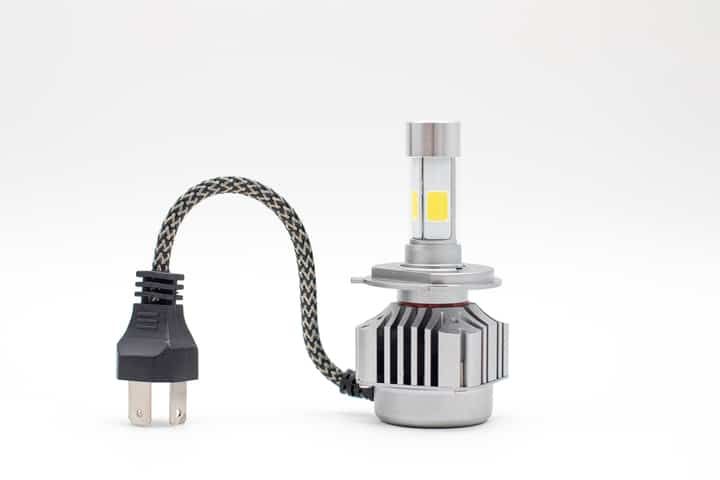
If you've decided to upgrade, you have two paths:
Option 1: LED Replacement Kit (Retrofit Bulbs)
A plug-and-play LED bulb that swaps directly into your existing housing. The most common base for halogen-replacement LEDs in projector housings is H7. SuperBrightLEDs has a vehicle lookup that takes year, make, and model.
- Pros: cheap (typically $30–$150 per pair), fast to install, no housing work.
- Cons: not FMVSS 108-compliant as drop-ins for halogen housings; beam pattern quality depends entirely on the bulb's chip geometry; may trigger CANBUS errors; may not physically fit behind dust covers due to heat sinks.
Option 2: Complete LED Headlight Assembly
An entirely new headlight fixture with LEDs designed-in from the ground up — effectively an OEM-style sealed or integral-beam assembly.
- Pros: beam pattern engineered to match the LED light source; DOT-compliant if sold as a certified assembly; no bulb/housing compatibility guesswork.
- Cons: much more expensive (often $400–$1,500+ per pair); limited availability for older or less-common vehicles; installation can be more involved.
CANBUS Compatibility
Most vehicles from the mid-2000s onward monitor headlight current through a CANBUS system — it's how the dashboard knows when a bulb is burnt out. LEDs draw much less current than halogens, so the CANBUS can mis-read the low draw as a failed bulb. The symptoms: dashboard warning lights, rapid flashing (hyperflash), or the bulbs refusing to turn on at all.
Solutions: buy LED bulbs with built-in CANBUS compatibility (most reputable kits offer this), or install external load resistors in line with each bulb to simulate halogen-level current draw. Check your vehicle's known quirks before buying — some European vehicles are notoriously picky.
Heat and Durability
LEDs run cooler at the filament-equivalent point than halogens, but the driver circuitry and chip substrate do generate significant heat that has to be dissipated through the heat sink. In enclosed headlight housings with poor airflow, a cheaply built LED can cook itself and fail prematurely — or, worse, fail inconsistently, producing flicker and color drift. Good-quality retrofits use active fans or large passive sinks; cheap ones skimp on thermal management.
Buying Guidance
Stick to established brands with published beam-pattern photos, specified chip layouts, and a warranty. Look for DOT / SAE markings on complete assemblies; for retrofit bulbs, look for verifiable CANBUS support, a matched heat-sink design, and color temperature at or below 6,000 K. Avoid no-name Amazon/eBay listings touting 20,000-lumen claims — the claims are not measured to any standard, and the beam patterns are usually terrible.
Also read: Why Do LED Turn Signals Flicker?
Here are the main pros and cons of LED lights:
- Up to 3–4× the raw lumen output of halogens and instantaneous full brightness.
- Significantly more energy-efficient than HIDs (15–18 W vs 35 W).
- Very long lifespan — often outlasts the vehicle itself.
- OEM LED assemblies are fully FMVSS 108-compliant and widely available as factory-installed options.
- Aftermarket retrofit bulbs are not FMVSS 108-compliant in housings designed for halogens.
- Beam pattern quality depends entirely on how well the LED chip geometry mimics a halogen filament — cheap kits produce hotspots and glare.
- Heat sinks may not fit behind factory dust covers; CANBUS errors are common without compatibility circuitry.
- Complete LED headlight assemblies are substantially more expensive than retrofit bulbs.
FAQ
Is it legal to put LED bulbs in my projector headlights?
In the US, aftermarket LED retrofit bulbs are not approved by FMVSS 108 as replacements in housings originally designed for halogens, so they're technically non-compliant at the federal level. OEM LED headlamps and complete certified LED assemblies are fully legal. State-level enforcement of the retrofit rule varies, but most states will flag headlights that are visibly dazzling, too blue, or incorrectly aimed.
Will LED bulbs work in a reflector headlight?
Generally, no — dropping aftermarket LED bulbs into a reflector housing designed for halogens produces a scattered, glare-heavy beam pattern because the LED's light source geometry doesn't match the reflector's optical design. Factory OEM reflector headlights that shipped with LEDs are a different matter; those are engineered and certified as complete assemblies.
Why do my new LED headlights cause dashboard warnings or rapid flashing?
Your vehicle's CANBUS system detects the low current draw of LEDs as a bulb failure. Fix it by buying CANBUS-compatible LED bulbs (most reputable brands offer them) or by installing in-line load resistors that simulate halogen-level current draw.
What's the maximum color temperature I should look for?
Around 6,000 K is the practical threshold. Above that, light shifts into a blue-violet range that scatters more in rain and fog, reduces visibility, and is more likely to dazzle other drivers. Many states specifically restrict blue-tinted headlights.
Are more lumens always better?
No. Real-world on-road brightness depends much more on beam pattern and housing compatibility than on raw lumen count. A well-engineered 2,500-lumen LED in a properly matched projector will outperform a poorly engineered 10,000-lumen bulb in a housing that can't focus it.
Final Words
Brighter is not always better — but brighter, correctly focused, and correctly aimed usually is. LED headlights beat halogen and HID on nearly every metric that matters, provided the beam pattern is engineered properly for the housing. For most drivers with projector-equipped vehicles, a quality LED retrofit is a real upgrade; for those with reflector housings or unusually space-constrained engine bays, a complete LED assembly is the safer path.
What's your experience — have you retrofitted LED bulbs into projector headlights, and did the beam pattern hold up? Does your state have specific restrictions that affected your choice?