
How To Illuminate An Outdoor Hot Tub?
Pool submersibles are typically rated to around 95°F — and hot tubs run at 100–104°F. That gap is small enough to miss and just wide enough to kill your lights.
 Eugen
EugenEugen Nikolajev
Creator of LED Lighting Info
Hi, I am Eugen. I was always one of those kids who had all sorts of weird lighting gadgets for every occasion.
Now, I want to share my knowledge and experience about lighting with you on LED Lighting Info.
Read my editorial standards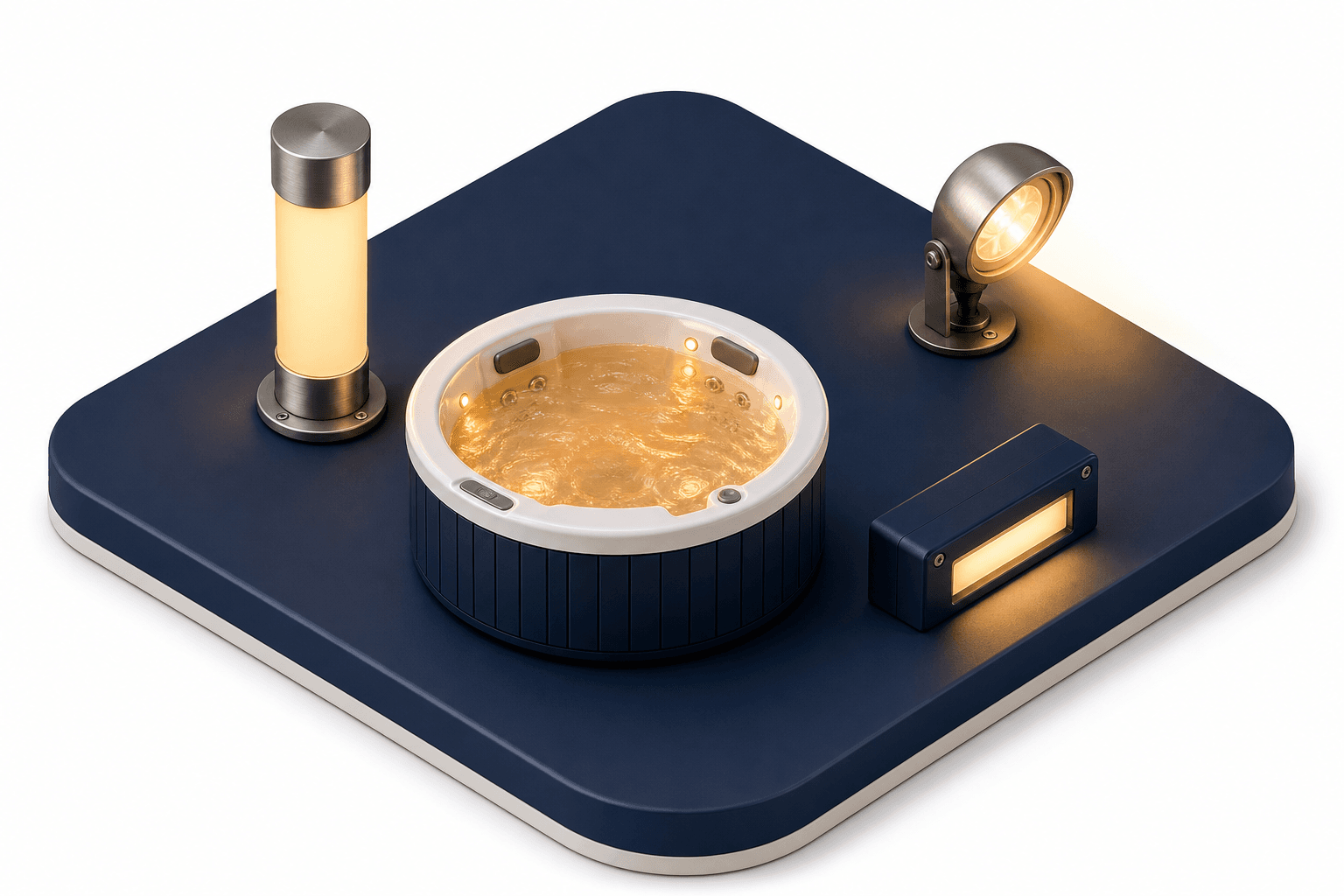
Key Takeaways
There are many ways to illuminate a hot tub, including submerged or floating lights, LED strips around the hot tub (especially on the steps), deck lighting, and string lights hung around – but not over – the hot tub itself.
Hot tub lighting isn't just about atmosphere — get it wrong and you have a slip hazard around wet decking, an electrical risk near water, or a tub you can't comfortably use after dark.
In this guide, I'll cover:
- Lighting options for the area around a hot tub
- How to hang string lights safely, including the NEC clearance rules
- Whether submerged or floating lights belong inside a hot tub
- The specs that actually matter: IP ratings, color temperature, and GFCI/RCD protection
Lighting Options for the Hot Tub Area
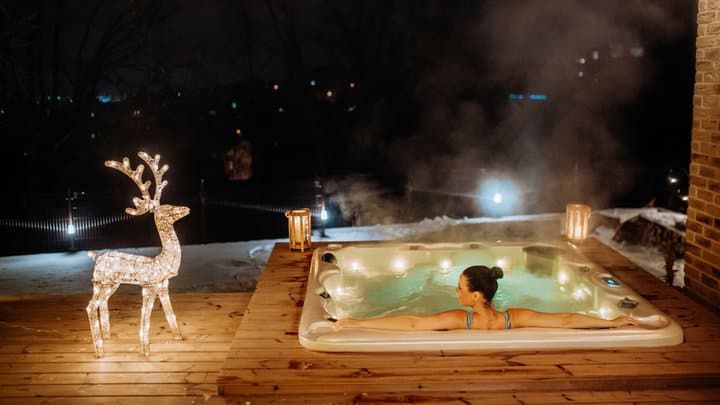
The right combination depends on the size and layout of your outdoor space, but two priorities should drive every choice:
Safety: the walkway between the house and the hot tub should be well-lit, and the immediate area around the tub should be bright enough to avoid slips on wet decking.
Atmosphere: you want enough light to set the mood without killing the relaxation. Layer multiple low-intensity sources rather than one bright fixture.
LED strip lights
LED strip lights are the cleanest option for the immediate area around the hot tub. Attach them to the outside edge of the tub or under the lip of steps for a hidden-source, modern look. RGB and RGBW strips let you shift between warm white for unwinding and saturated colors for a party mood.
Best for: edge lighting on the tub, step illumination, accent strips along decking.
Pros:
- Easy to install with adhesive backing
- Source hidden, light visible — discreet effect
- Wide range of colors and dimming options
Cons:
- Low throw — pair with another light source for wider coverage
- Mains-powered strips need a hidden cable path; battery options are dimmer
Power: mains (with low-voltage transformer) or battery. Look for IP65 minimum for exterior strips, and IP68 for any section that might get submerged.
String lights
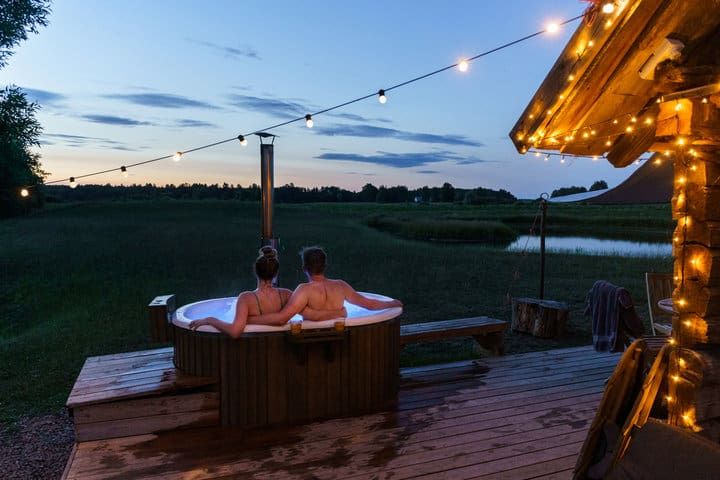
String lights produce a gentle, wider glow and double as a visual feature in their own right. They're also the trickiest installation option around water — pay close attention to where you anchor them and the clearance rules covered in the next section.
Best for: atmosphere over a wider area, pergolas, fence lines, and tree-anchored installations near the hot tub.
Pros:
- Soft, ambient light over a large area
- Decorative — the lights themselves are part of the look
Cons:
- Hardest install — requires sturdy anchor points and careful routing
- Strict NEC clearance rules apply if hung over or near the tub
Power: mains (with weatherproof outlet) or solar. Look for fixtures listed for wet locations, not just "weatherproof," with IP65 or better.
Deck lights
Installed flush with the decking, deck lights pick out the walking surface around the tub and the steps leading up to it. They're great for safety lighting that disappears during the day.
Best for: step risers, deck perimeters, marking the safe path to the tub.
Pros:
- Flush mount — no obstruction, no glare in the eyes
- Excellent for marking step edges and walkway boundaries
Cons:
- Requires drilling recesses into the decking
- Wired versions need access to the underside of the deck for cabling
Power: mains (low-voltage transformer) or solar. Solar only works if the decking gets direct sun during the day.
Wall-mounted patio lights
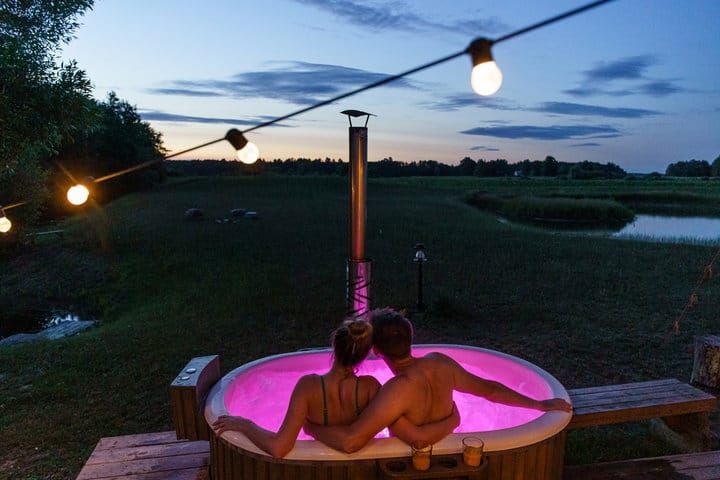
Wall-mounted patio lights are the least atmospheric option here, but they're a workhorse for general illumination. Skip security-style floodlights — they're too harsh for a relaxation setting. Use several smaller dedicated fixtures spaced out instead.
Best for: general background light when the tub sits against a house wall, fence, or shed.
Pros:
- Out of the way — no floor or deck space lost
- Easy physical mounting
Cons:
- Wiring behind a wall is the hard part
- Easy to over-light the space if fixtures are too bright
Power: mains, almost always hard-wired.
Hanging String Lights Safely Around A Hot Tub
String lights overhead are one of the best-looking ways to dress a hot tub area, but the electrical risk is real. If an anchor fails, a strand can drop into the water — which is why the National Electrical Code restricts where you can put them.
Under NEC Article 680 — which covers outdoor hot tubs via Section 680.42 and incorporates the overhead-lighting rules from 680.22(B) — any luminaires (including string lights) installed above the hot tub or within 5 feet horizontally of its inside walls must be mounted at least 12 feet above the maximum water level and be listed for damp or wet locations.
Standard line-voltage fixtures are permitted at that 12-foot clearance. The code also allows listed low-voltage luminaires to be installed closer under separate rules in 680.22(B)(6), so low voltage isn't required — it's an alternative.
Two other practical points:
- Many string lights are sold as "weatherproof," which is not the same as listed for wet locations. Check the IP rating — IP65 is a sensible minimum outdoors.
- All outdoor electrical circuits near water should be protected by a Ground Fault Circuit Interrupter (GFCI in the US) or Residual Current Device (RCD in the UK and EU). These cut power within milliseconds when a fault leaks current to ground — exactly the kind of fault that turns a wet patio into an electrocution hazard.
Local code amendments vary, so consult a licensed electrician before installing anything overhead near a hot tub. The simplest way to avoid the clearance problem entirely: don't run string lights directly above the tub. Use them in the surrounding area, where the rating and height rules are easier to meet.
You can use my guide on hanging string lights around a pool for anchoring techniques that work just as well here.
Lights Inside The Hot Tub
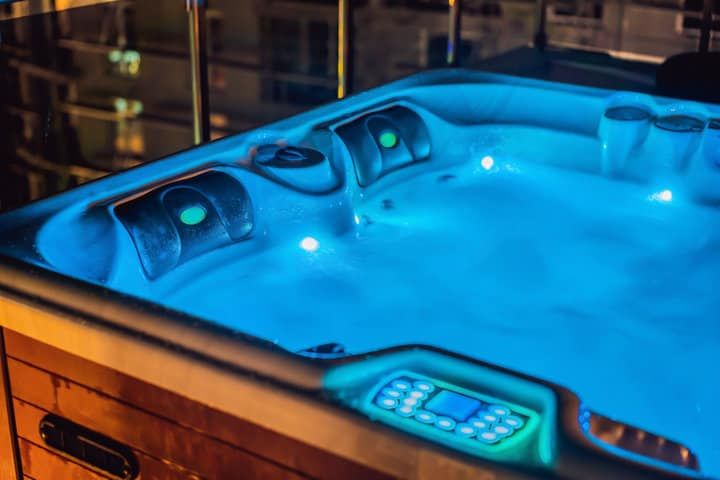
Lights inside the tub create a very different effect from area lighting, but I wouldn't rely on them alone. The water jets scatter and diffuse the light, reducing both reach and clarity. Pair in-tub lights with deck lights or LED strips outside the tub for usable visibility.
Submerged lights
Submerged lights attach to the inside of the tub with suction cups, which work equally well on the hard lining of a fixed tub and on the rubber wall of an inflatable one.
The most important spec to check is temperature rating. Hot tubs typically run at 100–104°F (38–40°C), and many "submersible" products marketed for pools, ponds, or aquariums are only rated to around 95°F. Don't assume a generic pool light will survive in a spa. Look for fixtures explicitly listed for hot tubs or spas — for example, Clear Lighting's hot-spring-rated strip or Wave Spas' submersible hot tub light — and confirm the maximum operating temperature on the product page before buying.
RGB and color-changing submersible lights are extremely popular for hot tubs. They let you shift between warm whites for unwinding and saturated colors for a party setting, often with a remote. For anything that lives in the water, look for IP68 (continuous immersion) rather than IP67 (temporary immersion only).
Floating lights
Skip floating lights for a hot tub. They get pushed around constantly by the jets, the direction of the light shifts in a distracting way, and they bump into bathers. Floating lights are a pool or pond product, not a spa product.
What To Look For When Buying
IP rating
The IP (Ingress Protection) rating tells you how watertight a fixture is. The second digit covers water — that's the one to focus on for hot tub installations:
- IP65 — protection against water jets from any direction. Minimum for fixtures around the exterior of the tub.
- IP67 — protection against temporary immersion (up to 1 meter for 30 minutes). OK for fixtures that might briefly get splashed or dunked.
- IP68 — continuous immersion. Required for any fixture that lives in the water.
Color temperature
Measured in Kelvin (K), color temperature is one of the biggest atmosphere levers and it's almost universally overlooked. For a hot tub, my default is warm white in the 2700K–3000K range — it reads as relaxed and inviting. Cool white (5000K and above) feels clinical and is better suited to security lighting than to a soak. If you want flexibility, RGB or RGBW fixtures let you switch between moods.
GFCI / RCD protection
Any outdoor electrical circuit near water must be protected by a Ground Fault Circuit Interrupter (US) or Residual Current Device (UK/EU). These devices cut power within milliseconds when they sense current leaking to ground — the specific kind of fault that causes electrocution in wet environments. If your existing outdoor circuit isn't GFCI/RCD-protected, sort that out before adding any lighting near the tub.
A Note On Inflatable Hot Tubs
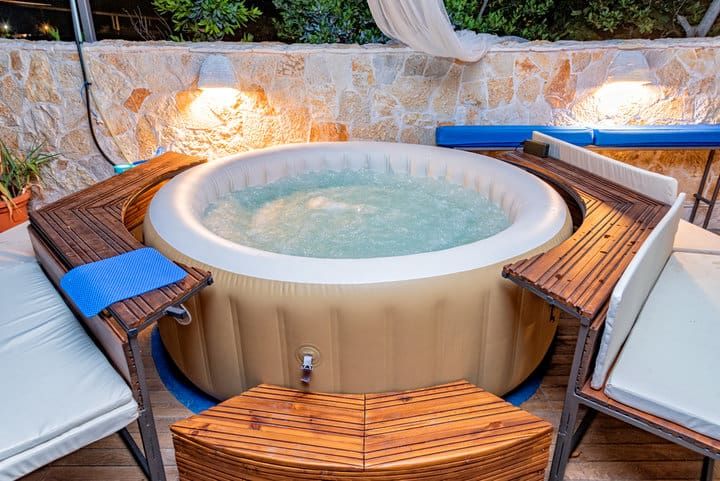
Inflatable hot tubs don't need a different lighting strategy from rigid ones. Suction-cup submersibles stick to rubber walls as well as they do to hard linings, and area lighting (string lights, deck lights, exterior strips) doesn't care what the tub is made of.
The one consideration that matters: pick hot-tub-rated submersibles rather than generic pool lights. Inflatable tubs run at the same elevated temperatures as rigid ones, and that's the spec that catches people out — not the surface the light sticks to.
Choosing Your Hot Tub Lighting Setup
A workable hot tub lighting setup almost always combines two or three sources rather than relying on a single fixture. My rule of thumb:
- Something for the path and surroundings — deck lights, wall-mounted fixtures, or string lights kept at the required clearance.
- Something for the tub itself — LED strips along the edge or steps, or hot-tub-rated submersibles inside.
- Warm white as the default color temperature unless you specifically want color-changing flexibility.
Whatever combination you pick, check the IP rating against where each fixture will actually sit, confirm the circuit is GFCI- or RCD-protected, and respect the overhead clearance rules for anything hanging over the water. The rest is aesthetics.