Can Outdoor Christmas Lights Get Wet?
A red holographic UL label is the one thing that separates a Christmas light string rated for rain and snow from one that isn't — and most people never notice it's there.
 Eugen
EugenEugen Nikolajev
Creator of LED Lighting Info
Hi, I am Eugen. I was always one of those kids who had all sorts of weird lighting gadgets for every occasion.
Now, I want to share my knowledge and experience about lighting with you on LED Lighting Info.
Read my editorial standards
Key Takeaways
As long as you buy Christmas lights that are properly rated for outdoor use with a high IP rating, they will be safe to use outdoors. Just make sure they're either plugged in indoors or into a protected outdoor outlet.
If you live somewhere with wet winters, you've probably wondered whether your outdoor Christmas lights are actually safe in the rain. After all, water and electricity are a bad mix, right?
There's a little more to explain, so let's dive deeper into:
- Whether Christmas lights are safe to use in the rain
- Whether it's OK for plugs to get wet
- How to protect Christmas lights from the weather
Are Outdoor Christmas Lights Safe In The Rain?
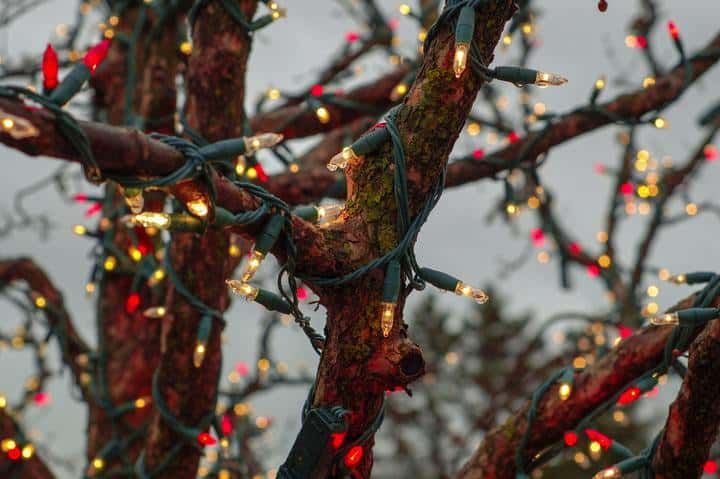
Christmas light strings sold in the U.S. are tested under UL 588, the safety standard for seasonal decorative lighting. There are two relevant categories: indoor-only strings, which carry a green holographic UL label, and indoor/outdoor strings, which carry a red holographic UL label. The red label means the lights are approved for both indoor and outdoor use — there isn't a separate "outdoor-only" category. Lights certified by ETL (Intertek) under the same standard are equally valid.
So when people talk about outdoor lights being used indoors, they're really talking about red-labeled strings. They'll work fine inside; they're just often brighter and run hotter than you typically want indoors — especially incandescent strings.
The difference between indoor-only and outdoor-rated strings comes down to waterproofing. Outdoor lights have bulbs and wires sealed against the elements, and that level of sealing is described by the IP rating.
Understanding the IP rating
IP (Ingress Protection) is the rating that tells you how sealed an electrical item is against solid particles and liquid. You'll usually find it printed on the packaging or in the product listing online.
The rating is made up of two numbers — the first is the protection against solid particles like dust (ranging 0–6), and the second is liquids (ranging 0–8, with a separate IPX9K test on top).
You may also see an "X" in place of one of the digits (e.g., IPX4) — that just means the product hasn't been tested for that category, not that it failed.
Here's what each level of water protection means:
| Second Digit | Protection Level |
|---|---|
| 0 | No protection claimed (designed for dry use only) |
| 1 | Dripping water (vertical) |
| 3 | Spraying water |
| 4 | Splashing water from any direction |
| 5 | Water jets |
| 6 | Powerful water jets |
| 7 | Temporary immersion (1 m for 30 minutes) |
| 8 | Continuous immersion (depth specified by manufacturer) |
| 9K | High-pressure, high-temperature jet spray (specialized industrial test) |
One important caveat: the water-ingress ratings are not cumulative beyond IPX6. A product rated IPX7 (immersion) isn't necessarily protected against high-pressure jets, and IPX9K isn't simply "better than" IPX8 — it's a separate industrial test for 80–100 bar, ~80°C jet washdown. For Christmas lights, this rarely matters; just don't assume a higher number always covers every lower one.
What rating do you actually need?
For Christmas lights hung outdoors, an IP rating ending in 4 (typically IP44) is enough — it's protected against splashing water from any direction. Many strings are rated IP65 or IP67, which adds protection against water jets or temporary immersion, useful if you're running lights along the ground or somewhere they might sit in a puddle.
As long as you buy Christmas lights that are rated IP44 or better and carry a red UL or ETL holographic label, they'll be safe in the rain and snow.
LED vs. incandescent in wet weather
Both LED and incandescent strings are sold with outdoor ratings, but LEDs have a real safety edge outdoors. They run much cooler, draw a fraction of the power, and use low-voltage drivers in many cases. Incandescent bulbs get hot, and a hot glass bulb hit by cold rain can occasionally crack — which is exactly the kind of breach that lets water reach the filament. If you're starting fresh, LEDs are the better choice for wet conditions.
Can Christmas Light Plugs Get Wet?
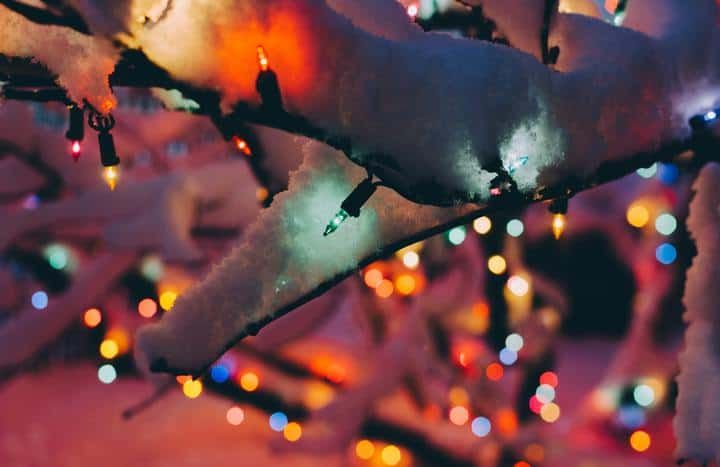
If the lights themselves are waterproof, does that mean the plug is too? Not necessarily. The plug and any connection points are still vulnerable, and an exposed plug sitting in a puddle is the most likely cause of a short, a tripped breaker, or — worst case — a fire.
Follow these steps to keep connections safe:
- Choose your plug location. Plugging into an indoor outlet and running the cord through a door or window is the simplest option. If you need to plug outdoors, use an outdoor-rated GFCI outlet.
- If outdoors, install a weatherproof cover. A weatherproof in-use cover (sometimes called a "bubble cover") seals around the plugged-in cord so the outlet stays protected even while in use. Install it on a dry day.
- Use outdoor-rated extension cords. If you need to extend the reach, use a cord specifically rated for outdoor use (look for an "SJTW" or "SJEOW" jacket marking). Indoor cords have thinner insulation that isn't designed for wet conditions.
- Protect cord-to-cord connections. The point where a light string plugs into an extension cord is another weak spot. Extension cord safety covers seal that junction to IP44.
- Keep connections off the ground. Drape cables over bushes, hooks, or railings rather than leaving them in grass where water can pool. Even outdoor-rated gear lasts longer when it isn't sitting in a puddle.
How To Protect Christmas Lights From Rain
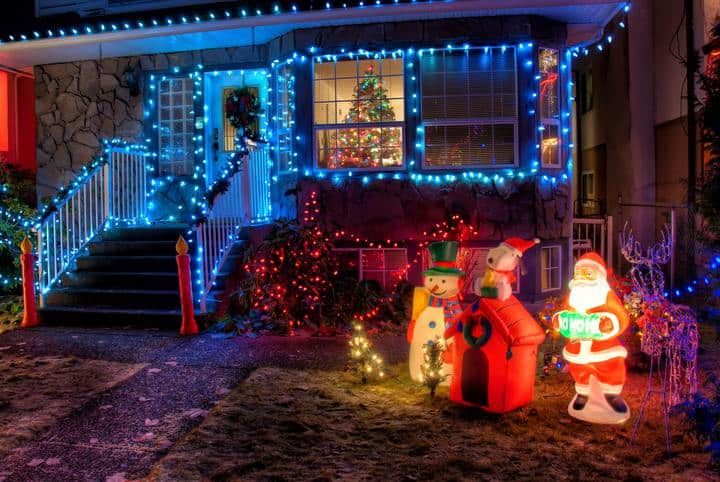
If you've bought outdoor-rated waterproof lights, there isn't much else you need to do day to day. A few practical habits help, especially when the weather turns nasty.
Inflatables and standalone decorations
If you have inflatable Santas, wicker reindeer, or other standalone decorations, bring them indoors ahead of a serious storm — or cover them with a tarp. Either way, power them off first; trapping a powered fan or transformer under a tarp is a worse outcome than a soaked decoration.
Should you turn lights off during a storm?
Outdoor-rated lights on a GFCI-protected circuit are designed to handle steady rain, snow, and freezing temperatures. But in my experience, it's worth switching them off during severe weather — heavy windstorms can pull strings down or tear connectors apart, and once the seal on a connector is compromised, the IP rating no longer applies. If a string gets damaged or partially submerged in standing water, unplug it and let it fully dry out before powering it back on.
Always use a GFCI outlet
The single most important electrical safety device for Christmas lights is a Ground Fault Circuit Interrupter (GFCI) — the outlet (or breaker) with the test and reset buttons on it.
All outdoor outlets at dwellings must have GFCI protection under the National Electrical Code. Many indoor outlets are required to as well — under NEC 210.8(A), GFCI protection is required in bathrooms, kitchens, garages, basements, laundry areas, crawl spaces, and within 6 feet of any sink. If you're plugging your Christmas lights into an indoor outlet in one of those rooms, it should already be GFCI-protected.
A GFCI detects when current is leaking out of the circuit — for example, through water or a damaged wire — and cuts power within milliseconds. That's different from a surge protector (which guards against voltage spikes) or a regular breaker (which trips on overload). The GFCI is what protects you from shock when water and electricity meet.
Test the GFCI monthly using the built-in test and reset buttons — UL and the NEC both recommend this. Press "Test" with something plugged in; the device should cut power. Press "Reset" to restore it. If the test button doesn't trip the outlet, replace it. GFCIs do wear out, and a non-functioning one looks identical to a working one.
The Bottom Line
If you only do one thing, make sure your outdoor Christmas lights are IP44-rated or better and carry a red UL or ETL holographic label.
If you do two things, also plug them into a GFCI-protected outlet — and test that GFCI before the season starts.
If you do three, protect every connection: a weatherproof in-use cover on the outdoor outlet, an outdoor-rated extension cord, and all junctions kept up off the ground. Do those three things and your lights will be safe through almost any winter weather you'll see.
FAQ
What IP rating do outdoor Christmas lights need?
IP44 is the minimum for outdoor Christmas lights — it protects against splashing water from any direction. IP65 or IP67 adds protection against water jets or temporary immersion, which is useful if any part of the run will sit on the ground or in a gutter.
Can I use indoor Christmas lights outside if it's not raining?
No. Indoor-only lights (green UL holographic label) aren't sealed against moisture — and outdoor conditions include dew, condensation, and humidity even when it isn't actively raining. Use only strings with a red UL or ETL holographic label outdoors.
Are LED Christmas lights safer than incandescent in the rain?
Generally yes. LEDs run much cooler, so there's no risk of a hot bulb cracking when hit by cold rain, and they draw less current overall. Both types are sold with outdoor ratings, but LEDs have a real safety and longevity edge in wet conditions.
Do I need to take down my Christmas lights during a storm?
Outdoor-rated lights on a GFCI circuit can handle steady rain and snow without issue. For severe storms with high winds, switch them off — wind can pull strings down or break connectors, and a compromised seal voids the IP rating. If a string ends up submerged or damaged, unplug it and let it dry fully before reusing.
What happens if my Christmas lights get wet inside the plug?
If water gets into a live plug, expect a tripped breaker or GFCI at best, and a short, melted plug, or fire at worst. Unplug immediately (from the breaker if the plug itself is wet — don't touch a wet energized plug), let everything dry completely, then inspect for corrosion or damage before reusing. When in doubt, replace the affected cord or string.