
Do Pool Lights Need To Be Grounded?
At 12V, LED pool lights sit below the NEC's low-voltage contact limit — but in water, that's still enough current to cause muscle tetany and prevent a swimmer from surfacing.
 Eugen
EugenEugen Nikolajev
Creator of LED Lighting Info
Hi, I am Eugen. I was always one of those kids who had all sorts of weird lighting gadgets for every occasion.
Now, I want to share my knowledge and experience about lighting with you on LED Lighting Info.
Read my editorial standards
Key Takeaways
120-volt pool lights must be grounded, but grounding is not legally required for low-voltage fixtures. Grounding low-voltage lights is still strongly recommended where possible, and the pool itself must be bonded regardless of voltage.
Pool lights occupy a uniquely hazardous intersection of electricity and water, which is why grounding and bonding rules for them are stricter than almost any other residential lighting application.
Many electrical devices include a live wire, a neutral wire, and a third wire — the ground. The ground wire is designed to safely carry current away if there is a short or other fault, so it does not pass through you.
So pool lights need to be grounded, right?
Here is what I will cover:
- The difference between bonding and grounding
- Whether LED pool lights need a grounding wire
- How to bond and ground a swimming pool light
- The risks of skipping bonding and grounding
Difference Between Bonding And Grounding

Both bonding and grounding make a pool safer, but they do different jobs. The table below summarizes the distinction at a glance.
| Aspect | Grounding | Bonding |
|---|---|---|
| Purpose | Provides a low-impedance fault-current return path so the breaker trips | Equalizes voltage across all metal parts so there is no shock potential between them |
| What is connected | Electrical components (fixtures, transformers, motors) | Non-electrical metal (rails, ladders, light housings, pump bodies) |
| Required for 120V lights? | Yes | Yes |
| Required for 12V lights? | No (but the transformer must be grounded) | Recommended |
| Wire spec | Green or bare copper sized to the circuit | #8 AWG solid copper minimum (NEC 680.26) |
Grounding wires an electrical component so that a stray current has somewhere safe to flow if there is a fault — a short, damaged insulation, or a failing internal part.
The grounding wire provides a low-resistance return path back to the breaker, allowing it to trip quickly and cut power. (The popular description of grounding as a "path of least resistance to earth" is technically imprecise — earth itself is a poor conductor. The grounding conductor works because it bonds back to the source neutral.)
Grounding is not a guarantee. If a fixture is shorting and you handle it with the power still on, current may still find a faster path through your hands. But properly grounded equipment keeps stray current out of the water under normal fault conditions and lets the overcurrent device do its job.
Bonding uses a wire to tie together every metal pool component that could conduct electricity but is not designed to — pool steps, ladder anchors, handrails, pump motor housings, and metal light housings (the housing only, not the electrical part of the light).
Current looks for the fastest path to earth, and it also tries to equalize across a circuit. If a fault energizes one metal pool component and you are touching another — or the conductive water — the voltage difference between them is what shocks you.
Bonding ties everything to the same electrical potential. Even if a fault energizes one part, the deck, rails, water, and housings all sit at the same voltage, so no current flows through you to reach a different potential.
Do LED Pool Lights Need A Grounding Wire?
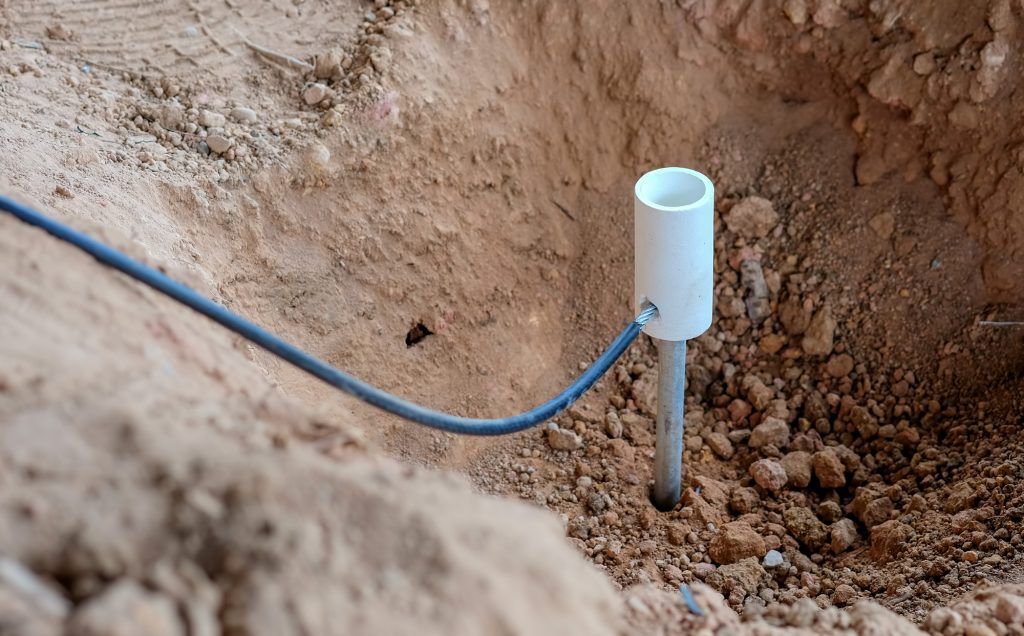
Whether LED pool lights need to be grounded depends on their voltage.
Most LED pool lights are low voltage — they typically run at 12V, with multi-tap transformers offering 13V and 14V taps to compensate for voltage drop on longer cable runs. The NEC's "low-voltage contact limit" for sinusoidal AC is 15V RMS.
These lights do not legally require grounding, and most do not include a ground wire.
Some LED retrofits do require grounding — typically when an LED bulb is installed into an existing fixture originally designed for incandescent or halogen lamps. Those usually run on mains voltage, and they absolutely must be grounded.
Voltage and shock risk in water
A 120V shock can be fatal — especially in or near water, where reduced body resistance allows much more current to flow.
12V is lower risk than 120V, but it is not inherently safe. In water, body resistance is sharply reduced, and even low-voltage current can cause muscle tetany — involuntary contraction that can prevent a swimmer from surfacing. The NEC treats voltages below the 15V RMS "low-voltage contact limit" as lower risk, not safe.
If a low-voltage fixture has a grounding wire, connect it.
Wet niche vs. dry niche fixtures
Wet niche fixtures sit in a flooded recess in the pool wall and rely on the housing and gasket to keep water away from the lamp's electrical contacts. Dry niche fixtures are sealed behind a window in the pool wall, with the lamp accessed from a corridor on the dry side.
Both have specific bonding and grounding rules, but wet niche is by far the more common residential setup, and the bonding lug inside the niche is what you tie into when bonding the pool.
The transformer and GFCI
The transformer must always be grounded. That is a legal requirement under the National Electrical Code. The transformer's input side is still handling mains voltage before stepping it down, and any fault on that side becomes a serious hazard if the unit is not grounded.
GFCI protection is also required. NEC 680.23 mandates GFCI protection for all 120V underwater luminaires, and many jurisdictions extend that to low-voltage circuits feeding pool equipment. A GFCI senses current leaking to ground — including through a person — and shuts off the circuit within milliseconds. Pair every pool light circuit with GFCI protection, even where local code does not yet require it for low-voltage runs.
The same logic applies to bonding. Mains-voltage lights must have bonded housings; for low-voltage fixtures, bonding is technically optional but still strongly recommended.
How To Bond And Ground A Swimming Pool Light
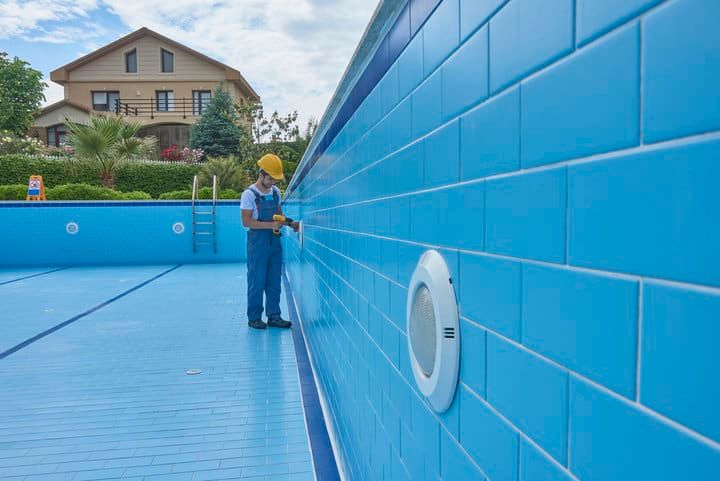
Switch off the pool light circuit at the breaker before doing any of this. In most U.S. jurisdictions, any new 120V pool light circuit must be installed by a licensed electrician, and even where DIY is permitted, an inspection is usually required before the system can be energized.
Grounding the fixture
- Identify the cable from the fixture. It contains the live, neutral, and (where present) ground conductors.
- Run the cable to a listed pool-rated junction box. NEC 680.24 requires this J-box to sit at least 4 inches above the deck and 8 inches above the maximum water level, be listed for swimming pool use, and be made of corrosion-resistant material.
- Inside the J-box, connect the fixture's ground wire to the equipment grounding conductor running back to the breaker panel.
- Connect the live and neutral conductors to the supply wires.
- If the fixture is low-voltage and the cable is sealed at the lamp without a ground conductor, there is nothing to ground at the fixture itself — but the transformer feeding it must be grounded.
Bonding around the pool
- Locate the bonding lug on each metal component within 5 feet of the pool wall — the wet niche light housings, ladder anchors, handrails, diving board supports, pump motor, and any other metal hardware.
- Run a continuous #8 AWG solid copper wire (the minimum gauge required by NEC 680.26) from lug to lug, tying every conductive component into one bonded grid. The wire can be insulated, covered, or bare.
- Bond the perimeter surface — typically a copper grid embedded in the deck, or the structural reinforcing steel of a poured concrete pool. NEC TIA 23-9 (October 2023) restricted the use of a single #8 wire as the sole perimeter bonding method in many installations, so check current requirements with your local AHJ.
- Bond the pool water using a listed water-bonding fitting if no other bonded surface is in continuous contact with the water.
- Terminate the bonding grid at the equipment bonding terminal on the pump motor. Do not tie the bonding grid to the grounding electrode system unless your local code specifically requires it.
Is It Safe To Use A Pool Without Bonding And Grounding?

If you use mains-voltage lights, the National Electrical Code requires they be bonded and grounded.
Skip it, and any fault in the lighting circuit can put live voltage into the water or onto the pool deck. Pool electrocutions are rare, but they happen, and they are almost always preventable.
The NEC itself is not federal law, but it has been adopted into law by every U.S. state and most local jurisdictions, making compliance legally required in the vast majority of places where pools are installed. The adopted edition varies (some jurisdictions are still on the 2017 NEC, others on 2020 or 2023), but the bonding and grounding requirements for pool lighting have been in place for decades. If a swimmer is injured or killed in a pool that was not bonded and grounded to code, the owner can face criminal negligence charges.
Hiring a licensed electrician shifts some of the liability — but the pool owner ultimately remains accountable for the safety of the pool.
If you are using mains-voltage lights, make sure they are properly bonded and grounded. The health and legal risks are not worth the gamble.
Final Words
If you are unsure whether your pool was bonded correctly, a licensed electrician can perform a continuity test on the bonding grid — typically for under $200. The test confirms that every metal component around the pool sits at the same electrical potential, and it is the cheapest peace of mind a pool owner can buy.
I also recommend a visual inspection of every underwater fixture at the start of each swim season. Condensation inside the lens means the gasket has failed and water is in contact with the lamp assembly — replace the fixture before anyone gets back in the pool. The same goes for cracked lenses, corroded housings, or a GFCI that trips on its own.
The bonding grid, the equipment grounding conductor, and the GFCI are designed to protect swimmers from the worst-case fault. Inspecting them on a regular schedule is what keeps that protection real.