
How Often Do Pool Lights Need To Be Replaced?
A single LED pool bulb can outlast a decade of pool ownership — while cutting your lighting energy bill by roughly 85% compared to the halogen it replaces.
 Eugen
EugenEugen Nikolajev
Creator of LED Lighting Info
Hi, I am Eugen. I was always one of those kids who had all sorts of weird lighting gadgets for every occasion.
Now, I want to share my knowledge and experience about lighting with you on LED Lighting Info.
Read my editorial standards
Key Takeaways
LED pool lights typically last 25,000–50,000 hours, with some 2025 models rated up to 60,000 hours. Halogen bulbs land between 2,000 and 5,000 hours, while incandescent pool bulbs only manage about 800–1,000 hours.
Pool light lifespan varies dramatically by bulb type — and knowing the difference can save you hundreds of dollars over the life of your pool.
Changing a pool light is a small job, but it can be tricky if you don’t know what you’re doing, and understanding how often you’ll need to do it should shape the bulb you buy.
Here’s what I’ll cover:
- How long pool lights last, by bulb type
- How to safely change a pool light without draining the pool
- Whether you should upgrade to LED
- What it costs — bulbs, electricity, and electrician fees
How Long Does A Pool Light Last?
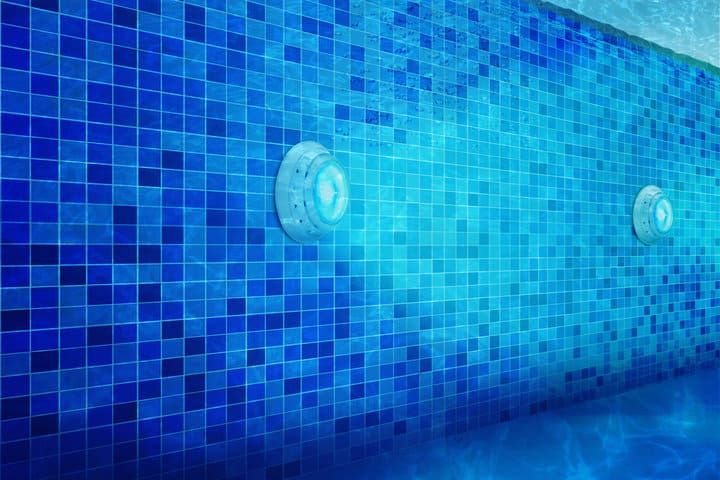
How long a pool light lasts depends almost entirely on the bulb technology inside it.
Incandescent
Incandescent bulbs are the classical bulb type. A current passes through a filament, the filament heats until it glows, and most of the energy is wasted as heat rather than light. Eventually the filament burns out. In pool fixtures, incandescents typically last 800–1,000 hours.
Halogen
Halogen bulbs are an evolution of the incandescent: the filament sits inside a sealed envelope filled with halogen gas. Halogen gas inside the bulb helps redeposit evaporated tungsten back onto the filament, extending its life and improving efficiency.
In pool fixtures, halogen pool bulbs typically last 2,000–5,000 hours, with around 3,000 hours being a representative midpoint.
LED
LEDs use a completely different mechanism. There’s no filament — current passes through semiconductors in the diodes and emits light directly. They draw far less power, run cooler, and last dramatically longer: typically 25,000–50,000 hours, with some 2025 models rated up to 60,000.
Hours alone are hard to picture, so assume you run your pool lights for 5 hours a night. Here’s how that translates into real time before replacement:
| Bulb Type | Lifespan (hours) | Years at 5 hrs/night (year-round) | Years at 5 hrs/night (half year) |
|---|---|---|---|
| Incandescent | 800–1,000 | ~6 months | ~1 year |
| Halogen | 2,000–5,000 (≈3,000) | ~1.5 years | ~3 years |
| LED | 25,000–50,000 | 13–27 years | 27–55 years |
Most pool owners only run lights for half the year, which is why halogens often only need replacing every couple of seasons in practice — and why an LED can outlast the pool itself.
How To Change A Pool Light Underwater
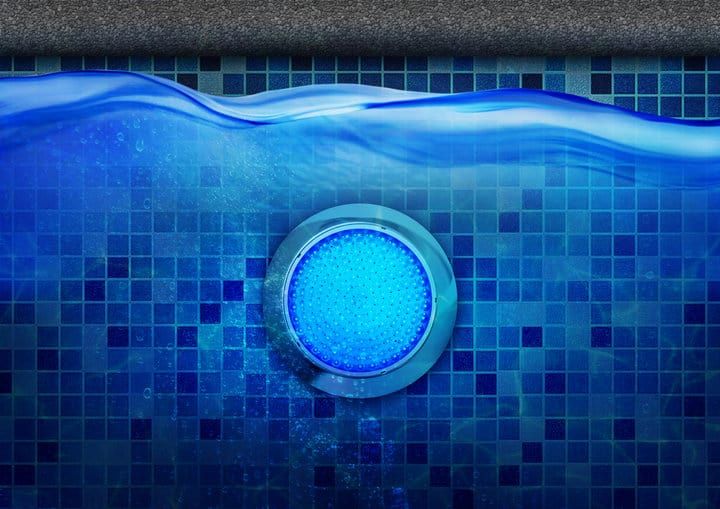
The good news: you don’t have to drain the pool. The not-so-obvious news: you don’t actually do the work underwater either. Per NEC Article 680.23(B)(4), wet-niche pool lights must have enough cord coiled in the recess to allow the fixture to be removed from the niche and placed on the deck for re-lamping or servicing without disconnecting it. That’s the cord you unspool when changing the bulb.
Safety first
Pool lights are an electrical fixture inside a body of water — the safety steps are not optional:
- Switch off the breaker that feeds the pool light, not just the wall switch. A switch can be wired wrong; a breaker is unambiguous.
- Check the voltage of your fixture before touching anything. Most modern installs are low-voltage (12V) through a transformer, but older systems can be 120V — that distinction matters.
- If you’re not 100% sure the circuit is dead, hire an electrician. This is one of those jobs where guessing is a bad plan.
Step-by-step: replacing the bulb
- Switch off the breaker feeding the pool light.
- Unscrew the light fixture from the niche.
- Pull it away from the recess, unwrapping the cord if it is spiraled.
- Lift the fixture out of the water and onto the poolside.
- Remove the light cover. It’s normally held in place by a gasket — you may need to unscrew a bolt, or it may just unclip.
- Unscrew the old bulb and install the new one. Confirm the replacement is rated for wet/submersible use and matches the fixture’s voltage.
- Inspect the gasket. If it shows any wear, replace it now — it’s cheap insurance against a leaking fixture.
- Seal the light, then briefly hold it underwater. If you see bubbles escaping, the seal is compromised and the housing needs replacing — otherwise it will leak water and damage the light.
- Replace the cover, lower the fixture back into the recess, and carefully tuck the cord away.
- Secure it with one screw, then turn the breaker back on and verify the light works before driving the rest of the screws home.
Replacing a sealed LED unit, or swapping an older fixture for a sealed LED, is a much bigger job — it involves feeding new cable through the existing conduit. My guide on replacing pool lights with LEDs covers that process in detail.
Should I Replace The Pool Light Bulb With LED?
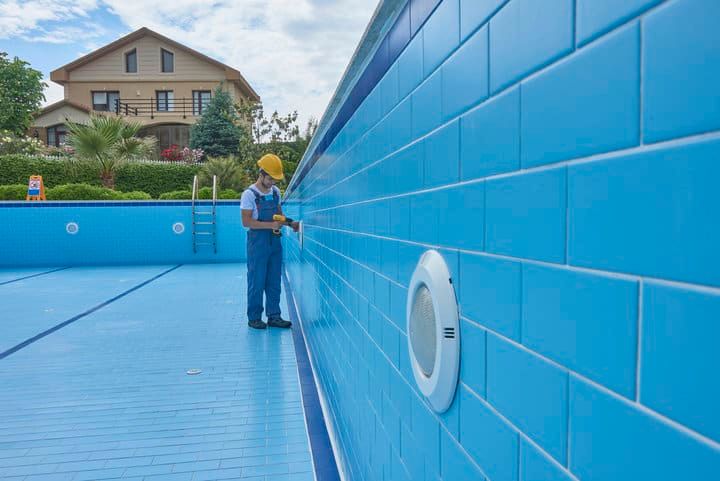
There are good reasons to retrofit older pool fixtures with LED bulbs.
Energy use
An E26-base LED pool retrofit typically draws around 40 watts, compared to 300–500 watts for the halogen or incandescent fixtures it replaces. With four pool lights running 1,000 hours a year, the difference looks like this at a U.S. residential rate of $0.17/kWh (the 2025 EIA average — rates vary by state):
| 4× LED | 4× Halogen (300W) | |
|---|---|---|
| Watts per light | 40 W | 300 W |
| Total wattage | 160 W | 1,200 W |
| Energy per 1,000 hrs | 160 kWh | 1,200 kWh |
| Cost at $0.17/kWh | ~$27.20 | ~$204 |
That’s a roughly $175 saving per year on electricity alone — and the gap widens at 500W halogen fixtures or in higher-rate states.
Lifespan and brightness
On top of the energy savings, an LED bulb will outlast a halogen 10–25× over, so you’re buying fewer bulbs and doing fewer underwater swaps.
On brightness: modern LED pool bulbs often deliver more lumens than the halogens they replace, despite using a fraction of the power. Most pool owners actually prefer a gentle glow rather than maximum output, so the practical benefit is matching halogen-level brightness at far lower wattage.
Color temperature and color-changing
LEDs let you pick a white-light color temperature when buying — warm white (around 2700K) gives a soft, halogen-like glow, while cool white (5000K and up) is brighter and more daylight-like. If you want color, LEDs are available in more colors than any halogen bulb — many color-changing models cycle through millions of shades and ship with a remote.
One important caveat
Not every LED bulb is interchangeable in a pool fixture. Any replacement must be rated for submersible/wet-location use and match the fixture’s voltage (12V or 120V). A standard household LED in a pool niche is both a safety hazard and a warranty problem.
How Much Does It Cost To Replace Pool Lights?
If you’re swapping the bulb in an existing fixture, it’s a DIY job — the only cost is the bulb. Expect to pay $10–$30 for a halogen bulb and $50–$150+ for an LED replacement bulb, with color-changing models at the upper end. Sealed LED fixtures (full-unit replacements) cost considerably more.
An LED bulb seems pricey next to a $20 halogen, but remember it lasts 10–25 halogens worth — the lifetime bulb cost is lower.
If you’d rather have a pro replace the entire fixture, expect roughly an hour per light. Electrician rates typically run $50–$130 an hour, with a service call or trip fee of $75–$150. Costs vary considerably by region — rates in major metro areas can exceed these figures. For a single pool light, budget somewhere in the range of $125–$280 in labor on top of the fixture cost.
The Bottom Line
Stick with halogen or incandescent and you’ll be replacing pool bulbs every couple of seasons. Switch to LED and a single bulb can outlast the next decade of pool ownership while cutting your lighting energy bill by roughly 85%.
If your fixture takes a standard E26 base, an LED retrofit is the easiest upgrade you can make to a pool — just confirm the replacement bulb is rated for wet locations and matches your fixture voltage before you fit it.