Does Smart Lighting Use More Electricity?
Smart LED bulbs cost roughly $15 more per year to run than standard LEDs — but smart scheduling can erase that gap before you notice it on your bill.
 Eugen
EugenEugen Nikolajev
Creator of LED Lighting Info
Hi, I am Eugen. I was always one of those kids who had all sorts of weird lighting gadgets for every occasion.
Now, I want to share my knowledge and experience about lighting with you on LED Lighting Info.
Read my editorial standards
Key Takeaways
A current-generation smart LED draws roughly 1–2 watts more in active use and another 0.2–0.5 watts in standby compared to a non-smart LED of the same brightness. For a typical 30-bulb household, that works out to under $15 per year — and a single smart schedule can offset most of it.
Do smart LED bulbs actually cost more to run than standard LEDs? Yes — but the gap is smaller than most people assume, and the smart features themselves can wipe out the difference.
Do Smart LED Lights Use More Electricity Than Standard LEDs?
By now, you’re probably aware that LEDs are the most energy-efficient form of artificial light. They produce the same amount of light (if not more) as traditional incandescent, halogen, and fluorescent bulbs using a fraction of the wattage.
But where do smart LEDs fit in? Here’s a like-for-like comparison from Philips’s own catalog.
A current Philips Hue White A19 (60W-equivalent) draws 8.8 watts to produce 800 lumens. A comparable non-smart Philips LED A19 (also 60W-equivalent, 800 lumens) draws roughly 8 watts. Specs vary by generation and SKU, so check the current product pages for the latest figures.
That ~1.5-watt gap is the “smart tax.” At the U.S. residential average of about $0.17 per kWh (per the EIA, 2025), here is how it plays out:
| Standard LED (8W, 800 lm) | Smart LED (9.5W, 800 lm) | |
|---|---|---|
| Daily cost (2 hrs/day) | ~0.27¢ | ~0.32¢ |
| Annual cost (1 bulb) | ~$0.99 | ~$1.18 |
| Annual cost (30 bulbs) | ~$29.78 | ~$35.41 |
| Annual difference | — | ~$5.63/year |
Across a 30-bulb home running 2 hours per day, that’s roughly $5–$6 per year in extra active-use cost. Standby power adds a bit on top — more on that next.
Why do smart bulbs draw more power? Because they’re doing more. A wireless radio, microcontroller, and color-mixing electronics all need a few extra milliwatts. As with any device, every feature you add nudges the wattage up.
Lifespan is roughly a wash. Most smart bulbs are rated for 15,000–25,000 hours — the same range as good non-smart LEDs — so the wattage gap is the only meaningful long-term running-cost difference.
Why Do Smart Lights Use Electricity While Off?
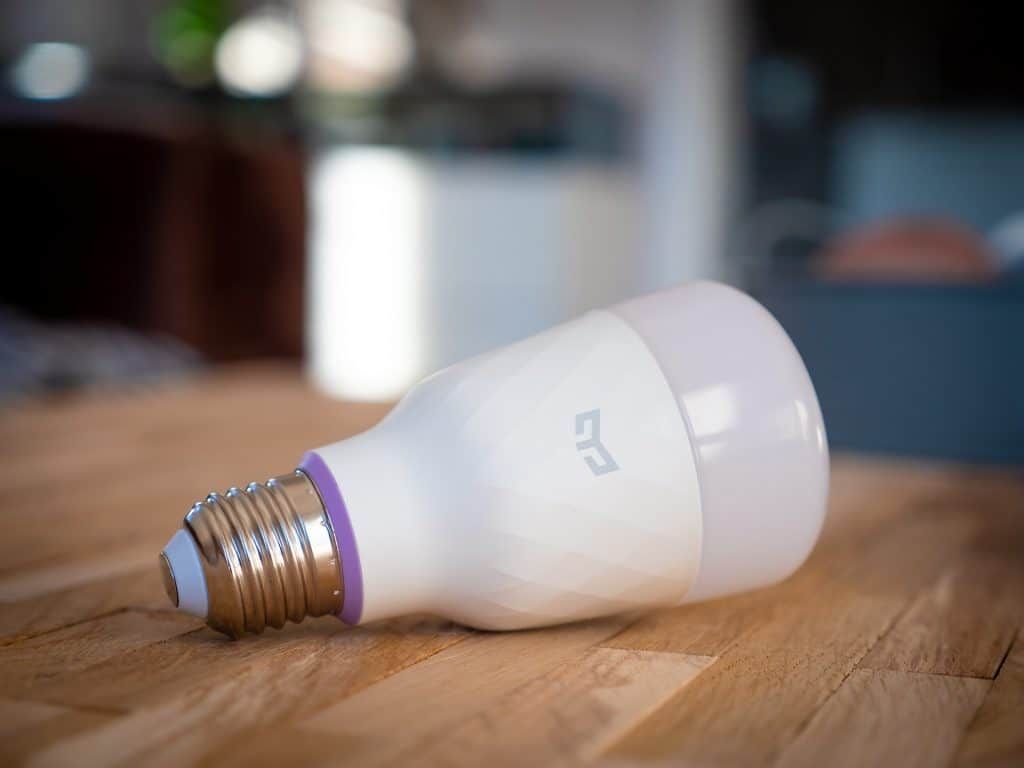
Smart LED bulbs sip a small amount of power even when they’re not emitting light. This is called vampire power, or a ghost load.
Smart LEDs are essentially always on. The only way to fully cut their power is by interrupting the circuit at the wall switch or by unplugging the fixture.
The bulb’s wireless radio (Wi-Fi, Zigbee, or Bluetooth, depending on the product) keeps drawing standby power so it can respond instantly when a command arrives. Think of it like a TV in standby mode, waiting for the remote.
According to the IEA and Lawrence Berkeley National Laboratory, standby power accounts for roughly 5–10% of residential electricity use in developed countries — meaningful, but nowhere near the “20% of world electricity” figure that gets repeated online.
In 1999, the International Energy Agency launched the One Watt Initiative, which aimed to cap appliance standby power at 1W by 2010 and 0.5W by 2013. Many jurisdictions, including the EU and the U.S. through Energy Star, have since adopted standby-power regulations.
How Much Standby Power Actually Costs You
If you’re keen to minimize your energy bills, you’ll want to know exactly how much a smart bulb costs while sitting dormant. The good news: it’s trivial — typically two to three cents per month per bulb.
Here’s how to do the math for any bulb:
- Find the standby wattage. Most smart bulbs draw 0.2–0.5W in standby; check the spec sheet or product page.
- Multiply by standby hours. If the bulb is in active use 2 hours/day, it’s in standby 22 hours/day — about 660 hours per month.
- Convert to kilowatt-hours. Divide watt-hours by 1,000.
- Apply your electricity rate. Multiply kWh by the price you pay per kWh on your utility bill (~$0.17 nationally).
Worked example: a 0.2W bulb in standby for 660 hours uses 0.132 kWh × $0.17 ≈ $0.02 per month, or about $0.27 per year per bulb. For a 30-bulb household, that’s roughly $8 per year in standby alone.
To put 0.2 watts in context: a standard AA battery holds roughly 2.5 watt-hours of usable energy — enough to power a 0.2W draw for about 12 hours. A truly minuscule load.
Does Turning Off Wi-Fi Cut Standby Power?
Eight dollars a year may sound trivial, but if you have a comprehensive smart-bulb array, it adds up. Could you stop the standby draw by killing the Wi-Fi?
The short answer: no — and for many smart bulbs, Wi-Fi has nothing to do with it.
Most Philips Hue bulbs, for example, communicate via Zigbee through the Hue Bridge — not your home Wi-Fi. Other ecosystems use Bluetooth or Thread. Turning off the router doesn’t affect those bulbs at all. Even for Wi-Fi-direct bulbs, the radio keeps trying to reconnect, so standby draw stays roughly the same.
The only way to fully eliminate standby draw is to physically cut power — flipping the wall switch or pulling the bulb from the socket. Doing so disables the smart features entirely, turning a smart bulb into a dumb one.
How To Reduce Smart Bulb Standby Power
You don’t have to choose between smart features and zero standby draw. A few practical options:
- Use a smart wall switch instead of smart bulbs. One smart switch controls every bulb on the circuit and adds standby draw once per fixture, not per bulb.
- Group bulbs on a smart plug. Schedule the plug to fully cut power overnight or while you’re at work.
- Choose Zigbee, Thread, or Matter bulbs over Wi-Fi-direct ones. Mesh-network bulbs typically draw less standby power than Wi-Fi radios.
- Buy bulbs that meet Energy Star standby limits. Many newer products comply with sub-0.5W standby targets.
Smart Scheduling Can Erase the Premium
Here’s the part most “smart vs. standard” comparisons miss: smart bulbs can save more electricity than they consume in standby.
A standard LED only turns off when someone remembers to flip the switch. A smart bulb can:
- Turn off automatically when no one is home (geofencing).
- Dim to 20% after a set hour to reduce consumption without going dark.
- Switch off via motion sensor when a room empties.
- Run scheduled “off” routines for porch and outdoor lights.
In a household where lights routinely get left on, scheduling alone can offset the entire smart-bulb premium — and then some.
Smart vs. Standard LED: The Bottom Line
For a typical 30-bulb household running 2 hours per day:
- Active-use premium: ~$5–$6 per year
- Standby premium: ~$8 per year (about 2–3¢ per bulb per month)
- Total annual premium: under $15 per year
That’s the cost. The benefit is convenience, automation, and the ability to cut waste through scheduling. If even a third of your bulbs run on smart schedules, you’ll likely come out ahead on the electricity bill.
For me, the real question isn’t “do smart bulbs cost more to run?” — it’s “do you actually use the smart features?” If you do, they pay for themselves in convenience and saved energy. If you don’t, save the money and stick with standard LEDs.
FAQ
Do smart bulbs need to stay powered to work?
Yes. Smart bulbs need continuous power to maintain their wireless connection and respond to commands. Cutting power at the wall disables the smart features.
How much does a single smart bulb cost in standby?
About $0.02–$0.03 per month, or roughly $0.27 per year, at the U.S. residential average rate of $0.17 per kWh.
Does turning off Wi-Fi save standby power?
No. Most smart bulbs use Zigbee, Thread, or Bluetooth — not Wi-Fi. And Wi-Fi-direct bulbs keep their radio active even when the network is down, so the standby draw remains the same.
Are smart LEDs as long-lasting as standard LEDs?
Generally, yes. Smart bulbs typically carry rated lifespans of 15,000–25,000 hours, similar to non-smart LEDs.
What's the cheapest way to add smart control to lights?
A smart wall switch. It controls every bulb on the circuit and only adds standby draw once per fixture, not once per bulb.